Stewart Binns - Conquest
Здесь есть возможность читать онлайн «Stewart Binns - Conquest» весь текст электронной книги совершенно бесплатно (целиком полную версию без сокращений). В некоторых случаях можно слушать аудио, скачать через торрент в формате fb2 и присутствует краткое содержание. Город: London, Год выпуска: 2011, ISBN: 2011, Издательство: Penguin Books, Жанр: Историческая проза, на английском языке. Описание произведения, (предисловие) а так же отзывы посетителей доступны на портале библиотеки ЛибКат.
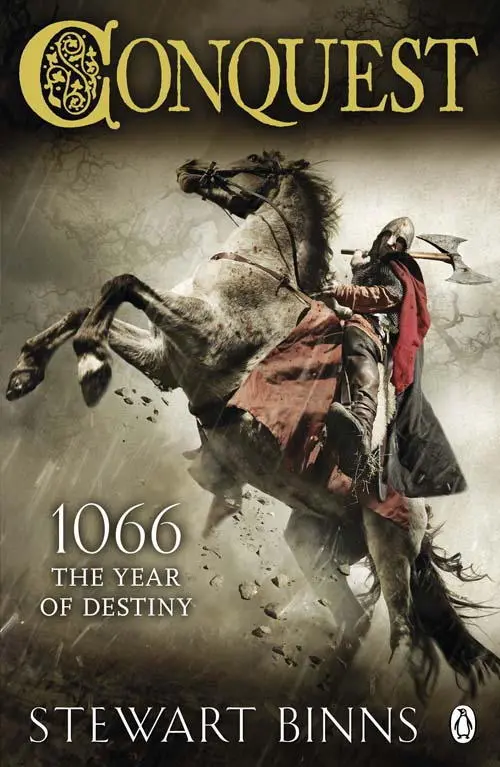
- Название:Conquest
- Автор:
- Издательство:Penguin Books
- Жанр:
- Год:2011
- Город:London
- ISBN:978-0-141-96059-3
- Рейтинг книги:5 / 5. Голосов: 1
-
Избранное:Добавить в избранное
- Отзывы:
-
Ваша оценка:
Conquest: краткое содержание, описание и аннотация
Предлагаем к чтению аннотацию, описание, краткое содержание или предисловие (зависит от того, что написал сам автор книги «Conquest»). Если вы не нашли необходимую информацию о книге — напишите в комментариях, мы постараемся отыскать её.
The battle is hard fought and bloody, the lives of thousands have been spent, including that of King Harold. But England will not be conquered easily, the Anglo-Saxons will not submit meekly to Norman rule.
Although his heroic deeds will nearly be lost to legend, one man unites the resistance. His name is Hereward of Bourne, the champion of the English. His honour, bravery and skill at arms will change the future of England. His is the legacy of the noble outlaw.
This is his story.
Conquest — читать онлайн бесплатно полную книгу (весь текст) целиком
Ниже представлен текст книги, разбитый по страницам. Система сохранения места последней прочитанной страницы, позволяет с удобством читать онлайн бесплатно книгу «Conquest», без необходимости каждый раз заново искать на чём Вы остановились. Поставьте закладку, и сможете в любой момент перейти на страницу, на которой закончили чтение.
Интервал:
Закладка:
Harold and his army were on the move again within thirty-six hours. He knew that Duke William was either still in transit in the Channel or had already landed on the south coast. Harold had 1,500 mounted housecarls with him, but to ensure that his baggage train could keep pace, he travelled south much more slowly than he had in his dash northwards. His baggage was laden with Norse armour, shields and weapons, a vital cache of materiel for the forthcoming battle with the Normans – an encounter that could be only a matter of days away.
Messengers were despatched to all parts of the realm. Harold had estimated that he needed at least 4,000 housecarls for the clash against William and possibly as many as 6,000 fyrdmen. He prayed that the annual harvesting had been completed and that such a force could be assembled. Most of his brothers’ housecarls – those of Gyrth, Earl of East Anglia, and of Leofwine, Earl of the South West Midlands – were still in reserve and were among England’s finest. His biggest concern was the availability of the men of Edwin, Earl of Mercia, and Morcar, Earl of Northumbria. Between them, they had well over 1,000 housecarls of the highest quality but, despite the fact that both men had promised Harold their support, he knew their commitment was questionable. Fiercely expressed separatism had always been a part of northern politics and Harold suspected that Edwin’s and Morcar’s real purpose was independence for the North.
At the end of the third day of the march south, the advanced party of the army was approaching the River Trent at Newark. News had reached the locals of the great victory at Stamford Bridge, and the King was greeted with loud cheers as he approached the walls of the burgh. He acknowledged the gifts of food from the local burghers, but passed straight through, hoping to camp further south on the road to London.
‘These Mercians seem genuine in their affection for you, sire.’
‘It is never the people who make life difficult for kings, Hereward. It is their leaders who plot and scheme; it is their ambitions that are at the root of mischief. All the people want is peace and food in their bellies.’
Hereward’s admiration for his king, a monarch not of royal blood but nevertheless a great leader, grew by the day. ‘Sire, do you think that a kingdom can ever be stronger than the tribal loyalties of its people?’
‘Yes, I hope so. As in Roman times, or under Alfred, people will readily lend their allegiance to something far greater than their tribe. If their leaders bring them peace and prosperity, they will follow them.’
‘Torfida and I often talk about the Greeks and the Romans and how they believed that people could govern themselves according to principles enshrined in laws and codes of honour.’
‘That is my dream for England, Hereward. We are a new people, mere infants compared to the civilizations of antiquity. But England is a rich land with strong people of many races; perhaps we can create a way of life that will be admired like those of Greece and Rome.’
‘That is a laudable ambition, my Lord, but it needs men like you to achieve it.’
‘But it also needs men like you, Hereward, and women like Torfida. Great civilizations are built by people of intelligence, wisdom and courage, not just by kings.’
Hereward longed to tell Torfida about the King’s leadership and how well he carried the Talisman. Soon he would have the opportunity he craved; the King had sent word to Glastonbury that their families should join them in London. He had also sent a messenger to Winchester to summon Edith Swan-Neck. Harold knew that it would be an opportunity for them to say farewell to those who would face the impending challenge from Duke William.
Dusk was fast approaching when Harold’s scouts returned with news that there was a suitable clearing ahead for a night camp. The scouts were not alone. A captain of the housecarls of Earl Gyrth, accompanied by two sergeants-at-arms, had met them on the road. Their horses had been ridden hard for many hours and Harold and his entourage guessed immediately what their news would be.
‘Sire… William, Duke of Normandy, landed a large invasion force at Pevensey two days ago. There was no resistance and they are already on the rampage, looting, burning and desecrating wherever they go. They are executing the priests; whole villages of menfolk are being murdered, the women raped, even boys as young as twelve are being cut down.’
The King visibly flinched at the news. ‘Thank you for your report, Captain. How many are there in William’s force?’
‘Sire, Lord Gyrth’s scouts are counting now, but an elderly local man, who served with King Edward’s housecarls, estimated about ten thousand: at least three thousand cavalry and six thousand infantry.’
There was a stunned silence at the size of the Duke’s invasion force. It confirmed the King’s most pessimistic prediction.
‘Captain, rest your horses and get some sleep. Hereward, send Martin Lightfoot to see what he can tell us of the Normans’ plans.’
Hereward gave Martin detailed instructions about what was needed. The King ordered fresh horses to be brought up so that he and his personal bodyguard of two squadrons could push on to London. He left instructions for his force from Stamford Bridge to come on as quickly as it could and for the entire army to assemble in London in five days’ time, six at the most.
Before Harold arrived in London, he went to Waltham Abbey to pray; it was a special place for the King. It contained the Holy Rood, a flint cross, found, it was rumoured, in an ancient ruin by a tenant of Harold’s in the Somerset village of Montacute. Two teams of oxen were sent to take the cross to Glastonbury Abbey but – again, according to local legend – the oxen refused to travel north and carried the cross eastwards across the whole of southern England to the ancient Saxon settlement of Waltham in Essex. Harold had built a fine church to house the relic and endowed an abbey and a community of monks. The church had been consecrated by Harold in 1060 and, since then, pilgrims had flocked from all over Europe to pray to the Holy Rood. Now, a king in a dire plight was one of them. He was accompanied by Edith Swan-Neck and spent most of the afternoon praying and listening to the plainchant of the assembled community. In the evening, Abbot Aethelsinge said a private mass for them at the high altar.
Harold thanked the Abbot and asked him to pray for him and for England.
Then, in the hoary light of a full moon, he headed for London at a gallop.
Harold and Edith were in Westminster early on the morning of 7 October 1066, where the King immediately called a Council of War.
Hereward, Alphonso and Einar were there with all the captains of the King’s housecarls – over fifty of England’s finest, bravest men. There were at least the same number of thegns and both Harold’s brothers, the Earls Gyrth and Leofwine. Hakon, the young son of Harold’s dead brother, Svein, was there, making the Godwinson family complete.
Harold had invited all opinions and viewpoints.
Leofric, Abbot of Peterborough, spoke first. ‘Sire, the situation is grave and news comes daily of the atrocities committed by the Normans. But I beg you to consider caution. Duke William has nowhere to go; his back is to the sea. If you take time to gather your forces, you could outnumber him on a substantial scale.’
Esegar, Sheriff of Middlesex, spoke next. ‘William the Bastard’s wickedness knows no bounds. He carries the Pallium of Rome, but he is despoiling it with the blood of the Saxons. Word will soon filter back to Rome and he will lose all support in Europe. He is making a noose for his own neck.’
Godric, Sheriff of Fyfield in Berkshire, suggested a more subtle tactic. ‘Gather your forces on the North Downs, or at Penshurst on the Medway; send small units to harass his army and lay waste to the entire hinterland, forcing him to come north to meet you. In a month’s time you could have a fully armed and prepared force of eight thousand housecarls and twice that number of fyrdmen.’
Читать дальшеИнтервал:
Закладка:
Похожие книги на «Conquest»
Представляем Вашему вниманию похожие книги на «Conquest» списком для выбора. Мы отобрали схожую по названию и смыслу литературу в надежде предоставить читателям больше вариантов отыскать новые, интересные, ещё непрочитанные произведения.










Обсуждение, отзывы о книге «Conquest» и просто собственные мнения читателей. Оставьте ваши комментарии, напишите, что Вы думаете о произведении, его смысле или главных героях. Укажите что конкретно понравилось, а что нет, и почему Вы так считаете.