Stewart Binns - Conquest
Здесь есть возможность читать онлайн «Stewart Binns - Conquest» весь текст электронной книги совершенно бесплатно (целиком полную версию без сокращений). В некоторых случаях можно слушать аудио, скачать через торрент в формате fb2 и присутствует краткое содержание. Город: London, Год выпуска: 2011, ISBN: 2011, Издательство: Penguin Books, Жанр: Историческая проза, на английском языке. Описание произведения, (предисловие) а так же отзывы посетителей доступны на портале библиотеки ЛибКат.
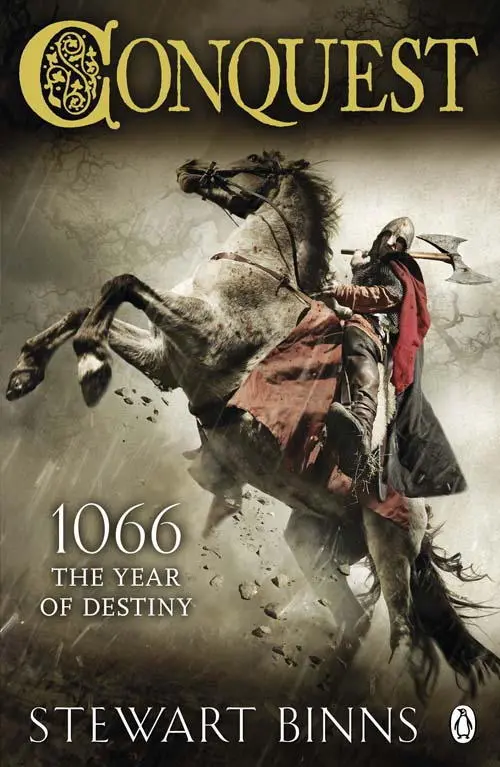
- Название:Conquest
- Автор:
- Издательство:Penguin Books
- Жанр:
- Год:2011
- Город:London
- ISBN:978-0-141-96059-3
- Рейтинг книги:5 / 5. Голосов: 1
-
Избранное:Добавить в избранное
- Отзывы:
-
Ваша оценка:
Conquest: краткое содержание, описание и аннотация
Предлагаем к чтению аннотацию, описание, краткое содержание или предисловие (зависит от того, что написал сам автор книги «Conquest»). Если вы не нашли необходимую информацию о книге — напишите в комментариях, мы постараемся отыскать её.
The battle is hard fought and bloody, the lives of thousands have been spent, including that of King Harold. But England will not be conquered easily, the Anglo-Saxons will not submit meekly to Norman rule.
Although his heroic deeds will nearly be lost to legend, one man unites the resistance. His name is Hereward of Bourne, the champion of the English. His honour, bravery and skill at arms will change the future of England. His is the legacy of the noble outlaw.
This is his story.
Conquest — читать онлайн бесплатно полную книгу (весь текст) целиком
Ниже представлен текст книги, разбитый по страницам. Система сохранения места последней прочитанной страницы, позволяет с удобством читать онлайн бесплатно книгу «Conquest», без необходимости каждый раз заново искать на чём Вы остановились. Поставьте закладку, и сможете в любой момент перейти на страницу, на которой закончили чтение.
Интервал:
Закладка:
Harold went to squadron after squadron in the shield wall, beseeching his men to give everything for the people of England.
‘Remember the stories of Alfred, told by your fathers. This land has a spirit that could not be subdued by the Danes, was not broken by Hardrada and will not be humbled by this cut-throat, William the Bastard. You are gathered here from all over our land. You fight today for your families and your homes but, most of all, for your freedom. The man you face today is a cruel and vicious warlord. He will strip us of everything we live for, burn our crops, slaughter our livestock, rape our women and murder our children. We stand between him and his evil ambition. We stand together; our shield wall will never break. Men of England, stand with me until victory is ours!’
Great cheers ran along the English line as the King galloped along in front of his men. Hereward looked at the assembled army and then at the Normans massed on the lower ground below. Somehow, close to 8,000 men had made it to the English cause. Harold’s heroism, resolve and generalship had inspired them to rush to the King’s standard, and they would fight with the ferocity of men protecting their homes.
Over six centuries, since the end of Roman rule, the strength of the Anglo-Saxon army had been forged on the anvil of frequent battles against its ferocious Celtic and Scandinavian neighbours, building a military ethos of the highest calibre. Despite its losses at Stamford Bridge and the absence of housecarls yet to arrive, including those of the treacherous Earls Morcar and Edwin, standing with Harold on Senlac Ridge was the greater part of the finest army in northern Europe – one of the most awesome the world had ever seen.
When the King returned to his standard, Hereward offered him his own encouragement. ‘Only you could have achieved this. Here stand men of Saxon, Danish and Celtic blood, bound together by their belief in you and the England that you represent.’
‘Thank you, Hereward, I am proud to have you at my side. Stay close this day.’ As Harold surveyed the battlefield sweeping down before him from Senlac Ridge, the opposing cavalry and its heavily armed knights were his greatest concern.
By his side, Hereward counted almost 1,500 Norman knights in full armour with lances, axes, maces and swords. He thought of his many battles, hoping to find a key to the encounter. He looked at the ground and the formation of the army, probing to see a feature that had been overlooked, or a nuance that would offer a hidden advantage, but he could see none. Five hundred cavalry hidden in the woods would have been invaluable, but they were not there. Edwin and Morcar, the two northern earls, had remained in their earldoms; a self-seeking act that denied England over 1,000 of its finest men.
Martin, who had taken a brief rest after his reconnaissance mission, rode up and joined Hereward, Alphonso and Einar in a position just behind the King, whose hearthtroop of two squadrons was fanned out in front of him. The four loyal comrades dismounted and Alphonso secured their horses to the rear. It was unlikely that they would be needed; this fight would not be about rapid pursuit or hasty withdrawal, it would be a fight for the ground they stood on – England’s ground.
Hereward turned to his companions. ‘If the battle goes badly, I will stand my ground with the King. If he falls, I will fall with him. Stay for as long as you can be useful to the King, then make haste to your loved ones. Take this to Torfida.’ Hereward handed Einar a small purse of leather, which held a lock of his golden hair. ‘God be with you, my friends.’
‘God be with you, Hereward,’ all three replied in unison.
Preparations in the Norman ranks were equally well advanced.
They numbered over 9,000 and were organized into three army groups: Breton allies to the left on the western side, French and Flemish supporters and mercenaries to the right on the eastern side and the bulk of the force, the Normans, in the centre. William had adopted an unusual pattern of deployment. He sent his archers forward, just out of range of the English bowmen, his infantry arranged in deep columns behind them and his squadrons of cavalry drawn up in the rear. His own command position was central to the last squadron of cavalry, identified by the papal pallium, held aloft by Pope Alexander’s legate to Rouen.
Flying next to the pallium, stiffened by gusting winds from the English Channel to the south, were William’s standard, the Leopard of Normandy, and the standards of all the warlords of Normandy and surrounding territories: Eustace, Count of Boulogne, an opportunist with a brutal reputation; Geoffrey, Bishop of Coutances, who led the prayers before the battle; Hugh de Grandmesnil, a warrior of great repute; Hugh de Montfort, a resolute soldier of fortune; William’s half-brother, the ruthless and ambitious Odo, Bishop of Bayeux; and William’s trusted henchmen who would go anywhere for a fight – Walter Gifford, William of Malet, William of Evreux, William Fitzsbern and William Warenne.
The Duke’s battle cry was short and to the point. He rode out in front of his infantry, in the space between them and the archers, and above the distant din of derision from the English, bellowed in his deep, coarse voice.
‘You have travelled with me on a great voyage to fight on a distant shore. You have done so in the noble tradition of our Viking ancestors. This fight was not of our making, nor was it born from the desire for naked conquest; this land was rightfully granted to me by King Edward of England, a wise and gentle king. We are here to claim what is rightfully ours. The Pope knows this and gives us his holy blessing; the rest of Europe knows this and lends its support. The richest land in northern Europe is before you. Fight to make it a Norman kingdom for your children and your grandchildren. You are the bravest of the brave.’
As the Norman roars echoed up the hill, the English hollered back, until the whole countryside was filled with the ear-splitting tumult of almost 20,000 indomitable men.
Now, there was nothing left for either army to do but fight.
On William’s signal, his archers and crossbowmen advanced within range and began their fusillade at the English shield wall. As they did so, his infantry launched its first assault, making slow progress towards Senlac Ridge. They sang the ‘Song of Roland’ as they went, but the melody soon faded, to be replaced by the shocking clash of sword against sword and the agonizing cries of foe against foe.
After almost an hour of fighting, neither the Norman archers nor their infantry had made much impact on the English shield wall. Every time there was a minor breach, it was filled by equally formidable housecarls from the King’s reinforcements. The circular shields of the English allowed them to close or open their wall at will, gave them much more freedom to brandish their battle-axes and meant that they could adopt the Roman ‘testudo’ – the turtle – to cover themselves against hails of arrows.
The Normans’ kite-shaped shield was much better suited to combat on horseback, where the narrow base could protect the legs of the mounted warrior. As the Normans withdrew, the ground was littered with their dead; hundreds of men had perished – almost five Normans to each Englishman.
It was time for William to launch his much-vaunted cavalry.
His powerful destriers, despite carrying 200 lbs of man and armour, managed a reasonable gallop, even up the significant gradient of Senlac Ridge. As their ground was less steep, the Bretons reached the shield wall first, but did not have enough momentum to dent it. They had to turn sideways to strike with their axes and swords, making them easy prey for the defenders. Much the same happened on the French-Flemish right. In the centre, the much more formidable elite Norman squadrons did make some breaches, but they were easily filled; Hereward and his companions rushed to any vulnerable points to reinforce the wall until replacements arrived from the rear.
Читать дальшеИнтервал:
Закладка:
Похожие книги на «Conquest»
Представляем Вашему вниманию похожие книги на «Conquest» списком для выбора. Мы отобрали схожую по названию и смыслу литературу в надежде предоставить читателям больше вариантов отыскать новые, интересные, ещё непрочитанные произведения.








Обсуждение, отзывы о книге «Conquest» и просто собственные мнения читателей. Оставьте ваши комментарии, напишите, что Вы думаете о произведении, его смысле или главных героях. Укажите что конкретно понравилось, а что нет, и почему Вы так считаете.