Stewart Binns - Conquest
Здесь есть возможность читать онлайн «Stewart Binns - Conquest» весь текст электронной книги совершенно бесплатно (целиком полную версию без сокращений). В некоторых случаях можно слушать аудио, скачать через торрент в формате fb2 и присутствует краткое содержание. Город: London, Год выпуска: 2011, ISBN: 2011, Издательство: Penguin Books, Жанр: Историческая проза, на английском языке. Описание произведения, (предисловие) а так же отзывы посетителей доступны на портале библиотеки ЛибКат.
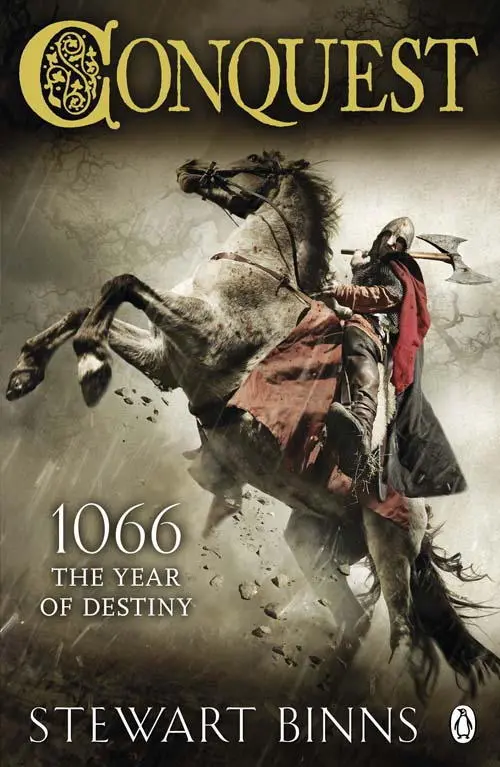
- Название:Conquest
- Автор:
- Издательство:Penguin Books
- Жанр:
- Год:2011
- Город:London
- ISBN:978-0-141-96059-3
- Рейтинг книги:5 / 5. Голосов: 1
-
Избранное:Добавить в избранное
- Отзывы:
-
Ваша оценка:
Conquest: краткое содержание, описание и аннотация
Предлагаем к чтению аннотацию, описание, краткое содержание или предисловие (зависит от того, что написал сам автор книги «Conquest»). Если вы не нашли необходимую информацию о книге — напишите в комментариях, мы постараемся отыскать её.
The battle is hard fought and bloody, the lives of thousands have been spent, including that of King Harold. But England will not be conquered easily, the Anglo-Saxons will not submit meekly to Norman rule.
Although his heroic deeds will nearly be lost to legend, one man unites the resistance. His name is Hereward of Bourne, the champion of the English. His honour, bravery and skill at arms will change the future of England. His is the legacy of the noble outlaw.
This is his story.
Conquest — читать онлайн бесплатно полную книгу (весь текст) целиком
Ниже представлен текст книги, разбитый по страницам. Система сохранения места последней прочитанной страницы, позволяет с удобством читать онлайн бесплатно книгу «Conquest», без необходимости каждый раз заново искать на чём Вы остановились. Поставьте закладку, и сможете в любой момент перейти на страницу, на которой закончили чтение.
Интервал:
Закладка:
In one such incident, witnessed by Hereward, the Duke had to deal with a case of rape and murder committed by a young groom. When the man was brought before the Duke, he made the mistake of trying to excuse his crimes by saying that the girl was very pretty and had smiled at him. The Duke rose in fury and beat him to death with the Baculus, bellowing obscenities at him as he did so. It was the most violent attack on a man Hereward had ever witnessed, even on a battlefield.
He learned that it was not the first time the Duke had personally administered such a punishment.
When they returned to Rouen to celebrate Christmas, Hereward shared his concerns with the others. In particular, he sought their advice on the wisdom of continuing in William’s service.
Martin was usually very talkative, but his mood had become morose in the last few days following news from England of the defeat and slaughter of his King, Gruffydd ap Llywelyn. It was a gruesome story.
At the beginning of 1063, King Edward ordered Harold, Earl of Wessex, to deal with the recalcitrant Welshman once and for all. He led a small band of mounted housecarls on a surprise winter raid on Gruffydd’s royal enclosure on the River Clywd in Rhuddlan. Gruffydd escaped by the skin of his teeth, but Harold destroyed everything in sight, including his entire fleet.
In the summer, Harold went back to Wales with a much bigger army, moving up from the south, while his brother Tostig, Earl of Northumbria, attacked in the north. Three months of bloody clashes ensued, with Gruffydd trying to fight a guerrilla campaign with an ever-dwindling force. Eventually, Gruffydd had to go to ground, but not before a final act of defiance, when, tied to a hinny and suspended by their hair, he returned to Harold the severed heads of eight of his housecarls.
The English were even more vindictive in response, roaming the countryside and carrying out summary executions. The Welsh princes capitulated and sued for peace. Harold, with brutal irony, asked for the head of Gruffydd as a condition of the settlement. His own people relentlessly pursued the King into the wild and desolate mountains of Snowdonia. When he was finally cornered, alone and defenceless, he was bound like a wild boar, hung upside down and beheaded.
Harold had been conciliatory in victory. Gruffydd’s brothers were made earls in Wales as vassals of King Edward. He persuaded the King to revoke the law banning intermarriage between the English and the Welsh and, as an example to all, agreed to take Gruffydd’s widow, Ealdgyth, as his wife.
Martin had much to reflect on in the passing of his king. However, he was firm in his views about the Duke: he did not like him and argued that they should find another employer.
Alphonso was also clear on the subject of service to the Duke. It was cold in Normandy and he wanted to return to the south. For him it was simply a matter of climate.
Einar was level-headed and considered, as usual. He pointed out that there was no finer army in the whole of Europe. The pay was good; Rouen was a fine city and – if Edward had nominated him as his successor – then, one day, William would be the rightful King of England. Ingigerd and Maria agreed with their men, but Torfida was strangely quiet. For her, the months since their arrival in Normandy had passed quickly. She was busy during the week, tutoring the offspring of the rich of Rouen, and on Saturdays she helped the nuns with the poor children at the alms house of Rouen Abbey.
Unusually, Torfida spoke last about the Duke. ‘If William becomes king after Edward’s death, there will be a war, because the English nobles will not accept it. Then there are the Scandinavians; Harald Hardrada and Svein Estrithson, King of the Danes, both have envious eyes on England. We could easily have another Scandinavian ruling at Winchester. England could become an unholy battleground between three ferocious armies –’
Maria interrupted Torfida in full flow. ‘You paint a frightening picture, Torfida, but what of us? What do we do?’
Torfida’s reply was succinct. ‘As for us, Maria, we follow a path that has been pointing towards England ever since we left Melfi.’
Hereward had been thinking carefully about all that had been said. ‘Maria, it is always your choice whether you continue with us on our journey. Torfida and I have chosen our path and we will follow it. The rest of you must find your destinies. If you think they are with us, we will always be in your debt; if you choose another path, we will understand and you will go with our blessing.’
Ingigerd responded without hesitation. ‘I think I can speak for all of us. Where you go, we go; it’s as simple as that.’
Torfida embraced each of them in turn and thanked them for their loyalty.
Hereward returned to the vexing subject of the English succession. ‘It is not Edith who has failed to provide an heir; it’s the other way round. Edward likes boys, it’s well known. They say Edith is a virgin and that the King only married her to cement the alliance with her father, Earl Godwin. A queen can’t sprout an heir if her king doesn’t plant his royal seed.’
Torfida responded, repeating her catechism about destiny. ‘Perhaps you’re right. But my point is, a great war is coming and, somehow, we are going to be a part of it. I am certain that our journey has been leading us to it, so we must continue what we are doing and wait to see what our destiny brings us.’
‘I cannot fight for the Normans against the English – they are my people.’
‘And mine, Hereward. I am not suggesting that we fight our own people. We should continue as we are for now; we can make our decision about what to do when the time comes. This Duke is a fearsome man, but we have been delivered here for a reason. That reason will soon become clear, I know it.’
Hereward looked around the table.
They all nodded, even Martin.
They would stay.
William returned to his relentless quest for military excellence in early January 1064, ensuring that Hereward and the men spent several more months with the Duke in training throughout Normandy. Torfida and the family stayed in Rouen.
As time passed, it occurred to Hereward that since they had arrived in Normandy, Torfida had rarely talked about the Talisman.
It was as if she knew it had brought them to where they needed to be and that it would lie dormant until the next phase of their lives came to pass.
11. The Oath
The next crucial phase in the lives of Hereward and Torfida began, like many important happenings, without warning.
It was early May 1064, a warm spring day with nature in full bud. The Duke was mounted on his destrier in the middle of a Norman conroi, a powerful squadron of twenty-five mounted warriors led by a knight. They were practising an attack with their spears pointed downwards like lances, a devastatingly effective cavalry technique if carried out in a disciplined formation. The Duke knew that if ever it came to a fight against the English housecarls, his mounted conroi would have to break their legendary shield wall.
Riders cresting the horizon with messages for the Duke were commonplace, but these three had an urgency about them that was immediately apparent. When they reached William, they and their horses were sweating profusely and the men relayed their message breathlessly.
An important English earl had been shipwrecked on the coast, near the mouth of the River Somme, in the lands of Guy, Count of Ponthieu, William’s brother-in-law and his vassal. Guy had seized the earl under the Lagan Law of shipwrecks and was holding him in Montreuil, from where he would be ransomed for a sum befitting his status. One of the ship’s English crew had escaped and fled to Rouen – to seek Duke William’s help, and with news that the shipwrecked mariner was none other than the Earl Marshal of England, Harold Godwinson, Earl of Wessex.
Читать дальшеИнтервал:
Закладка:
Похожие книги на «Conquest»
Представляем Вашему вниманию похожие книги на «Conquest» списком для выбора. Мы отобрали схожую по названию и смыслу литературу в надежде предоставить читателям больше вариантов отыскать новые, интересные, ещё непрочитанные произведения.








Обсуждение, отзывы о книге «Conquest» и просто собственные мнения читателей. Оставьте ваши комментарии, напишите, что Вы думаете о произведении, его смысле или главных героях. Укажите что конкретно понравилось, а что нет, и почему Вы так считаете.