Stewart Binns - Conquest
Здесь есть возможность читать онлайн «Stewart Binns - Conquest» весь текст электронной книги совершенно бесплатно (целиком полную версию без сокращений). В некоторых случаях можно слушать аудио, скачать через торрент в формате fb2 и присутствует краткое содержание. Город: London, Год выпуска: 2011, ISBN: 2011, Издательство: Penguin Books, Жанр: Историческая проза, на английском языке. Описание произведения, (предисловие) а так же отзывы посетителей доступны на портале библиотеки ЛибКат.
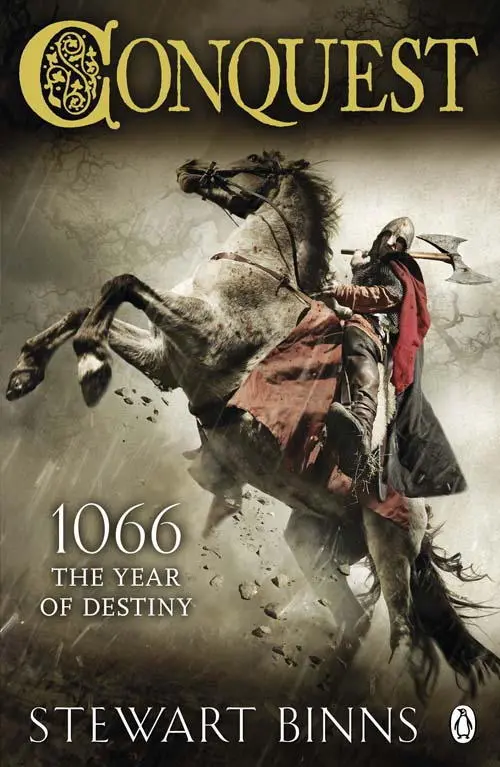
- Название:Conquest
- Автор:
- Издательство:Penguin Books
- Жанр:
- Год:2011
- Город:London
- ISBN:978-0-141-96059-3
- Рейтинг книги:5 / 5. Голосов: 1
-
Избранное:Добавить в избранное
- Отзывы:
-
Ваша оценка:
Conquest: краткое содержание, описание и аннотация
Предлагаем к чтению аннотацию, описание, краткое содержание или предисловие (зависит от того, что написал сам автор книги «Conquest»). Если вы не нашли необходимую информацию о книге — напишите в комментариях, мы постараемся отыскать её.
The battle is hard fought and bloody, the lives of thousands have been spent, including that of King Harold. But England will not be conquered easily, the Anglo-Saxons will not submit meekly to Norman rule.
Although his heroic deeds will nearly be lost to legend, one man unites the resistance. His name is Hereward of Bourne, the champion of the English. His honour, bravery and skill at arms will change the future of England. His is the legacy of the noble outlaw.
This is his story.
Conquest — читать онлайн бесплатно полную книгу (весь текст) целиком
Ниже представлен текст книги, разбитый по страницам. Система сохранения места последней прочитанной страницы, позволяет с удобством читать онлайн бесплатно книгу «Conquest», без необходимости каждый раз заново искать на чём Вы остановились. Поставьте закладку, и сможете в любой момент перейти на страницу, на которой закончили чтение.
Интервал:
Закладка:
William was not his father’s legitimate son. The old Duke, Robert I, had fallen for a beauty called Herleve, the daughter of a humble tanner from Falaise. No one had been surprised that he had bedded her, but his long-term affection for her and the acceptance of their son, William, as his heir, had caused outrage.
Following the death of his father, Duke Robert, on the way home from a holy pilgrimage to Jerusalem, William became the Duke of Normandy in July 1035, at the tender age of eight. He was placed in the care of disciplinarian tutors and even harsher martial instructors, watched over day and night by knights loyal to his father, and he was denied any female or maternal presence in his life. His mother died when he was still a teenager, leaving William with few memories of a woman who had shown him little affection. Most boys would have wilted under the pressure, or snapped, but William was strong of body and resolute of mind. He increasingly developed into the role of powerful warrior and leader that had been ordained for him. He became uncompromising, like his tutors, and durable, like his instructors.
His life had been a long and bitter struggle against internal intrigue and external threats. As he struggled to forge Normandy into the most powerful presence in Europe, he was aided by his two half-brothers: Odo, Bishop of Bayeux, one of his most loyal and trusted confidants, and Robert, Count of Mortain, another close ally.
When the Duke reached the Bishop of Rouen for his anointing, he surveyed the most powerful subjects in his realm with the air of a man totally at ease with his position as their lord and master.
The Norman warrior tradition was potent and remorseless, and he was its apotheosis.
Duke William went hunting immediately after his anointment as Lord of Maine, and it took Hereward and his male companions almost two weeks to gain an audience with him.
The Duke read Hereward’s parchment of recommendation with a stony face. It was going to be a difficult audience.
‘This is an outstanding recommendation, Hereward of Bourne. I know of Guiscard; he is a man not renowned for his excessive generosity, so his testament bears much weight. I see you refused to be dubbed knight, but carry the Order of the Cotentin.’
‘I choose to carry my name by birth, your Grace. I like to live a modest life.’
‘So do I. I like that in a man. Modesty and discipline are vital to a long life as a warrior. Would you expect to serve me as a knight?’
‘I would, your Grace.’
‘But without the title?’
‘Yes, your Grace.’
‘You answer directly; I like that. And what of these men?’
While the Duke looked them up and down, Hereward introduced Einar, Martin and Alphonso, outlining in detail their various martial talents. Hereward was impressed to see that William was looking at their weapons, checking their appearance, assessing the condition of their clothes and armour and even checking the trim of their hair and beards. The Duke understood soldiers well, and knew how to tell the difference between good and bad.
‘They would be my men-at-arms. I would pay them out of my allowance from you, my Lord Duke.’
William of Normandy smiled for the first time. ‘You amuse me, Englishman. I don’t usually pay my knights; their service comes to me as a tithe through the obligation owed from the grant of their lands and titles.’
‘But they are your kinsmen, your Grace. I would serve you as a mercenary.’
‘Mercenaries usually serve as infantry or levies, not as knights.’
‘But I am an exceptional soldier.’
‘Perhaps you are; you certainly don’t lack confidence.’
The Duke rose from his ornately carved chair and stood directly in front of Hereward. He carried his Baculus with him, resting it in the bend of his right arm, and Hereward realized immediately that the Duke was left-handed.
‘There aren’t many men who can look me in the eye, Hereward of Bourne. I like my warriors to be big men; it puts the fear of God into the enemy. Do you see this? It has been carried by my family for many generations. Our Viking ancestors carried it on their conquests across the northern seas and it is spoken of in their sagas. It never leaves my side and is now the ducal mace of Normandy. My son will carry it, as will his son and grandson. By then, it will be the mace of England, the mace of a king.’
‘Your Grace?’
‘Yes, Hereward of Bourne, very soon, your England will be mine.’
‘You intend to invade?’
William paused a moment to caress the Baculus, as if it were a holy relic. ‘No need, although it would be a thrilling campaign. No, I am promised it. King Edward is half Norman, he was brought up here. We are cousins: his mother, Emma, was my great-aunt, sister of Duke Richard II. Edward has no children and my blood gives me primogeniture; Edward accepts this.’
The Duke rocked on his heels and he lifted himself a little so that he was slightly taller than Hereward. ‘It is in the record. Several years ago, Edward sent Robert of Jumièges, a fellow Norman whom he had made Archbishop of Canterbury, to inform me in person that he had nominated me as his heir.’
‘Yes, your Grace, but Harold Godwinson, Earl of Wessex, is now the King’s Earl Marshal. The Godwin family is very powerful, and they would not welcome a Norman on the throne of England.’
The Duke’s guttural voice boomed around his Great Hall. ‘They won’t have any choice! I have sent word to the King, insisting that he sends the Earl of Wessex to me in Rouen, to confirm the succession and his acceptance of it. Edward has agreed and, when the time is right, the Earl will come to my court and swear his loyalty.’
Hereward was astonished. Was this known in England? Many Englishmen disliked Edward’s Norman upbringing. If they knew he planned to hand the throne to the Duke of Normandy, there would be a rebellion among the thegns. After the years of struggle by the Saxons to rid themselves of Scandinavian rulers, they would not give up their land to a Norman without a fight.
‘So, Hereward of Bourne, to the matter in hand. You give good answers; I like you. It is agreed. You will join me, and your companions will be your men-at-arms. I have many excursions planned and, if you prove your worth, your reward will be land in England when I am king. Until then, I will pay you modestly from my exchequer, but I expect you to earn it.’
‘Thank you, your Grace. I should also tell you that I was an outlaw in England, banished by King Edward for an act of vengeance.’
‘A deed done in anger?’
‘No, my Lord, in cold blood.’
‘That is the best kind of revenge; it gives you time to savour it. Worry not; I will set aside your banishment when I am king.’ With that, he slapped Hereward on the back and asked him to sit with him. ‘You will travel with me. In two days, I go on a tour of the provinces to inspect my army. While we travel, you can tell me more about your act of revenge.’
The Duke’s tour of Normandy lasted until Christmas 1063, when tradition required him to be on his ducal throne in Rouen on Christmas Day to receive gifts from his loyal subjects.
Long days in the saddle with his men, in the wind, rain and snow of a Normandy winter, did not seem to discomfort William in the slightest. In fact, he seemed to thrive on it. Generally, he was in good humour, especially when he took a day off to go hunting. He was respected by his men and was usually excellent company. But there was a dark side to his character, which would emerge quickly and uncontrollably. His reactions to indiscipline or misdemeanours of any sort were always severe, usually violent and sometimes bestial. His face would redden to the colour of spilled blood, his eyes would protrude and his voice, harsh at the best of times, would thunder in anger. Everyone knew not to get in his way or catch his eye in such moments. Miscreants would be beaten or flogged; sometimes, he would assault them himself.
Читать дальшеИнтервал:
Закладка:
Похожие книги на «Conquest»
Представляем Вашему вниманию похожие книги на «Conquest» списком для выбора. Мы отобрали схожую по названию и смыслу литературу в надежде предоставить читателям больше вариантов отыскать новые, интересные, ещё непрочитанные произведения.









Обсуждение, отзывы о книге «Conquest» и просто собственные мнения читателей. Оставьте ваши комментарии, напишите, что Вы думаете о произведении, его смысле или главных героях. Укажите что конкретно понравилось, а что нет, и почему Вы так считаете.