Stewart Binns - Conquest
Здесь есть возможность читать онлайн «Stewart Binns - Conquest» весь текст электронной книги совершенно бесплатно (целиком полную версию без сокращений). В некоторых случаях можно слушать аудио, скачать через торрент в формате fb2 и присутствует краткое содержание. Город: London, Год выпуска: 2011, ISBN: 2011, Издательство: Penguin Books, Жанр: Историческая проза, на английском языке. Описание произведения, (предисловие) а так же отзывы посетителей доступны на портале библиотеки ЛибКат.
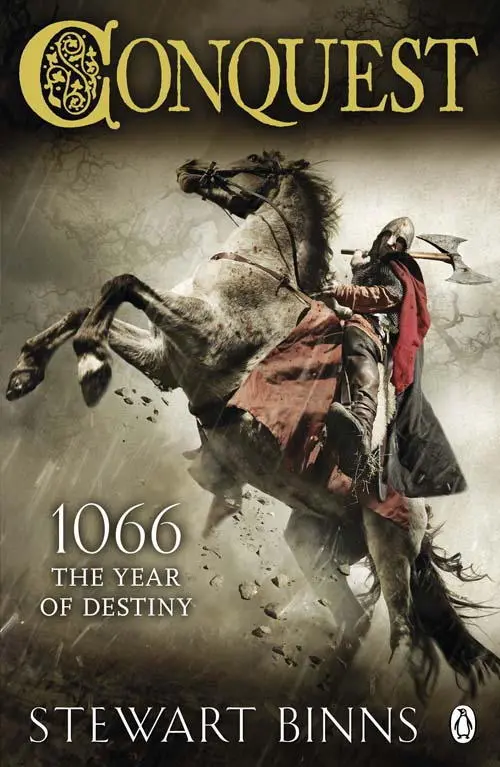
- Название:Conquest
- Автор:
- Издательство:Penguin Books
- Жанр:
- Год:2011
- Город:London
- ISBN:978-0-141-96059-3
- Рейтинг книги:5 / 5. Голосов: 1
-
Избранное:Добавить в избранное
- Отзывы:
-
Ваша оценка:
Conquest: краткое содержание, описание и аннотация
Предлагаем к чтению аннотацию, описание, краткое содержание или предисловие (зависит от того, что написал сам автор книги «Conquest»). Если вы не нашли необходимую информацию о книге — напишите в комментариях, мы постараемся отыскать её.
The battle is hard fought and bloody, the lives of thousands have been spent, including that of King Harold. But England will not be conquered easily, the Anglo-Saxons will not submit meekly to Norman rule.
Although his heroic deeds will nearly be lost to legend, one man unites the resistance. His name is Hereward of Bourne, the champion of the English. His honour, bravery and skill at arms will change the future of England. His is the legacy of the noble outlaw.
This is his story.
Conquest — читать онлайн бесплатно полную книгу (весь текст) целиком
Ниже представлен текст книги, разбитый по страницам. Система сохранения места последней прочитанной страницы, позволяет с удобством читать онлайн бесплатно книгу «Conquest», без необходимости каждый раз заново искать на чём Вы остановились. Поставьте закладку, и сможете в любой момент перейти на страницу, на которой закончили чтение.
Интервал:
Закладка:
After a particularly gruelling but successful campaign in Sicily, the Duke invested Hereward into the chivalrous Order of the Knights of the Cotentin, an honour normally given only to Normans.
As 1062 turned into 1063, Hereward began to sense that Norman success in Sicily was only a matter of time; although a vast and mountainous island, the Saracens were being rooted out of its rugged terrain village by village, and their total expulsion was inevitable.
As winter set in, Torfida noticed Hereward increasingly looking north. He could see the dark, brooding clouds over the high Apennines, imagery which reminded him of home. She knew that it was time for their journey to resume.
Throughout the previous two years, they had heard many reports from the Norman heartland in northern France and, in particular, tales of the exploits of William the Bastard, Duke of that land. Almost six feet tall, and distinctive by his bright red hair, he was several years older than Hereward, with an impressive reputation. He had inherited his dukedom at the age of eight, and had held on to it, despite the attentions of many who plotted to wrest it from him. He had a wily grasp of European affairs and an eye for new territorial opportunities.
Early in 1063, news reached Melfi that William had invaded the neighbouring state of Maine, following the death of its ruler. Hereward’s focus was now increasingly fixed on the northern horizon. It was becoming apparent that the great territorial prize to be had in northern Europe was England. Great warriors watched it like hawks: not only Duke William in Normandy, but also the equally ferocious Harald Hardrada, King of Norway, and Svein Estrithson, King of the Danes.
As Hereward speculated about the future of his homeland, Torfida’s love for him deepened. He had become the pride of the Norman army of Apulia but, more importantly, had found a measure of humility to diminish his conceit. He now used judgement to control his instincts and had developed a thoughtfulness to counterbalance his volatility.
Torfida knew that the north beckoned, and it was not lost on her that their journey was beginning to scribe the arc of a great circle, leading Hereward back towards England.
10. The Omen
Everyone was saddened to leave Melfi. Roger granted Hereward his heavy Norman horse, complete with armour, and from the Duke there was a parchment describing his valour in the service of Apulia and Christendom. Lord Roger had asked Hereward to take the title ‘Sir Hereward Great Axe’, as this was how the men of the army referred to him, but he declined, saying that he had been christened Hereward of Bourne and that he would prefer to keep his unadorned family title.
They had all earned considerable sums in the service of Apulia, especially Hereward in his capacity as a knight. For their journey north, they were able to hire six retainers. They were all Normans who had welcomed the opportunity to return home: a sturdy sergeant and two crossbowmen, a groom, and two servant girls. Hereward and Torfida had risen in the world and now had the distinctive bearing of the sophisticated nobility of Europe.
They stayed a week in Rome. However, the Papal See was rife with intrigue and plots and not a place in which to linger. However, the rest of the Italian peninsular became an ever-increasing source of wonder for them as they took the opportunity to visit Pisa, Siena, Florence, Bologna and Padua, before completing their sojourn in the magical city of Venice. The great church of St Mark, in the final stages of being rebuilt, was a haven not only for worship, but also for learning and philosophy. Everything on the Italian peninsular seemed to be built on such a vast scale; the churches, roads, palaces, monasteries and castles dwarfed anything they had seen in their homelands.
Torfida was like a human sponge in collecting knowledge and like a magpie in collecting artefacts. She bought a richly illustrated parchment map of the known world. When she showed the map to the others, they looked on in awe as she tracked their journey around its fringes.
The map also offered a stark reminder of the next phase of their travels: the Alps. They were grateful that it was high summer; it was not a journey they would have wanted to make in winter. Their passage took them past huge walls of white peaks stretching as far as the eye could see. Hundreds of feet beneath them, like a world in miniature, lay a wide valley of forests, lakes and pastures. At one point, Torfida jumped off her horse and walked into the distance on a tapestry of wild flowers to admire a sight more beautiful than anything she had ever seen.
After several minutes had passed, Hereward walked over to join her. She was motionless; her eyes were open wide, tears running down her cheeks.
She looked at him and began to sob. ‘How can anything be so beautiful? I have seen many wonders in many places, but how can this be? This is how Heaven should be.’
‘Perhaps it is Heaven.’
‘Oh, Hereward, let’s go down into the valley and stay awhile. The children can swim in the lakes; we can catch fish for dinner and collect wild berries. It is so magical.’
‘Of course we can stay – as long as you like.’
He held her tightly, rocking her like a baby. As she buried her head in his chest, he looked out across the vast expanse before them.
Torfida was right: how could anything be so astonishing?
They made camp in a wide meadow by a lake, sheltered by a huge wall of rock towering above. Fish were plentiful; there were numerous varieties of berries, as well as mushrooms of all kinds, and the forests teemed with game.
Gunnhild and Estrith were identical twins and resembled their mother. Although their hair and eyes were not as dark as Torfida’s, they were unmistakably her daughters. They had also inherited her curiosity, picking up anything that moved, and poking, prodding, pulling and plucking anything that did not.
They were learning to talk in the many languages of their extended family. Knowing only too well that ability with languages was one of the few ways in which a woman could gain a modicum of respect in a world dominated by war and trade, Torfida insisted that everyone in the group spoke to the girls in their native tongue. Not satisfied with that, Torfida was also determined to teach them Greek and Latin.
From their father, they had inherited boundless energy. They walked very early and were well coordinated and athletic but, unlike their father – whose restlessness and truculence had started as a toddler – Gunnhild and Estrith were well behaved. Indeed, Torfida would not have it any other way.
The idyllic setting of the Alps put Torfida into a contemplative mood. She did not want to leave, and spent hours weaving fantasies about how they could build a life for themselves high in the mountains and raise their children in peace. Late one afternoon, Torfida was deep in such a reverie when she was suddenly and cruelly reminded of reality.
She was clambering among the crags, high above their camp, on one of her frequent expeditions to collect specimens of the myriad alpine flowers she used in her medicines. The air suddenly turned foul like the stench of a blacksmith’s furnace and her hair stuck out from her head at right angles. There was a faint but audible crackling in the atmosphere around her and she suddenly felt very cold. Then came an ear-piercing crash, as if the earth were rending itself open, and Torfida was thrown at least ten yards down the crags, landing on her back on a grassy slope. Her whole body ached as if every part of her had been kicked and punched, and she could smell the sickly odours of singed hair and scorched flesh.
She opened her eyes a few moments later, as a booming echo of thunder rumbled round the mountains. Torrential rain began to fall and, as it did, steam rose from the ground around her, the sky was as black as pitch and the wind began to howl.
Читать дальшеИнтервал:
Закладка:
Похожие книги на «Conquest»
Представляем Вашему вниманию похожие книги на «Conquest» списком для выбора. Мы отобрали схожую по названию и смыслу литературу в надежде предоставить читателям больше вариантов отыскать новые, интересные, ещё непрочитанные произведения.










Обсуждение, отзывы о книге «Conquest» и просто собственные мнения читателей. Оставьте ваши комментарии, напишите, что Вы думаете о произведении, его смысле или главных героях. Укажите что конкретно понравилось, а что нет, и почему Вы так считаете.