Stewart Binns - Conquest
Здесь есть возможность читать онлайн «Stewart Binns - Conquest» весь текст электронной книги совершенно бесплатно (целиком полную версию без сокращений). В некоторых случаях можно слушать аудио, скачать через торрент в формате fb2 и присутствует краткое содержание. Город: London, Год выпуска: 2011, ISBN: 2011, Издательство: Penguin Books, Жанр: Историческая проза, на английском языке. Описание произведения, (предисловие) а так же отзывы посетителей доступны на портале библиотеки ЛибКат.
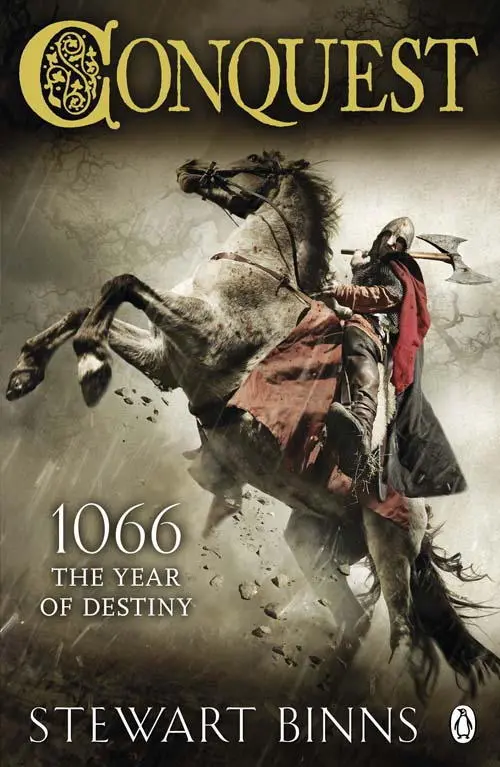
- Название:Conquest
- Автор:
- Издательство:Penguin Books
- Жанр:
- Год:2011
- Город:London
- ISBN:978-0-141-96059-3
- Рейтинг книги:5 / 5. Голосов: 1
-
Избранное:Добавить в избранное
- Отзывы:
-
Ваша оценка:
Conquest: краткое содержание, описание и аннотация
Предлагаем к чтению аннотацию, описание, краткое содержание или предисловие (зависит от того, что написал сам автор книги «Conquest»). Если вы не нашли необходимую информацию о книге — напишите в комментариях, мы постараемся отыскать её.
The battle is hard fought and bloody, the lives of thousands have been spent, including that of King Harold. But England will not be conquered easily, the Anglo-Saxons will not submit meekly to Norman rule.
Although his heroic deeds will nearly be lost to legend, one man unites the resistance. His name is Hereward of Bourne, the champion of the English. His honour, bravery and skill at arms will change the future of England. His is the legacy of the noble outlaw.
This is his story.
Conquest — читать онлайн бесплатно полную книгу (весь текст) целиком
Ниже представлен текст книги, разбитый по страницам. Система сохранения места последней прочитанной страницы, позволяет с удобством читать онлайн бесплатно книгу «Conquest», без необходимости каждый раз заново искать на чём Вы остановились. Поставьте закладку, и сможете в любой момент перейти на страницу, на которой закончили чтение.
Интервал:
Закладка:
She knew she had been struck by lightning and, by some miracle, had survived. She lay motionless, as if petrified, drenched by the storm’s downpour. Aware only of the continuous screeching in her ears, she was unable to hear Hereward’s desperate calls.
Martin reached her first, closely followed by Hereward, Alphonso and Einar; all feared she was dead. Martin had seen the lightning go to ground only a few feet from her. Knowing the mountains well, he had sensed the sudden change of atmosphere and the drop in temperature and, realizing that Torfida was high up, had scanned the slopes to locate her.
Just as he saw her, the bolt struck.
They carried her down the mountain as her body began to convulse. The skin on her face, legs and hands looked as if it had been hung in a smokehouse; tiny vessels had burst in her eyes, there were trickles of blood from both nostrils and her hair looked as if it had been frizzled in an oven. They could feel how hot her body was, and they noticed that her clothes were smouldering.
It took Torfida several days to recover. Her bloodshot eyes cleared and oil of lanolin helped restore her hair, but her mood remained sombre. The weather had continued to assail the mountains, even though it was late August. For Torfida, a place that in one moment had been a paradise had, in an instant, presented a glimpse of Hell that would give her nightmares for the rest of her life.
She spoke to Hereward alone. ‘I had begun to forget our purpose. This is an omen, a warning not to forget again. We must leave tomorrow; time is moving on and God only knows what is happening in England.’
Torfida began to cry. She looked as bereft as Hereward had ever seen her.
‘The King is old now, perhaps he is dead already. War may have started.’
‘Torfida, calm yourself.’
‘I am frightened, Hereward. We think we have the ability to make things happen, to change things, but compared to God and the world of nature he created, we are insignificant. That knowledge shakes me to my very core.’
‘Torfida, don’t talk like that, I need you. Whatever it is that we’re supposed to be doing with this cursed thing around my neck, I need you.’
She began to fight back the tears. ‘Hereward, get me out of these mountains. Let’s make haste for Normandy.’
‘Get some rest. We’ll break camp in the morning and sleep on lower ground tomorrow night.’
Hereward kissed her and held her tightly until she finally fell asleep. As he listened to the wind wail around the mountains, he too felt a quiver of anxiety. He had never believed in prophecies and omens, but now he felt a primordial shudder of instinctive fear and, desperate for the reassurance they would bring, he longed to wake the others.
He fought his demons and held Torfida even tighter. Whether it was an omen or not, Hereward knew that mountains were dangerous places and he feared that lightning could indeed strike twice. He resolved to get as far away as possible, as quickly as Torfida’s recovery would allow.
Everyone remained subdued for the next few days; they all wanted the mountains to be out of sight and for Torfida to regain her vitality.
Eventually, after several weeks and a detour to avoid the French strongholds of Paris and Chartres, they entered the Norman province of Evreux. They had not been so far north in a very long time and everyone shivered in the fresh autumnal winds. But, more importantly, Torfida was happier. Hereward stayed close to her. She seemed to be back to her alert, purposeful self. She had cut away all her singed hair, leaving a boyish bob that made her look much younger. Her eyes had regained their brightness and her skin its clarity.
Torfida’s decisiveness was also back, and she advised Hereward that they should head for Rouen, the seat of Duke William’s power.
They arrived in Rouen three days later.
It was a bustling city with new buildings being erected everywhere. The markets were busy and the people seemed affluent. Normandy was thriving. Duke William was on his way home from the cathedral at Jumièges, after giving thanks for victory over the Province of Maine. His invasion earlier in the year had been successful and he now held sway over the whole of northern France above the Loire. Not only that: the King of France, Philip II, was still a minor and the Duke’s only other serious rival, Geoffrey of Anjou, had recently died, leaving little threat from the south.
After finding lodgings in the city and bidding farewell to their retinue from Melfi, they prepared to watch the Duke on his triumphant return.
The streets were bursting with people and hundreds of sentries were deployed to keep clear the processional route. The Bishop of Rouen, flanked by the entire hierarchy of the Norman Church, and the newly appointed Bishop of Le Mans, the capital of the conquered Province of Maine, waited at the great door of the cathedral to anoint the conquering hero. Fanning out from the bishops, on both sides, were the abbots from Normandy’s monasteries, the sheriffs from its provinces and the great and the good of the city of Rouen.
At the centre of the group, and a pace or two ahead, was a woman who, at first glance, could easily have been mistaken for a child. At not much more than four and a half feet tall, she was dwarfed by everyone around her. Matilda, Duchess of Normandy, daughter of Baldwin V, Count of Flanders – William’s most important ally and guardian of the young King Philip of France – was a direct descendent of Alfred the Great of England and had a personality which belied her diminutive stature. It was known throughout Normandy that her marriage to Duke William was happy and that she was quite capable of standing up for herself, even in the presence of her formidable husband. Her tiny frame did not prevent her from enjoying robust health, producing three sons, five daughters and being now heavily pregnant with a ninth child.
Hereward and Torfida found the mood of excitement in the city infectious. As the horns sounded in front of the cathedral to signal the Duke’s entry into the square, they cheered along with everyone else. The Duke’s archers and crossbowmen came first, followed by a column of infantry, all marching four abreast in excellent order. The bowmen wore leather jerkins with brown woollen leggings, small leather skullcaps and, in addition to their bows, carried seaxs. Wearing mail hauberks and distinctive pointed helmets with long nose-guards, several columns of infantry and cavalry came next, carrying both sword and spear and holding the famous Norman conical shield. Then came the Duke, in the midst of at least a hundred colourfully dressed knights, many of them lords in their own right. With their huge destriers strutting beneath them, most carried a small pennon on their lance to affirm their chevalier status, but some carried much bigger and more elaborately designed gonfalons, which asserted their nobility as barons. The crowd could recognize where each knight came from by the local colours of his pennon or gonfalon; those from towns close to Rouen, such as Fécamp and Yvetot, were greeted by particularly fervent cheers.
The Duke finally came into Hereward’s view. His ducal coronet covered a mane of thick red hair and his ruddy complexion was framed by a neatly trimmed beard, slightly darker than the hair on his head. He wore an unexceptional woollen cloak over his mail coat and had the same armour and weapons as his knights. However, resting on the pommel of his saddle was the legendary ‘Baculus’, his formidable wooden war club. A weapon of war dating back generations to the Normans’ Viking ancestors, all previous Dukes of Normandy had carried it as an icon of authority and virility.
Sitting upright on his mount, William did not smile at his subjects, only giving a perfunctory nod to a particularly loud greeting, or to a face that seemed familiar. The crowd was impressed by his physical presence; he was clearly someone born to rule and rule firmly.
Читать дальшеИнтервал:
Закладка:
Похожие книги на «Conquest»
Представляем Вашему вниманию похожие книги на «Conquest» списком для выбора. Мы отобрали схожую по названию и смыслу литературу в надежде предоставить читателям больше вариантов отыскать новые, интересные, ещё непрочитанные произведения.









Обсуждение, отзывы о книге «Conquest» и просто собственные мнения читателей. Оставьте ваши комментарии, напишите, что Вы думаете о произведении, его смысле или главных героях. Укажите что конкретно понравилось, а что нет, и почему Вы так считаете.