Stewart Binns - Conquest
Здесь есть возможность читать онлайн «Stewart Binns - Conquest» весь текст электронной книги совершенно бесплатно (целиком полную версию без сокращений). В некоторых случаях можно слушать аудио, скачать через торрент в формате fb2 и присутствует краткое содержание. Город: London, Год выпуска: 2011, ISBN: 2011, Издательство: Penguin Books, Жанр: Историческая проза, на английском языке. Описание произведения, (предисловие) а так же отзывы посетителей доступны на портале библиотеки ЛибКат.
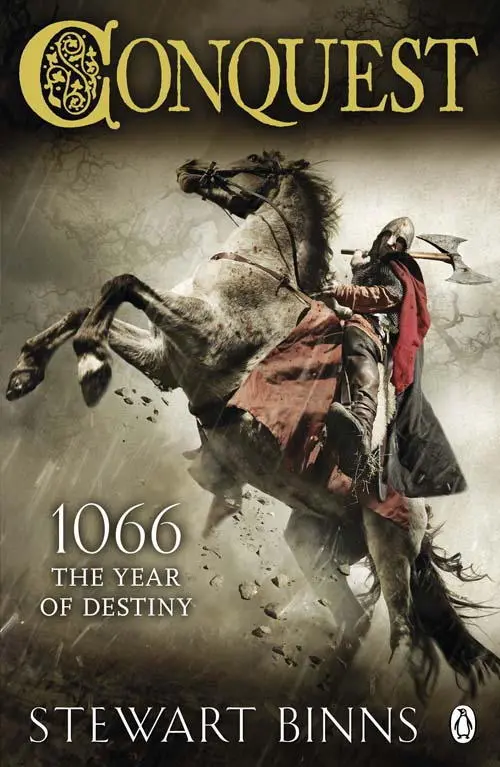
- Название:Conquest
- Автор:
- Издательство:Penguin Books
- Жанр:
- Год:2011
- Город:London
- ISBN:978-0-141-96059-3
- Рейтинг книги:5 / 5. Голосов: 1
-
Избранное:Добавить в избранное
- Отзывы:
-
Ваша оценка:
Conquest: краткое содержание, описание и аннотация
Предлагаем к чтению аннотацию, описание, краткое содержание или предисловие (зависит от того, что написал сам автор книги «Conquest»). Если вы не нашли необходимую информацию о книге — напишите в комментариях, мы постараемся отыскать её.
The battle is hard fought and bloody, the lives of thousands have been spent, including that of King Harold. But England will not be conquered easily, the Anglo-Saxons will not submit meekly to Norman rule.
Although his heroic deeds will nearly be lost to legend, one man unites the resistance. His name is Hereward of Bourne, the champion of the English. His honour, bravery and skill at arms will change the future of England. His is the legacy of the noble outlaw.
This is his story.
Conquest — читать онлайн бесплатно полную книгу (весь текст) целиком
Ниже представлен текст книги, разбитый по страницам. Система сохранения места последней прочитанной страницы, позволяет с удобством читать онлайн бесплатно книгу «Conquest», без необходимости каждый раз заново искать на чём Вы остановились. Поставьте закладку, и сможете в любой момент перейти на страницу, на которой закончили чтение.
Интервал:
Закладка:
William bellowed at his messenger almost before he had finished his report. ‘Go to my brother, Odo, and tell him that he must take fifty men to that fool Ponthieu and have Earl Harold delivered to me immediately. I will welcome him into Normandy at Eu, six days from now. Go! Go quickly!’
William was riding hard to Rouen within the hour.
Harold Godwinson must have been both relieved and impressed as he crossed the wooden pontoon on the River Bresle at Eu. On the opposite bank was the substantial presence of the Duke, surrounded by a grandiose assortment of counts, bishops, sheriffs, knights and 250 of his finest warriors. Not only that: as a mark of his beneficence, the Duke had paid Guy of Ponthieu a preposterous sum for the Earl’s ransom.
The show of respect between the two men, as they hailed one another with their swords and then shook hands, was sincere. Here were the two most important warlords in north-western Europe – one already called ‘sub-regulus’ to King Edward, the other a king in all but name, lord of the most powerful province in the region.
As William and Harold rode off together towards Rouen, Hereward could not help but notice their similarities rather than their differences. Both were exceptionally tall, although Harold was slightly shorter; both were fair, one very blond, the other a distinct redhead, and both were proud and self-confident. They were talking animatedly in Norman French, and seemed in good humour.
For the next few days, the Duke and the Earl were rarely seen. Their discussions were held behind closed doors in William’s palace at Rouen. Nevertheless, the rumour soon spread around the city that, indeed, this was the visit William had said would happen and that the Earl of Wessex had come to pay his respects and acknowledge the Duke of Normandy as his future king.
Rouen was alive with excitement. The English King was already sixty years of age; it could not be long before William’s accession came to pass. England was known to be a rich land with prodigous harvests and sturdy beasts, a treasure trove waiting to be plundered by every opportunist in Normandy.
As Hereward and Torfida sat by their hearth and discussed the dramatic arrival, their thoughts moved quickly to the motives of Harold Godwinson. Surely, the Earl felt great unease in bowing to Duke William? He must also know of the reputation of the Normans? If William became king, Normans would rapidly fill the bishoprics and supplant the earls and thegns.
There would be war.
Perhaps he was striking a bargain with William and they were planning England’s future together, with Harold negotiating guarantees about his own position?
Or would he simply take the throne himself after King Edward’s death?
The next morning, the Captain of the Duke’s personal squadron and two sergeants-at-arms arrived at the farmhouse and summoned Hereward to the Duke’s palace.
On hearing the news, Torfida jumped to her feet and grabbed Hereward excitedly. ‘This is the moment we’ve been waiting for; you are going to meet the Earl. By the time he leaves Normandy, we will know what we must do. But, be careful, there are great forces at work here; these are powerful and dangerous men.’
When Hereward reached the ducal palace, he marched up to the richly carved throne with the brisk step of a confident man. Queen Matilda sat to the Duke’s left, Harold was on his right.
Hereward bowed as the Duke introduced him.
‘My Lord Earl, this is Hereward of Bourne, a man you may know.’
‘I do, your Grace. I proclaimed him banished at Winchester some years ago.’
‘Indeed, he told me all about it; he has led an interesting life since then. Tell the Earl of Wessex your story, but spare us the details.’
Hereward bowed again and gave a short account of his chance meeting with Gruffydd, King of the Welsh, and of the Battle of Hereford. He described his involvement in the affairs of Macbeth, then recounted his long journey to Italy and his experiences in the service of Robert Guiscard in Apulia and Sicily.
Harold listened impassively before responding. ‘A great adventure, your Grace, but there is little in it to commend him to me. Although he nobly served your kin in Apulia, he has spent the rest of his time fighting for our enemies.’
‘Ah, but in fairness, my Lord Earl, he was an outlaw, cast out by his people. Besides, the two enemies you speak of are both dead, and Scotland and Wales now bow to Edward at Winchester.’
‘They will soon owe fealty to Westminster, on the Thames near London, your Grace. The King is building a fine new palace and cathedral there.’
‘So that is where I shall be crowned?’
Harold looked discomforted at the Duke’s provocative question. ‘Quite so, your Grace.’
Hereward scrutinized Harold as he answered. He spoke softly and submissively, as if he did not want to agree, but had to. Hereward sensed that Harold was cornered – not fearful, but trapped. He was not a man to be easily frightened; nevertheless, he seemed conspicuously uncomfortable.
‘Well, what do you say, my Lord Earl? Will you take him? He is a fine warrior and one of your own.’
Harold looked at Hereward again, this time with a hint of the warmth of kinship in his eyes. ‘His Grace, the Duke, has recommended that you accompany me on his new campaign against the Bretons, an expedition in which he has generously asked me to be at his side. I have listened carefully to Duke William. I accept that you left England without help or favour and within the terms of your banishment. I also agree that, apart from your choice of employer, your service in Wales and Scotland does you credit. I am told that you are a fine soldier; I am happy to have you in my hearthtroop, Hereward of Bourne.’
Hereward knew instantly that the die was cast, as Torfida had predicted.
Brittany was ruled by Count Conan II, but his rule was precarious. The Bretons had fierce tribal loyalties, and Conan had difficulty holding the tribal fiefdoms together. William had formed an alliance with Rivallon of Dol, a rogue Breton whose domain was in the border region. He had recently come under attack from Conan’s army and had appealed to William for help.
This gave the Duke the opportunity to invade Brittany and make his western border secure all the way to the Atlantic.
Ten days later, William’s army was in the field, in battle order, and approaching Normandy’s border with Brittany. The Duke’s army was ready to flex its muscles and demonstrate to Harold the power of Normandy’s military machine.
With the towering citadel of Mont St Michel in the distance, Harold was impressed by the army of Normandy as it marched across in full battle regalia. There were over 2,500 men, the elite of William’s forces. Harold headed a contingent of forty Englishmen. Just behind him, carried by two of his housecarls, were the Earl’s war banners: the Dragon of Wessex and his own personal ensign, the Fighting Man. The English standards were flying as part of the colours of a Norman army, which, if events were to unfold as seemed likely, might soon be an occupying army in England.
They crossed the border with Brittany at the River Couesnon. Barely ten miles further on, Lord Rivallon was besieged behind the walls of Dol by Conan’s army. Duke William ordered a halt and then gave instructions to make ready a forward camp so that they could move off before dawn and attack on the cusp of daylight.
That evening, the strategy was agreed: with the infantry in reserve, William would advance with his cavalry and mount an immediate attack. The Earl of Wessex, his knights, his housecarls and Hereward, with his three men-at-arms, would form their own conroi, and would attack second in line of precedence. They would be to the right of William’s personal conroi, the Matilda Squadron, each of whom carried on their lances a sky-blue riband, the favours of Duchess Matilda.
Читать дальшеИнтервал:
Закладка:
Похожие книги на «Conquest»
Представляем Вашему вниманию похожие книги на «Conquest» списком для выбора. Мы отобрали схожую по названию и смыслу литературу в надежде предоставить читателям больше вариантов отыскать новые, интересные, ещё непрочитанные произведения.










Обсуждение, отзывы о книге «Conquest» и просто собственные мнения читателей. Оставьте ваши комментарии, напишите, что Вы думаете о произведении, его смысле или главных героях. Укажите что конкретно понравилось, а что нет, и почему Вы так считаете.