Stewart Binns - Crusade
Здесь есть возможность читать онлайн «Stewart Binns - Crusade» весь текст электронной книги совершенно бесплатно (целиком полную версию без сокращений). В некоторых случаях можно слушать аудио, скачать через торрент в формате fb2 и присутствует краткое содержание. Город: London, Год выпуска: 2012, ISBN: 2012, Издательство: Penguin Books, Жанр: Историческая проза, на английском языке. Описание произведения, (предисловие) а так же отзывы посетителей доступны на портале библиотеки ЛибКат.
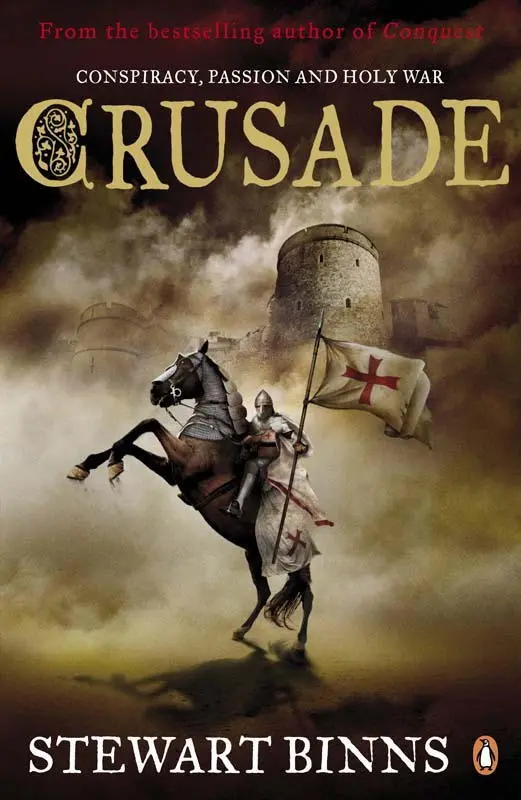
- Название:Crusade
- Автор:
- Издательство:Penguin Books
- Жанр:
- Год:2012
- Город:London
- ISBN:978-0-241-95758-5
- Рейтинг книги:3 / 5. Голосов: 1
-
Избранное:Добавить в избранное
- Отзывы:
-
Ваша оценка:
Crusade: краткое содержание, описание и аннотация
Предлагаем к чтению аннотацию, описание, краткое содержание или предисловие (зависит от того, что написал сам автор книги «Crusade»). Если вы не нашли необходимую информацию о книге — напишите в комментариях, мы постараемся отыскать её.
In the face of chaos and death, Edgar and his allies form a secret brotherhood, pledging to fight for justice and freedom wherever they are denied. But soon they are called to fight for an even greater cause: the plight of the Holy Land. Embarking on the epic First Crusade to recapture Jerusalem, together they will participate in some of the cruellest battles the world has ever known, the savage Siege of Antioch and the brutal Fall of Jerusalem, and together they will fight to the death.
Crusade — читать онлайн бесплатно полную книгу (весь текст) целиком
Ниже представлен текст книги, разбитый по страницам. Система сохранения места последней прочитанной страницы, позволяет с удобством читать онлайн бесплатно книгу «Crusade», без необходимости каждый раз заново искать на чём Вы остановились. Поставьте закладку, и сможете в любой момент перейти на страницу, на которой закончили чтение.
Интервал:
Закладка:
Robert turned to us and smiled.
‘The silver is from my own mint in Rouen; the coins have my head on them. When they were clearing the site, they found coins minted with the head of Alfred the Great. I had them melted down; I think my image will last a lot longer.’
We all smiled at Robert. He was not being arrogant; he meant what he said. Such was the bravado of the Normans, he knew that the churches his countrymen were building would be substantial enough to stand much longer than those of the Saxons.
York also brought the final additions to our army. The contingents from William’s northern magnates joined us there, giving us a formidable force over 5,000 strong. As usual it was a highly disciplined, well-provisioned professional army capable of putting the fear of God into its enemies and able to deliver a mighty blow should the intimidation not work.
Like his father, Robert had created four conroi of elite cavalry, 100 horsemen in total, as his own hearthtroop. I had the honour of commanding the second of those, composed largely of men from my own retinue. It was named the Cerdician Conroi in honour of my royal lineage – a great irony, under the circumstances, but only one of many anomalies, oddities and absurdities in England in those early days of Norman rule.
Edwin continued to be my standard-bearer, and Sweyn and Adela rode behind me as page knights-in-waiting.
As soon as we left York, I unfurled my war banner and the Wyvern of Wessex flew over English soil once more, another incongruity in bewildering times. Robert did not mind in the slightest. In fact, he said he was proud to have King Harold’s famous ensign in his ranks.
We reached Durham in the second week of September. It was a bleak and desolate place. The iron fist of the Normans did not rule as firmly that far north, and in the spring there had been a gruesome massacre.
Walchere of Liège, both Bishop of Durham and Earl of Northumbria, had become yet another victim of the lawlessness of the far reaches of England’s northern wilderness. Many of the Northumbrian nobles and thegns had found refuge in Scotland or escaped to the high fells during William’s onslaught of the winter of 1069. Now they were returning to their estates and villages and attempting to rebuild them. It did not take long for tensions to surface with the new Norman rulers.
In trying to settle a dispute between his Norman retinue and the local Northumbrian knights, Walchere had agreed to travel to Gateshead with a large force of his household knights to meet the local aristocratic families. Old enmities arose at the meeting and boiled over into violence. Walchere and his men were overpowered and locked in the church, which was then torched. Many died in the flames and any who escaped were butchered as they left. Over a hundred men were killed, almost all of them Normans.
When Robert heard the details of the slaughter, he acted with the ruthless efficiency that was the hallmark of Norman rule. Like the Roman disciplines of the past, the tenet was simple: work hard, pay your tithes, stay on the right side of the law and you will prosper; become idle, avoid your taxes or break the law and you will be punished with a ferocity that you will never forget.
Like his father’s Harrying of the North ten years earlier, Robert ordered his conroi to travel far and wide to find the perpetrators of the atrocity at Gateshead. For understandable reasons, my conroi was spared this odious task, but within two weeks the patrols had returned.
Their reports made my blood run cold. In total, 251 men had been killed in the chase or executed. Each arrested man had been tortured to extract the names of all who were involved in the massacre until the Normans were satisfied that all the culprits had been dealt with.
Where a man had been hiding in a village or farm, all the buildings were torched, livestock killed and the people cast out. The execution of the leading figure in the outrage, Eadulf Rus, a local nobleman related to the powerful Earls of Bamburgh, was saved until last and carried out in full view of the entire population of Durham, who had been ordered to attend.
With Normandy’s finest standing sentinel on their huge destriers, Eadulf Rus was dragged from the cage in which he had been incarcerated since his capture. He was in a bad way; he had been blinded, his tongue ripped out and his legs and arms broken by repeated blows from Norman maces.
He was still conscious as his body was hauled across the grassy bailey beneath the newly reinforced wooden keep being built above it. The crowd, mainly Anglo-Danes and kinsmen of Eadulf who had returned to their homes to try to rebuild their lives, was silent.
Robert sat on his destrier, his helmet set down, his face stern; he addressed the crowd in Latin.
‘I am Robert, Count of Normandy, son of William, King of England and Duke of Normandy. Let those who would slaughter a bishop of Christ and an earl of England, and over a hundred of his kin, understand that this will be their retribution.’
He then signalled to the execution party and Eadulf’s limp body was laid beside a mounting block, his head raised by its hair and his neck stretched to give the executioner a clear strike. One of the Normans’ most formidable sergeants-at-arms stepped forward, bowed to his lord and took Robert’s sword.
It took three blows to sever Eadulf’s head from his body, but it was done. There were a few gasps from the crowd and sobbing could be heard from some of the women, but in the main there was silence. The Northumbrian’s head was stuck on a spike above the gates of the castle and his body thrown into the River Wear. The crowd shuffled away dispassionately, hiding their true feelings from their Norman masters.
It was difficult to comprehend what they must have felt about the cruelty they had just witnessed. They had seen so much killing and knew only too well what the Normans were capable of.
Were they intimidated by what they had witnessed?
Probably not.
Were they angered and yet more emboldened to continue their resistance?
Unlikely.
Were they overwhelmed by the volume of suffering endured in over ten years of hardship, so as to be almost numb to any further pain?
Almost certainly.
I spent the evening with Edwin, Adela and Sweyn.
‘No one deserves to die like that.’
It was the first time I had heard Adela speak with a tremor of emotion in her voice.
‘Adela, it was a horrific punishment. But remember, he was a man who burned to death over 100 men.’
‘The execution fitted the crime, but to torture him like that is no better than the bestial act that he committed. Justice has to be greater than that.’
Sweyn concurred with Adela.
‘I agree. If a man has killed or raped, then he deserves to die. But his death should be just that – he forfeits his life, it is enough.’
Edwin looked at his young friends admiringly.
‘Those are wise words. How did you come to such a judgement?’
Sweyn looked at Edwin and me purposefully.
‘We remember what Hereward often said: “Let others make mayhem, we will make the peace.”’
I sensed that Adela and Sweyn had come to a new and profound view of the world and its traumas.
‘You two have become wise beyond your years.’
I was proud of them and honoured, like them, to be part of Hereward’s heritage. His principles were always unequivocal and yet he knew that it wasn’t always possible to make principled judgements in the real world; sometimes decisions had to be pragmatic and swayed by circumstances. Watching Robert mete out the punishment of the Normans was a case in point. Knowing him as I did, I felt sure he would have acknowledged that his justice was horrific. But did it match the bestial crime that had been committed?
Читать дальшеИнтервал:
Закладка:
Похожие книги на «Crusade»
Представляем Вашему вниманию похожие книги на «Crusade» списком для выбора. Мы отобрали схожую по названию и смыслу литературу в надежде предоставить читателям больше вариантов отыскать новые, интересные, ещё непрочитанные произведения.



Обсуждение, отзывы о книге «Crusade» и просто собственные мнения читателей. Оставьте ваши комментарии, напишите, что Вы думаете о произведении, его смысле или главных героях. Укажите что конкретно понравилось, а что нет, и почему Вы так считаете.