Stewart Binns - Crusade
Здесь есть возможность читать онлайн «Stewart Binns - Crusade» весь текст электронной книги совершенно бесплатно (целиком полную версию без сокращений). В некоторых случаях можно слушать аудио, скачать через торрент в формате fb2 и присутствует краткое содержание. Город: London, Год выпуска: 2012, ISBN: 2012, Издательство: Penguin Books, Жанр: Историческая проза, на английском языке. Описание произведения, (предисловие) а так же отзывы посетителей доступны на портале библиотеки ЛибКат.
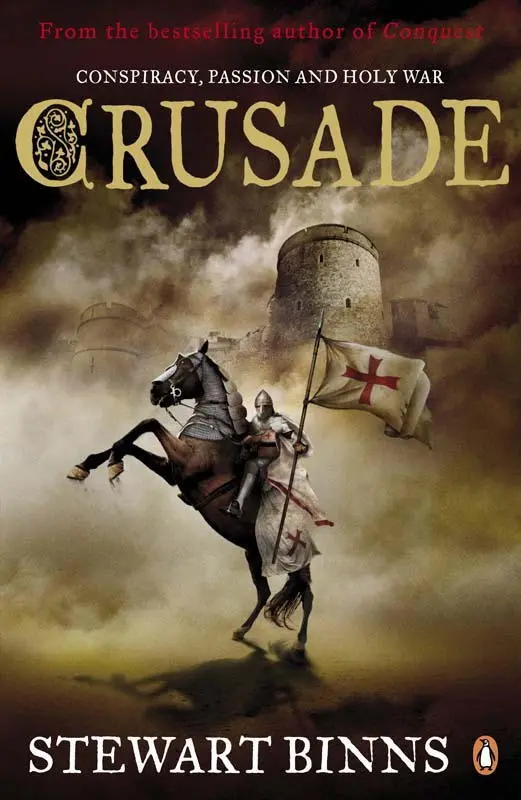
- Название:Crusade
- Автор:
- Издательство:Penguin Books
- Жанр:
- Год:2012
- Город:London
- ISBN:978-0-241-95758-5
- Рейтинг книги:3 / 5. Голосов: 1
-
Избранное:Добавить в избранное
- Отзывы:
-
Ваша оценка:
Crusade: краткое содержание, описание и аннотация
Предлагаем к чтению аннотацию, описание, краткое содержание или предисловие (зависит от того, что написал сам автор книги «Crusade»). Если вы не нашли необходимую информацию о книге — напишите в комментариях, мы постараемся отыскать её.
In the face of chaos and death, Edgar and his allies form a secret brotherhood, pledging to fight for justice and freedom wherever they are denied. But soon they are called to fight for an even greater cause: the plight of the Holy Land. Embarking on the epic First Crusade to recapture Jerusalem, together they will participate in some of the cruellest battles the world has ever known, the savage Siege of Antioch and the brutal Fall of Jerusalem, and together they will fight to the death.
Crusade — читать онлайн бесплатно полную книгу (весь текст) целиком
Ниже представлен текст книги, разбитый по страницам. Система сохранения места последней прочитанной страницы, позволяет с удобством читать онлайн бесплатно книгу «Crusade», без необходимости каждый раз заново искать на чём Вы остановились. Поставьте закладку, и сможете в любой момент перейти на страницу, на которой закончили чтение.
Интервал:
Закладка:
Inside the great tower was an elegant chapel which had been completed and consecrated to St John the Evangelist only a few weeks earlier. We stayed for a while and prayed for our safe return from Scotland.
With the great oak door closed and the din of the masons’ mallets and chisels all but stifled, it was a place of immense charm and serenity. The chapel’s sturdy columns, plain Roman arches and solid, unadorned stonework spoke volumes about its builders: powerful, determined and austere, this was indeed a Norman place of worship. Our footsteps echoed and we hushed our voices to a whisper, making the place resonate with its symbolic power.
I watched Edwin, Adela and Sweyn, English kinsmen and now brothers-in-arms, to see if they too admired the handiwork of their Norman lords. If they did, they did not show it. Edwin was too chivalrous to disclose any disdain, Adela, as always, was impassive, while Sweyn looked stern, as a young knight should.
There we were, four progeny of England, in the company of Normandy’s military elite, admiring their icon of the oppression of our homeland. It was a perplexing experience.
Sweyn spoke to me as we left the great tower.
‘Sire, they do things on a massive scale. No army, no matter how big, could breach these walls.’
‘Never underestimate them, Sweyn. You don’t have to like them, but you must respect them and learn from them.’
‘Should we not also fear them, my Lord Prince?’
‘Yes, we should fear them; they are capable of inflicting terrible retribution on those who cross them.’
‘I can’t see how we can ever loosen their grip on England.’
‘Neither can I. They are here to stay, and we have to come to terms with that.’
Adela had been listening and reacted angrily. ‘I will never accept that.’
I tried to mollify her forceful stance. ‘One day you will. Eventually, the whole of these islands will belong to them. There is no one to stop them.’
‘That’s not true. I, for one, will never give up!’
‘Adela, it’s now more than ten years since Senlac Ridge; there are tens of thousands of Normans here. Look at this fortress, this beautiful chapel. We can’t make the sand in an hourglass fall upwards.’
‘But what will become of us, if we don’t fight?’
‘England will evolve. It is already changing, and what was fought for at Ely is vital. Everyone deserves to be treated according to the law and with respect; that is something I hope the four of us can strive for.’
‘But the rule of law, and respect for all people, must be just as difficult to achieve as freeing England from the Normans.’
‘Perhaps… but, like those who died at Ely, we can each find our own destiny in fighting for a cause – even if the cause seems impossible to achieve. Because nothing is truly impossible.’
‘Do you really believe that?’
‘Yes, I do. Hereward taught me that when I watched him lead a few hundred men against William and the entire Norman army.’
8. Atrocity at Gateshead
As we travelled north our welcome was less enthusiastic, but still courteous. Beyond Peterborough, the population was far more Anglo-Dane than Saxon and their loyalty to England had always been meagre, so it was hardly surprising that they should be lukewarm in their greeting to the Normans.
In the north and west, the Norman marcher barons ruled largely hostile territory from the safety of their redoubtable donjons, many of which were having their original timber structures replaced by massive stone keeps, deep ditches and high curtain walls. There was still unease in those parts of the country; the people looked cowed, their Norman lords apprehensive.
Almost no one recognized me, which was a relief. I had been a clean-shaven boy when I left England, now I sported cropped whiskers, fashionable in Europe, rather than the full beard of Britain and Scandinavia, and wore the garb of a Norman lord; to all intents and purposes, I appeared to be one of them.
For Adela and Sweyn, the journey through Northumbria was a trying time. Although they had witnessed the brutality at the end of the Siege of Ely, the enormous scale of the horrors of the Harrying of the North was almost too much to comprehend. Each devastated village, with its hideous corpses and decaying fragments of buildings, was a glaring reminder of the massacre at Bourne and what they had suffered there. I watched them carefully, fearing that at any moment they might leap on to the nearest of our Norman comrades and slit his throat!
We reached York in time for the celebration of a very singular day for the burgh. Although the north-west was still a wasteland, a few people were returning to the major eastern burghs of the past, such as York and Durham, where a modicum of normality was beginning to return.
Not only were the Normans building mighty fortresses in praise of their military prowess, they were also erecting great cathedrals in homage to God. Thomas of Bayeux, who had been appointed Archbishop of York by the King, had taken ten years to gather the resources to begin a new cathedral to replace the derelict Saxon minster. When he heard of our journey to the North, he decided that it was a perfect opportunity for Robert to lay the foundation stone. So, amidst great panoply, yet another Norman monument began on the site of a place of worship that was centuries old.
Thomas of Bayeux was that other type of Norman – not the marauding warlord intent on building a military empire, but the builder of cultural empires, a man devoted to creating places of learning and for the worship of God. He had a kindly demeanour, but still had the gleam of the zealot in his eyes.
He greeted Robert like a prodigal son, overjoyed that such a prominent Norman would anoint his new project. A man of at least forty years of age, Thomas would of course never see his homage to God completed, but it mattered little to him; it would be his legacy to future generations and his gift to God. Those were the only things that were important. This was the power of the Normans – their desire to create a lasting legacy based on their immense martial prowess and their unshakeable faith in themselves and in God.
As we watched the masons and churchwrights busy themselves in preparation for laying the foundation stone, I tried to explain to Adela and Sweyn why I respected our Norman conquerors.
‘Look at them – like ants, relentless. It’s little wonder that Normans are sought after everywhere as soldiers and builders.’
Adela seized on my analogy.
‘More like pigs, to my mind – and it is our trough they’re feeding from. This church will be built with the sweat of thousands of English peasants, and thousands more will be made to pay unfair tithes to support it.’
‘I concede that it will not be built without sacrifice, but I wager that when the common people of Northumbria see their church rise to the heavens, they will be proud of it and claim it as their own.’
Sweyn added his own voice to Adela’s argument.
‘But they won’t have a choice.’
‘I agree, and that is to be regretted. But one day people will have choices – even the lowliest villein. I am committed to that.’
‘Indeed, sire, we know you are. That is why Adela and I have sworn our allegiance to you and Edwin.’
‘I am delighted that you have. This is only the beginning of a long road together; let us hope our path is not too arduous and that at the end of it we will feel that the journey has been worth it.’
When it came to the time for the ceremony, Thomas of Bayeux blessed the huge cornerstone as it hung over its position in the south-east corner of what would be the nave of the new church. The remains of the old Saxon minster had been cleared away and a deep trench for the footings of the new nave had been dug. The trench seemed to go on for ever, suggesting a building of huge proportions. The cornerstone was a cube, half the height and width of a man, and had to be lowered into position by block and tackle and a team of oxen. Before it was set down, Robert placed a pouch of silver and a small crucifix in the trench beneath the stone. When it was in place, the masons backfilled the trench with rubble and the first of the thousands of pieces of finely dressed limestone that would be fashioned into the new church was laid.
Читать дальшеИнтервал:
Закладка:
Похожие книги на «Crusade»
Представляем Вашему вниманию похожие книги на «Crusade» списком для выбора. Мы отобрали схожую по названию и смыслу литературу в надежде предоставить читателям больше вариантов отыскать новые, интересные, ещё непрочитанные произведения.



Обсуждение, отзывы о книге «Crusade» и просто собственные мнения читателей. Оставьте ваши комментарии, напишите, что Вы думаете о произведении, его смысле или главных героях. Укажите что конкретно понравилось, а что нет, и почему Вы так считаете.