Stewart Binns - Crusade
Здесь есть возможность читать онлайн «Stewart Binns - Crusade» весь текст электронной книги совершенно бесплатно (целиком полную версию без сокращений). В некоторых случаях можно слушать аудио, скачать через торрент в формате fb2 и присутствует краткое содержание. Город: London, Год выпуска: 2012, ISBN: 2012, Издательство: Penguin Books, Жанр: Историческая проза, на английском языке. Описание произведения, (предисловие) а так же отзывы посетителей доступны на портале библиотеки ЛибКат.
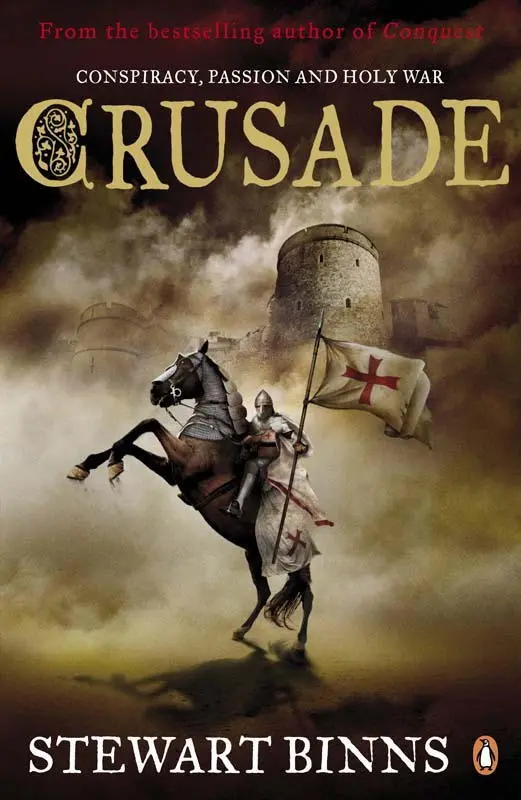
- Название:Crusade
- Автор:
- Издательство:Penguin Books
- Жанр:
- Год:2012
- Город:London
- ISBN:978-0-241-95758-5
- Рейтинг книги:3 / 5. Голосов: 1
-
Избранное:Добавить в избранное
- Отзывы:
-
Ваша оценка:
Crusade: краткое содержание, описание и аннотация
Предлагаем к чтению аннотацию, описание, краткое содержание или предисловие (зависит от того, что написал сам автор книги «Crusade»). Если вы не нашли необходимую информацию о книге — напишите в комментариях, мы постараемся отыскать её.
In the face of chaos and death, Edgar and his allies form a secret brotherhood, pledging to fight for justice and freedom wherever they are denied. But soon they are called to fight for an even greater cause: the plight of the Holy Land. Embarking on the epic First Crusade to recapture Jerusalem, together they will participate in some of the cruellest battles the world has ever known, the savage Siege of Antioch and the brutal Fall of Jerusalem, and together they will fight to the death.
Crusade — читать онлайн бесплатно полную книгу (весь текст) целиком
Ниже представлен текст книги, разбитый по страницам. Система сохранения места последней прочитанной страницы, позволяет с удобством читать онлайн бесплатно книгу «Crusade», без необходимости каждый раз заново искать на чём Вы остановились. Поставьте закладку, и сможете в любой момент перейти на страницу, на которой закончили чтение.
Интервал:
Закладка:
My personal experience on the battlefield and the deeds of Sweyn and Adela left me with much to think about. Up until then, my motives in contemplating a fight, or in the heat of battle, had always been focused on myself. Either I, as an Atheling Prince, had been the cause of the conflict, or else I stood to gain significantly from the outcome. But this time, I was peripheral to the cause.
Vinbald’s sudden, horrendous death and my response to it made me realize why people fight with such courage – even though they may not benefit directly from victory, or suffer overmuch from defeat. Sweyn and Adela had shown the same resolve in their passion to enter the fray and to influence the outcome of the battle.
In essence, I had learned how to fight.
7. Brothers-in-Arms
King William’s injuries at Gerberoi were not severe enough to immobilize a young warrior for long, but at the age of forty-four his recuperation took some time. This did not improve his humour and only added to the acceleration of his corpulence. The damage to his morale was also significant – enough to suggest that he might never fully recover from it.
In the summer of 1079, Robert’s bravado in challenging his father reaped a bountiful harvest. The King’s magnates, both in England and Normandy, gathered in Rouen, steeled themselves to the task and confronted William. They were led by men whose own sons had joined the cause of William’s prodigal son.
Their words hardly needed saying: Normandy and England’s neighbours were now too strong, Malcolm of Scotland too opportunistic, the Danes too avaricious, for William’s large and difficult-to-defend domain. Therefore, it was imperative that he treat with his firstborn, offer concessions to him and make peace in his realm.
They were not easy words to say, nor were they palatable for William to listen to, but after the customary bellowing and blustering, hear them he did. So, in the middle of August 1079, we accompanied Robert and his followers after he was invited to Rouen to negotiate with his father.
I had sent intelligence to King Malcolm in Dunfermline throughout the internecine squabbles in Normandy. He had been poised to act since the spring and now his timing was perfect. Two weeks before the negotiations, he launched a major offensive, ravaging a huge area from the Tweed to the Tees and filling his barns, granaries and treasury with plunder. It was a major card for Robert to play in the haggling to come.
Sweyn and Adela had returned to us by then, much chastened by the experience of being stalled in pursuing their ambitions. I agreed that they could accompany us to Rouen, in part because I wanted to see how they would react when they were again close to the King. We did not discuss their return to their home in the Lot but, for some reason, I sensed that they had not gone there, but had journeyed elsewhere. There was a diffidence about them which I suspected disguised a secret; one day I would come to know what it was.
The confabulation with the King was tense. He was accompanied by Queen Matilda, Roger of Montgomery, Hugh of Grandmesnil and the ageing Roger of Beaumont. Besides me, Robert chose Robert of Bellême and Ives and Aubrey of Grandmesnil, all sons of the men they were facing.
As I watched the polite formalities and courtesies, I felt uncomfortable – an outsider privy to what was, in truth, a family feud which just happened to be among the most powerful men in northern Europe. I was also ill at ease in being in the confidence of one party to the quarrel. Even these Normans, who had become my friends, were the very same people who had stolen my birthright and were oppressing my kinsmen. I also had the same anxieties that everyone else must feel. The fate of kingdoms often hinges on the outcome of battles, but this time the future of England and Normandy rested on the settlement of a family quarrel. But this was no ordinary family, this was the brood of an extraordinary warlord.
I was deep in those thoughts when the King, who was on his best behaviour, made the same observation that had occurred to me.
‘Why do we have an English prince in our midst, a man who repeatedly bows to me and then chooses to be my enemy?’
‘Father, he is my ally, wise counsel and good friend. He is no enemy of Normandy.’
On any other occasion that would have sent William into a tirade, but the circumstances made him relent and, with a sneer aimed at me and a dismissive grunt, he signalled for the parley to begin.
It did not take long to reach an agreement. Two crucial factors were in play. William’s humiliation at Gerberoi had put Robert in a powerful position, especially because of the support he could now draw on, both inside Normandy and among its enemies. This meant that, if William were to placate his son, he would also placate his enemies, especially Philip of France. Secondly, Robert had saved his father’s life on the battlefield. This meant that not only was the King in his personal debt, but he also had an obligation in the eyes of the entire Norman aristocracy to reward his son for his magnanimity in victory.
‘My son, let our differences stay in the past. Your prowess in the field at Gerberoi and your exemplary behaviour towards me have taught me to understand that my regard for you fell far short of what it should have been and that my deeds and words, and those of your brothers, were ill-judged and hurtful. All that will now be put right and the wrongs of the past will not happen again.’
They were astonishing words, such that I had to pinch myself to be sure I was hearing them, uttered by the same man who in the past had conceded nothing to any man, under any circumstances.
‘Thank you, Father, I am content that you now feel you can give me the respect that I have deserved for a very long time.’
Robert was visibly moved by his father’s contrition. Although he was short-tempered, impetuous and sometimes indolent, Robert was good company and generous and had become a close friend. I was delighted that the burden of half a lifetime of disrespect and bullying by his father appeared to have been lifted from his shoulders.
The King solemnly granted to Robert his succession to the Dukedom of Normandy and made recompense for all his son’s costs during the rebellion, which were substantial. Tactfully, Robert did not raise the subject of the English throne, or the inheritance of his brothers; those quarrelsome subjects would have be resolved, or otherwise, in due course. The Queen sat and beamed, there were comradely hugs all round, and food and drink began to appear for a celebratory feast.
During the merriment, the King delivered a shock. Although William was not as imperious as he had been, he was still capable of flashes of highly astute manoeuvring. It was not a trap for Robert – indeed, for him, it was a generous gesture – but, for me, it was certainly a move that would test my diplomacy and force me to examine my loyalties. The King delivered his surprise with a hint of mischief in his eyes.
‘Robert, I am concerned about our northern borders. As you know, Malcolm of Scotland has flagrantly ridden roughshod over the pact we made at Abernethy. I would like you to lead our army on a campaign to remind him of his manners.’
Robert was beside himself. Not only was it a tangible affirmation of his reconciliation with his father, but it was also a major blow to Rufus, who would read into the mission the suggestion that Robert may well inherit England as well as Normandy.
William delivered his devious ploy with a smile and with cunningly chosen words.
‘Prince Edgar, perhaps you would accompany Robert? You know the Scots well; you can be of great service to us in helping to put them in their place.’
Robert looked concerned for me. I just about mustered a smile in response.
Читать дальшеИнтервал:
Закладка:
Похожие книги на «Crusade»
Представляем Вашему вниманию похожие книги на «Crusade» списком для выбора. Мы отобрали схожую по названию и смыслу литературу в надежде предоставить читателям больше вариантов отыскать новые, интересные, ещё непрочитанные произведения.






Обсуждение, отзывы о книге «Crusade» и просто собственные мнения читателей. Оставьте ваши комментарии, напишите, что Вы думаете о произведении, его смысле или главных героях. Укажите что конкретно понравилось, а что нет, и почему Вы так считаете.