Stewart Binns - Crusade
Здесь есть возможность читать онлайн «Stewart Binns - Crusade» весь текст электронной книги совершенно бесплатно (целиком полную версию без сокращений). В некоторых случаях можно слушать аудио, скачать через торрент в формате fb2 и присутствует краткое содержание. Город: London, Год выпуска: 2012, ISBN: 2012, Издательство: Penguin Books, Жанр: Историческая проза, на английском языке. Описание произведения, (предисловие) а так же отзывы посетителей доступны на портале библиотеки ЛибКат.
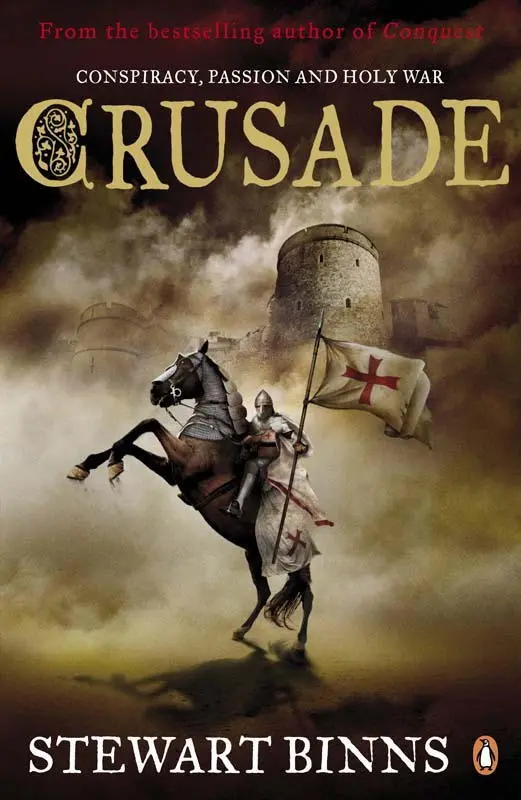
- Название:Crusade
- Автор:
- Издательство:Penguin Books
- Жанр:
- Год:2012
- Город:London
- ISBN:978-0-241-95758-5
- Рейтинг книги:3 / 5. Голосов: 1
-
Избранное:Добавить в избранное
- Отзывы:
-
Ваша оценка:
Crusade: краткое содержание, описание и аннотация
Предлагаем к чтению аннотацию, описание, краткое содержание или предисловие (зависит от того, что написал сам автор книги «Crusade»). Если вы не нашли необходимую информацию о книге — напишите в комментариях, мы постараемся отыскать её.
In the face of chaos and death, Edgar and his allies form a secret brotherhood, pledging to fight for justice and freedom wherever they are denied. But soon they are called to fight for an even greater cause: the plight of the Holy Land. Embarking on the epic First Crusade to recapture Jerusalem, together they will participate in some of the cruellest battles the world has ever known, the savage Siege of Antioch and the brutal Fall of Jerusalem, and together they will fight to the death.
Crusade — читать онлайн бесплатно полную книгу (весь текст) целиком
Ниже представлен текст книги, разбитый по страницам. Система сохранения места последней прочитанной страницы, позволяет с удобством читать онлайн бесплатно книгу «Crusade», без необходимости каждый раз заново искать на чём Вы остановились. Поставьте закладку, и сможете в любой момент перейти на страницу, на которой закончили чтение.
Интервал:
Закладка:
The tests were arduous: target practice with longbow, crossbow and javelin; tilts at dummy targets and personal jousts with some of Robert’s finest horsemen; duels on foot and on horseback with sword, mace and seax; various tests of horsemanship, including a long-distance gallop through the forest and heath; and the final challenge, a foot-race around the camp where, at several points, they had to run a gauntlet of abuse, blows, traps and obstacles.
The test was scored by Hugh Percy and both passed handsomely. Sweyn’s score was one of the highest anyone could remember, while Adela’s would have put her close to the elite bracket of candidates had she not suffered the misfortune of being taken clean out of her saddle in one of her three jousts, which lost her several points. However, accompanied by much cheering, her sheer determination, desperate scrambling and instinctive cunning meant she beat Sweyn by ten yards in the foot-race, even though he had the physique of a hunting dog.
The camp was delighted at the outcome and had been thoroughly entertained for an afternoon.
It was a very special moment for Sweyn when he stood before Count Robert to be dubbed a Knight of Normandy. He bowed to his lord and, with the only blow to which Sweyn was required not to retaliate, Robert struck him hard across the side of his face with the mailed side of his gauntlet, drawing blood from his cheek and nose. He then handed him his pennon, placed his sword in his hand and raised it to the assembled crowd. The army cheered enthusiastically and his fellow knights raised their swords in the time-honoured salute.
Sweyn had got his wish. He was a member of the Order of Knights at the tender age of sixteen, an honour usually bestowed at a boy’s coming of age at twenty-one. Only members of the higher nobility or warriors of exceptional ability were given such an accolade so young.
The most significant gesture, one that I will remember for the rest of my days, was embodied in the colours of Sweyn’s pennon. Robert had sought advice from me and, despite what the three colours represented, was magnanimous enough to grant Sweyn the crimson, gold and black of Hereward’s war banner, the colours chosen to represent the Talisman of Truth by the noble Einar in 1069.
Sweyn tied the pennon to his lance and held it high in the air. It was yet another huge paradox for me to contemplate: it was less than ten years since Ely; we were in the wild and forsaken burgh of Durham, still not recovered from Norman brutality; and once more Hereward’s colours flew proudly over English soil, this time in front of William’s firstborn son and heir and the cream of Normandy’s army.
Robert then addressed Adela directly.
‘Adela of Bourne, you have acquitted yourself with great distinction here today, you have performed as well as the best of my knights. I hope you understand why I cannot dub you as knight today – but rest assured, you have won our respect.’
Robert nodded and a steward brought forward a magnificent black destrier of the size, quality and colour reserved for the elite Matilda Conroi.
‘Please accept this mount. It reflects our regard for you and especially your outstanding skill as a horsewoman.’
Adela, despite the disappointment of being denied knighthood, seemed overawed. She did not curtsy of course, but bowed deeply, smiled broadly and took the reins of the horse. The crowd responded warmly – most seemed won over by her impressive performance in the trial.
‘Count Robert, I am very grateful and appreciate all the support you have given Sweyn and myself. We are in your debt and will serve in whatever capacity you wish. The mount is a fine specimen and a more than generous gift. I will put him to good use, sufficient to be worthy of such largesse. As for convention, I hope to prove to you that although some traditions are worth keeping, many are not.’
Adela’s combative spirit could not be quashed.
I was much relieved that Robert appeared to take it in good part.
Later that night, Robert asked to see me.
‘I have been thinking about Adela. Do you want her to stay with this campaign and any others we go on together?’
‘Yes, I do.’
‘I think that’s a problem. There is much disquiet among the knights, and innuendo and banter among the men. Many of the women are suspicious or jealous of her. I had not given it a thought but, after the trial, Hugh, Yves and Aubrey came to me with the gossip. They are set against her staying – they say she will cause trouble, and that’s the last thing we want when we’re about to set out for Scotland.’
‘What are you saying?’
‘I assume she likes women rather than men?’ Robert asked bluntly.
‘It is never discussed. She has never taken any interest in men – except to be very protective of Sweyn, whom she treats like a younger brother. I know of no evidence to suggest that she’s inclined to either men or women, which must be a consequence of her trauma as a girl.’
I then told Robert what I knew of the events in her village. However, the information, although eliciting much sympathy, did not dispel his concerns.
‘There are many in the Church and in the nobility who would have her flogged – or worse – if there were any suggestion of her fornicating with another woman.’
‘There is no suggestion of that.’
‘That may be so, but I can’t stop the rumours and I can’t have disquiet in the army or the baggage train. Hell, in my naivety, I gave her a stallion today. When she said she’d put him to good use, you can imagine the insinuations that echoed around the camp!’
I despaired.
‘Robert, please, this will break her heart. She knows nothing else, has no other dreams; she just wants to fight.’
‘Someone is going to have to wed her. It will stop all the rumours and she can accompany you on as many campaigns as she likes; sometimes, the wives of knights not blessed with children accompany their men.’
‘That is preposterous. Who do you suggest takes her in marriage?’
‘I’ve no idea, but you must find someone. We can give him a small estate as an inducement, and I understand she is not without her own dowry.’
‘She wouldn’t accept it; I would wager a Danegeld on it.’
‘What about the boy, Sweyn? Or Edwin? That might be a good match.’
‘Robert, this is a shock. I need time to think.’
‘You have twenty-four hours. We march at dawn the day after tomorrow.’
I had to act quickly, and immediately sought Edwin’s advice.
‘Count Robert is adamant that someone must take her as a wife if she is to continue in his service.’
‘Sire, I thought he was an admirer.’
‘He is, but Hugh Percy and the others have spoken to him and are set against it. They say it will cause trouble and that many of the knights are opposed, claiming that she prefers to be the ram doing the tupping rather than the ewe being tupped.’
‘It is unfair, my Lord, she has done nothing wrong. I think I know why the knights are causing trouble. Some time ago, I woke early one morning to find her alone by the horses and very pensive. Eventually, she told me that during the night she had been disturbed by two knights from Avranches, naked, drunk and egged on by others, who were fondling her and pulling down her leggings. As you might guess, her seax was at the throat of one and her foot in the balls of the other within moments. I suspect both were humiliated. She told me that it was not the first time it had happened.’
‘Does she prefer women, as the rumours suggest?’
‘My Lord, I don’t know. She never has any suitors because she never encourages anyone – Emma and Edgiva seemed to be able to subdue the memory of Bourne, but Adela never could. They are now happily married with children, whereas Adela has chosen the life of a warrior. I suspect vengeance still burns in her heart.’
Читать дальшеИнтервал:
Закладка:
Похожие книги на «Crusade»
Представляем Вашему вниманию похожие книги на «Crusade» списком для выбора. Мы отобрали схожую по названию и смыслу литературу в надежде предоставить читателям больше вариантов отыскать новые, интересные, ещё непрочитанные произведения.




Обсуждение, отзывы о книге «Crusade» и просто собственные мнения читателей. Оставьте ваши комментарии, напишите, что Вы думаете о произведении, его смысле или главных героях. Укажите что конкретно понравилось, а что нет, и почему Вы так считаете.