Stewart Binns - Crusade
Здесь есть возможность читать онлайн «Stewart Binns - Crusade» весь текст электронной книги совершенно бесплатно (целиком полную версию без сокращений). В некоторых случаях можно слушать аудио, скачать через торрент в формате fb2 и присутствует краткое содержание. Город: London, Год выпуска: 2012, ISBN: 2012, Издательство: Penguin Books, Жанр: Историческая проза, на английском языке. Описание произведения, (предисловие) а так же отзывы посетителей доступны на портале библиотеки ЛибКат.
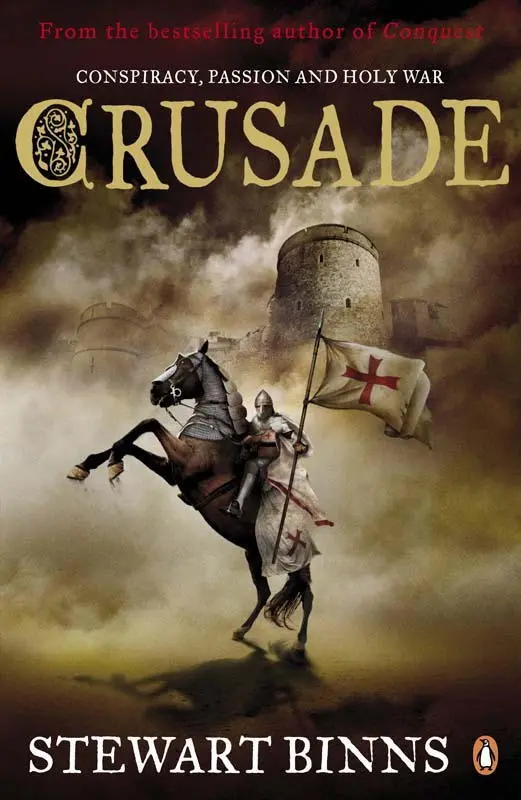
- Название:Crusade
- Автор:
- Издательство:Penguin Books
- Жанр:
- Год:2012
- Город:London
- ISBN:978-0-241-95758-5
- Рейтинг книги:3 / 5. Голосов: 1
-
Избранное:Добавить в избранное
- Отзывы:
-
Ваша оценка:
Crusade: краткое содержание, описание и аннотация
Предлагаем к чтению аннотацию, описание, краткое содержание или предисловие (зависит от того, что написал сам автор книги «Crusade»). Если вы не нашли необходимую информацию о книге — напишите в комментариях, мы постараемся отыскать её.
In the face of chaos and death, Edgar and his allies form a secret brotherhood, pledging to fight for justice and freedom wherever they are denied. But soon they are called to fight for an even greater cause: the plight of the Holy Land. Embarking on the epic First Crusade to recapture Jerusalem, together they will participate in some of the cruellest battles the world has ever known, the savage Siege of Antioch and the brutal Fall of Jerusalem, and together they will fight to the death.
Crusade — читать онлайн бесплатно полную книгу (весь текст) целиком
Ниже представлен текст книги, разбитый по страницам. Система сохранения места последней прочитанной страницы, позволяет с удобством читать онлайн бесплатно книгу «Crusade», без необходимости каждый раз заново искать на чём Вы остановились. Поставьте закладку, и сможете в любой момент перейти на страницу, на которой закончили чтение.
Интервал:
Закладка:
When I pushed Adela on the point, she admitted that it was perhaps easier for her, as a bystander, to answer that question, rather than if she were the Duke of Normandy.
Sweyn also conceded that actions were often easier to judge when one did not have the responsibility of making them. He then paused, looking a little sheepish.
‘Sire, when you rusticated us from Normandy, we did return to Aquitaine, but only briefly. We didn’t want to fester in the Lot for three months; our short lives are too precious to waste a quarter of a year in limbo.’
‘It is strange, but I sensed that there was more to your time away from Normandy than you admitted to.’
Adela continued the admission.
‘We travelled much further south, to Spain and the Taifa of Zaragoza, to meet an old friend of Hereward: the Cid, Rodrigo Diaz of Bivar, Armiger to Ahmad ibn Sulayman al-Muqtadir, the Lord of Zaragoza. Hereward often talked about Rodrigo’s prowess as a soldier, and he described the beauty of his wife, Doña Jimena –’
Sweyn interrupted.
‘Hereward went to Spain at a crucial point in his life, when Edith Swan-Neck asked him to lead the English resistance. Adela and I felt we were at the same crossroads in our lives.’
I had heard talk of Doña Jimena’s great beauty and was intrigued to know how true it was.
‘She is everything that is said about her and more. She is in her mid-twenties, with three young children – Maria, Cristina and the newly born Diego Rodriguez – but she still looks like a young girl, exactly as Hereward used to describe her, “as perfect as a black pearl”.’
Adela, irritated at the men dwelling on Doña Jimena’s loveliness, continued their account.
‘We were given a warm reception in Zaragoza. Hereward’s name was enough to get us an audience with the Cid – although I, as a woman dressed in the garb of a knight, did raise a few eyebrows!’
Adela was now in full flow.
‘Rodrigo has lost favour with the Christian King, Alfonso VI of León and Castile, and has offered his services to the Moors of southern Spain. There he finds much more justice and honour than among his kinsmen in Christian Spain. Rodrigo introduced us to the Muslim knights of Valencia and in particular to al-Muqtadir’s son, Yusuf al-Mu’taman. They are a remarkable family and it is obvious why the Cid would want to serve them.
‘They have just completed their gleaming new palace, the Aljaferia, and Prince Yusuf is visited constantly by scholars from all over Europe. His book Kitab al-Istikmal – The Book of Perfection – we were told is a wonder of mathematical calculation. If only Torfida were alive, I’m sure she would have understood it and been able to discuss it with him for hours.’
Sweyn was just as effusive.
‘Yusuf and Rodrigo told us about the Mos Militum, the Code of Knights, which is spreading in southern Europe. It is a code of honour based on the Futuwwa, the Way of the Spiritual Warrior, as written in the holy book of Islam, the Quran, and the Mos Maiorum, the code of honour of Ancient Rome. Young knights are adopting it throughout Spain, Italy and France. The code requires us to be honourable, truthful, courageous and humble, and to protect the weak – women, children and the old. Adela and I have both sworn to adopt the Mos Militum for the rest of our lives.’
It felt as if I were listening to visionaries or zealots who had found an eternal truth. Adela continued the sermon.
‘Hereward often talked about the Talisman of Truth, the ancient amulet they carried, and its messages of truth and courage. We also remember the Oath of the Brotherhood, the principles they fought for. The Mos Militum is an extension of that, but it’s not an amulet or an oath, it’s a way of life.’
I was fascinated, and I could see that Edwin was also intrigued.
‘It sounds like a worthy standard to follow; we must talk more about it. But first, you both need to be granted the title of knight and be given your own pennons. That is something only Count Robert can do, as I no longer have a domain to call my own. In your case, Adela, it is a highly unusual step for which I do not think there is a precedent.’
‘Then I will have to prove myself as better than the men.’
It was unusual for the trial of knighthood to be attempted at Sweyn’s age, but there was little doubt he was ready. Adela was old enough, but – as far as I knew – no woman had ever attempted it.
I looked at Edwin, who had been listening to the account of the trip to Zaragoza with mixed feelings. He was angry that, yet again, we had been disobeyed, but his admiration for our young companions’ conviction was all too evident. He just shrugged his shoulders.
‘So be it. Let’s talk to Count Robert and ask for them to be put to the test.’
9. Knighthood
While final preparations for the army’s attack on Scotland were made, Robert agreed that Sweyn could undergo the trial of knighthood as practised in Normandy for generations. However, he was adamant that Adela could not be admitted to the Order of Knights. His argument, although a massive disappointment for her, was compelling – even though I told him that she was formally a brother-in-arms to Edwin, Sweyn and myself.
‘That is your choice and has nothing to do with me, but no one has ever heard of a woman being admitted to the knighthood. If I were to be the first to sanction it, I would be ridiculed far and wide. And besides, it’s just wrong – she’s a woman, and women shouldn’t fight on the battlefield, let alone be knights.’
‘Many women have fought in battle and many have died.’
‘I know, and they have died well, but it has usually been in extremis to defend their homes and children. It still doesn’t make it right in my eyes, or in the eyes of God. Let that be my final word on the matter.’
Few men would disagree with Robert and there was little point in pressing him further, so I had to give Adela the bad news. I had one crumb of comfort for her, which was that Robert had agreed that she could undertake the test on the strict understanding that, no matter how well she performed, it would not qualify her to join the Order of Knights.
Edwin helped me break the news to her.
‘I will speak to the Count myself,’ she vowed.
‘You will not, Adela. That would be countermanding my authority and I will not allow it.’
‘I am the equal of all of them – and better than most. It is not just.’
Edwin intervened.
‘Remember who you are speaking to.’
‘My Lord, I’m sorry, but I want to be treated according to my talents, not constrained by traditions that men created to keep women as slaves.’
‘You have my sympathy, but you can’t fight the way the world is.’
‘On the contrary, sire, I can and I will.’
‘I understand but, on this occasion, I can’t help you.’
‘My Lord, I realize how much you have supported Sweyn and myself, and we will always be grateful. So, if I accept this, what will become of me? Will I be able to accompany you on campaigns?’
‘I don’t see why you can’t carry on as page in my retinue – and, indeed, bear arms. Let me talk to the Count after the trial.’
The trial was undertaken with the help of several of Robert’s senior knights, in a series of tests supervised by Hugh Percy. A large crowd gathered when word spread around the camp that Adela had been allowed to take the challenge.
There were many emotions and opinions about Adela within Robert’s army, both among the fighting men and the men and women who made up the baggage train. All assumed she would have preferred to be a man and that her sexual desires favoured women rather than men. That was understandable, given her appearance and demeanour, and most men – and many of the women – were adamant that a long night with a well-endowed, vigorous young man would solve all her problems. A few were more sympathetic, admiring her fortitude as well as her martial skills and courage.
Читать дальшеИнтервал:
Закладка:
Похожие книги на «Crusade»
Представляем Вашему вниманию похожие книги на «Crusade» списком для выбора. Мы отобрали схожую по названию и смыслу литературу в надежде предоставить читателям больше вариантов отыскать новые, интересные, ещё непрочитанные произведения.






Обсуждение, отзывы о книге «Crusade» и просто собственные мнения читателей. Оставьте ваши комментарии, напишите, что Вы думаете о произведении, его смысле или главных героях. Укажите что конкретно понравилось, а что нет, и почему Вы так считаете.