Nicola Griffith - Hild
Здесь есть возможность читать онлайн «Nicola Griffith - Hild» весь текст электронной книги совершенно бесплатно (целиком полную версию без сокращений). В некоторых случаях можно слушать аудио, скачать через торрент в формате fb2 и присутствует краткое содержание. Город: New York, Год выпуска: 2013, ISBN: 2013, Издательство: Farrar, Straus and Giroux, Жанр: Историческая проза, на английском языке. Описание произведения, (предисловие) а так же отзывы посетителей доступны на портале библиотеки ЛибКат.
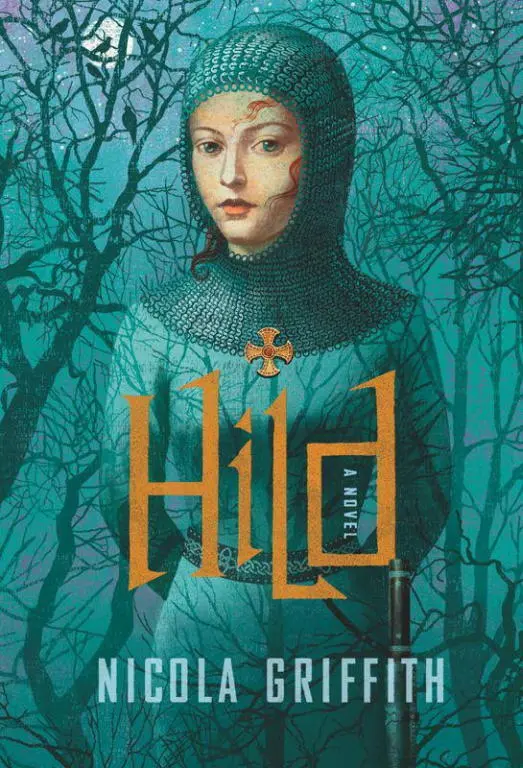
- Название:Hild
- Автор:
- Издательство:Farrar, Straus and Giroux
- Жанр:
- Год:2013
- Город:New York
- ISBN:978-0-374-28087-1
- Рейтинг книги:5 / 5. Голосов: 1
-
Избранное:Добавить в избранное
- Отзывы:
-
Ваша оценка:
Hild: краткое содержание, описание и аннотация
Предлагаем к чтению аннотацию, описание, краткое содержание или предисловие (зависит от того, что написал сам автор книги «Hild»). Если вы не нашли необходимую информацию о книге — напишите в комментариях, мы постараемся отыскать её.
But now she has only the powerful curiosity of a bright child, a will of adamant, and a way of seeing the world—of studying nature, of matching cause with effect, of observing her surroundings closely and predicting what will happen next—that can seem uncanny, even supernatural, to those around her.
Her uncle, Edwin of Northumbria, plots to become overking of the Angles, ruthlessly using every tool at his disposal: blood, bribery, belief. Hild establishes a place for herself at his side as the king’s seer. And she is indispensable—unless she should ever lead the king astray. The stakes are life and death: for Hild, for her family, for her loved ones, and for the increasing numbers who seek the protection of the strange girl who can read the world and see the future.
Hild is a young woman at the heart of the violence, subtlety, and mysticism of the early Middle Ages—all of it brilliantly and accurately evoked by Nicola Griffith’s luminous prose. Working from what little historical record is extant, Griffith has brought a beautiful, brutal world—and one of its most fascinating, pivotal figures, the girl who would become St. Hilda of Whitby—to vivid, absorbing life.
Hild — читать онлайн бесплатно полную книгу (весь текст) целиком
Ниже представлен текст книги, разбитый по страницам. Система сохранения места последней прочитанной страницы, позволяет с удобством читать онлайн бесплатно книгу «Hild», без необходимости каждый раз заново искать на чём Вы остановились. Поставьте закладку, и сможете в любой момент перейти на страницу, на которой закончили чтение.
Интервал:
Закладка:
The king hated Bebbanburg, hated being perched on a hill of rock with its face to the north and flank to the sea. Sea food, he said, was for seals, and high places for wealh and eagles. He liked green rolling hills, gentle valleys, and wide river mouths, good Anglisc dirt under his boots. But no matter how many messengers he sent to ask, the north wall at York was not quite finished nor the west ditch redug, and the end of winter was when starving wolves made desperate forays. Bebbanburg, a fort within a fort on a lump of rock sticking up from a beach, was impregnable. The beach was top-and-tailed by rocks but for a sandy hithe overlooked by a fortified tower on the outer stockade—a massive timber box-parapet. The inner fort had one entrance, tunnelled out of the rock and raised in steps leading to the great gate of the inner stockade. This enclosed the halls, shrine, and well in an area as big as a good-size field. The outer wall protected enough wiry grass for a couple of goats and space enough for workshops and a byre.
Near the end of the month, the king declared they weren’t to call it Bebbanburg anymore. Bebba had been the first wife of Æthelfrith and he would no longer abide reminder of those nithing Idings. They would call it Stānburg, because that was what it was, a fort on stone. Edwin was king; they called it Stānburg. But among themselves the wealh went on calling it Din Guaïroï, as they had since the long ago, and the Anglisc, after a few days, forgot and called it variously Bebbanburg, which infuriated the king—who twice had to be persuaded by his counsellors not to kill a forgetful gesith—or Cwenburg, for Edwin’s dead wife, which irritated the queen.
Hild thought perhaps she and Begu were the only ones who liked the place.
Begu enjoyed the closeness. She didn’t mind the people-upon-kine crowding, she didn’t even mind the food: oysters and mussels, pork—salted pork, pork in goose grease, dried pork—and bread. She liked the gossip all day in the queen’s hall. She loved falling asleep to the sound of the sea.
Hild liked the songs and stories at night: the same songs she’d heard at this time of year every year, but different in hall and in the byre, in the huddled farmstead over the fields and in the overcrowded kitchens where the cook and the baker struggled to feed an overking’s household from a petty king’s fireplaces. During the day, she liked escaping on her own along the snow-dusted beaches and into the unbroken whiteness of the fields. Sometimes she rode Cygnet and sometimes she took Cian, but mostly she walked on her own.
She didn’t remember the first time she had spent Solmonath in the burg, though it had been a time when Edwin was newly king, his household much smaller. But the rhythms were the same: The king paced his small hall like a trapped wildcat, demanding information his counsellors did not have. His counsellors vowed to send out another messenger—to York, to the north, to Lindsey, to Rheged, to Elmet—and to post another lookout on the stockade’s western tower with his eyes fixed on the overland path. They even watched from the seaward tower, though only a fool or a god would attempt a voyage at this time of year.
Osric had returned to Arbeia after Yule, dissatisfied but mollified by Edwin’s declaration that his dear cousin didn’t need to come with the other thegns in spring—he, Edwin, would come to Osric. Breguswith stayed, but Hild had no idea what her mother thought of all this. Though she seemed pensive. Hild watched anxiously for what herbs she might call for, but it was just the usual remedies for this time of year, for pink eye and lung crackle. They were well stocked, and the Crow was always at the king’s side—priests in black robes seemed to skulk everywhere in the thronging shadows of the short days—and Hild had little to do.
The household stewed in its own juice and kegs of mead and winter ale, and gossip and rumour flowed into the gap: The Idings were marching with the Dál Riata—no, the Picts. Cadwallon had allied with Rheged, and the men of the north would stream down the beach in the dead of night. Penda had already taken Lindsey and was even now burning Elmet.
Quarrels, love, hate, alliances, and whispers flared and died and flared again, and every night men fell asleep longing for colewort or nettle leaves or even a pint of cow’s milk—and a time when blue sky promised warm air and not killing frost. Teeth loosened, belts tightened, tempers frayed.
Slate sea on one side, white field on the other, beach scattered with rock to the north and south. At night, Hild listened to the seals moan.
One evening she stood with Cian on the wooden walkway at the highest corner of the stockade and watched the sun setting over the white fields like a winter apple, small and shrunken, staining the snow with its tired juice. The air smelt of iron and brine.
“The weather’s changing,” she said.
“It will never change. It will be like this forever. We will grow old and die and be forgotten, and the foxes will gnaw at our bones.”
He always got like that after spending too much time indoors. “Come with me tomorrow.”
“Where?”
“There’s a farm two leagues west.”
“Two leagues over the snow and two leagues back? With Hel and the frost giants ready to take us if we turn an ankle in a badger hole?”
“The weather will change.”
“It hasn’t changed yet.”
But the next day, just after noon, Hild pointed out puffy little clouds sailing in from the south and west, very white, followed by larger ones, greyer. “The snow is melting inland.”
“But not here,” Cian said.
“Not yet.”
The field, ringed by bare trees, was silent but for the crackle of their breath—no robins, no wrens, no sparrows—and beneath that the faint whisper and rustle of snow melting. The crest of the field showed patches of brown ridge but the low point where they stood was unbroken snow. At their feet lay a dead wood pigeon. What was left of it looked thin.
Hild pointed to the odd, knobby prints on either side. “Peregrine kill. That’s where its talons dug in the snow. There’s where its wings touched when it mantled.”
“A hawk made this mess?”
“Then a fox, then a crow,” she said, pointing. “They’re all hungry.”
Cian pulled his bold cloak more tightly about him, and they walked on. Not far from the farm Hild thought she saw a stoat—blotched, like the field, with brown—but didn’t bother to point it out. She wondered what it could be eating with most of the birds gone, the hedgepigs and squirrels asleep, and peregrines and owls, foxes and crows fighting over the rest.
Their shadows were slanting by the time they reached the farm.
“Look,” he said. Mixed with the brown melt ridges she saw a very faint hint of green: the tips of winter colewort. Hild swallowed and wiped her mouth. Soon. Two weeks or three.
Hild came to the farm most years but this year she was greeted not by the old man but a child, sitting on a greasy fur in the sun by the hut’s low door, half naked, hair matted, jamming a pebble in its tiny-toothed mouth.
“Aurgh!” it said.
A man burst through the door brandishing a hatchet.
“Peace,” Hild said, empty hands out. “Ulf, he’s fine.”
“I’m not Ulf,” said the man, lowering the axe. Indeed, he wasn’t. He was too young. “I’m Rath. Rathlaf. My father has gone on.”
“I’ll miss him,” she said. “And my friend, Cian Boldcloak, will miss him, too. He has heard how strong and clever he was, how canny a husbandman. We’ll drink to his memory.”
Cian—who had never heard of Ulf or his son, Rath—nodded agreement and swept back his cloak to show the two bottles hanging by straps from his shoulder.
Читать дальшеИнтервал:
Закладка:
Похожие книги на «Hild»
Представляем Вашему вниманию похожие книги на «Hild» списком для выбора. Мы отобрали схожую по названию и смыслу литературу в надежде предоставить читателям больше вариантов отыскать новые, интересные, ещё непрочитанные произведения.





Обсуждение, отзывы о книге «Hild» и просто собственные мнения читателей. Оставьте ваши комментарии, напишите, что Вы думаете о произведении, его смысле или главных героях. Укажите что конкретно понравилось, а что нет, и почему Вы так считаете.