Nicola Griffith - Hild
Здесь есть возможность читать онлайн «Nicola Griffith - Hild» весь текст электронной книги совершенно бесплатно (целиком полную версию без сокращений). В некоторых случаях можно слушать аудио, скачать через торрент в формате fb2 и присутствует краткое содержание. Город: New York, Год выпуска: 2013, ISBN: 2013, Издательство: Farrar, Straus and Giroux, Жанр: Историческая проза, на английском языке. Описание произведения, (предисловие) а так же отзывы посетителей доступны на портале библиотеки ЛибКат.
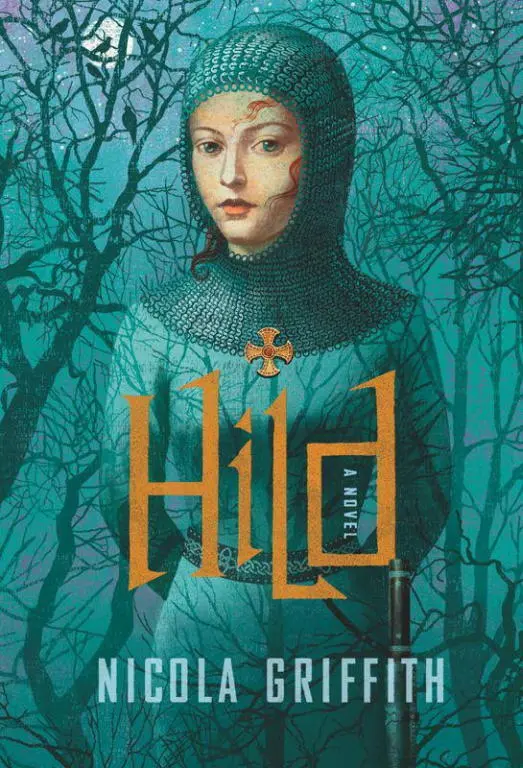
- Название:Hild
- Автор:
- Издательство:Farrar, Straus and Giroux
- Жанр:
- Год:2013
- Город:New York
- ISBN:978-0-374-28087-1
- Рейтинг книги:5 / 5. Голосов: 1
-
Избранное:Добавить в избранное
- Отзывы:
-
Ваша оценка:
Hild: краткое содержание, описание и аннотация
Предлагаем к чтению аннотацию, описание, краткое содержание или предисловие (зависит от того, что написал сам автор книги «Hild»). Если вы не нашли необходимую информацию о книге — напишите в комментариях, мы постараемся отыскать её.
But now she has only the powerful curiosity of a bright child, a will of adamant, and a way of seeing the world—of studying nature, of matching cause with effect, of observing her surroundings closely and predicting what will happen next—that can seem uncanny, even supernatural, to those around her.
Her uncle, Edwin of Northumbria, plots to become overking of the Angles, ruthlessly using every tool at his disposal: blood, bribery, belief. Hild establishes a place for herself at his side as the king’s seer. And she is indispensable—unless she should ever lead the king astray. The stakes are life and death: for Hild, for her family, for her loved ones, and for the increasing numbers who seek the protection of the strange girl who can read the world and see the future.
Hild is a young woman at the heart of the violence, subtlety, and mysticism of the early Middle Ages—all of it brilliantly and accurately evoked by Nicola Griffith’s luminous prose. Working from what little historical record is extant, Griffith has brought a beautiful, brutal world—and one of its most fascinating, pivotal figures, the girl who would become St. Hilda of Whitby—to vivid, absorbing life.
Hild — читать онлайн бесплатно полную книгу (весь текст) целиком
Ниже представлен текст книги, разбитый по страницам. Система сохранения места последней прочитанной страницы, позволяет с удобством читать онлайн бесплатно книгу «Hild», без необходимости каждый раз заново искать на чём Вы остановились. Поставьте закладку, и сможете в любой момент перейти на страницу, на которой закончили чтение.
Интервал:
Закладка:
Hild had walked next to her mother. Breguswith didn’t seem any different, apart from being wet, but she was not inclined to talk—she had always had a fine sense of occasion, and Hild had told her what Fursey had said, that she was supposed to be filled with grace, washed clean, serene; Breguswith was determined to play the part. Hild then walked with Cian. He didn’t talk, either. He hadn’t talked much since his return from fighting the Saxons with what looked like a bite mark along his jaw. “The shield wall is like being thrown into a pit with boars and blood,” he’d said. “A striving of mud, and muscle, and madness.” And he had refused to say more. The bite was healing. Perhaps baptism would wash him clean of the things he had done.
Hild stayed at his side, content to walk in silence and watch a covey of mallards, all drakes, green heads sparkling in the sun as they dove and preened and made their own kind of baptism.
14
EADFRITH THE ELDEST ÆTHELING continued to pursue the Saxons south and west. Osric returned to Arbeia, but Breguswith stayed. Since her baptism, she and the queen had reached some kind of understanding whose shape Hild was still trying to fathom. The queen’s good word spread: Her mother was once again the woman that women went to with their pains and troubles. The baptism had changed the spin pattern of the whole cloth. Edwin paid more attention to Paulinus and less to Hild. It wouldn’t last long—the king would change his mind, it’s what he did—and meanwhile, he was no longer concerned that Hild bring him Fursey. What was one homeless, hunted priest with a wrongly shaved head to him?
Cadfan died and Cadwallon became king of Gwynedd. Edwin brooded, then married Osfrith, his second son, to Clotrude, second daughter of Clothar, king of the Christian Franks. He would draw more Romish weft to his warp. Let Cadwallon eat that.
Osfrith seemed stunned by marriage. Gwladus reported to Hild that, according to Arddun, Osfrith and Clotrude screamed like stuck pigs every night. The gesiths, including the handful of Franks who had accompanied Clotrude, teased the ætheling without mercy. The Franks wore crosses, very like those worn by the newly baptised Anglisc: squat, heavy things, easily mistaken for the hammers the majority of gesiths still wore. Most gesith crosses were bronze. Some silvered copper. Cian’s was gold.
Hild and Cian took to walking along the river at the end of the day when they might go unnoticed. He wore both his sword, with its gold hilt ring from Hild’s uncle the king, and his cross, a gift from his godmother the queen, with the same mix of pride and wariness.
Larks crisscrossed the deepening sky as they walked west along the river’s inside bend, where the flow was sluggish and water bugs dimpled the surface. Hild walked with her skirts kilted up. It was the first hot day of the year, and there was no one to see but Cian.
“I wish we were by the bird cherry at Goodmanham,” she said. “There always seemed to be a breath of wind there.”
“Breath of the tree sprites, you said.”
“You believed me.”
“I did.”
“You believed me, too, about the frog who swallowed the heart of a hægtes.”
“I did not.”
“You did.” The birdsong was fading. Crickets chirred in their place. “Did you ever believe I was a hægtes?” He didn’t say anything and she couldn’t read his face in the gathering twilight. “I don’t mind.”
He stopped, took her arm, a hard grip just below her elbow. “Yes, you do.” His voice was rough as a blacksmith’s file, his eyes a deeper blue than the sky. “We all care, we always care, what they say of us.”
He let go. They walked on. She rubbed her arm.
“You are not a hægtes.”
She walked with her chin up, not understanding why her eyes were suddenly brimming.
“You know the gesiths sing songs about you?”
“I’ve heard them.” She fell behind a moment and surreptitiously blotted her cheek with her shoulder.
“Not all of them.” Now there was a smile in his voice, an encouragement, the kind of tone he’d use to gentle a horse before changing gait. “In their songs you might be a hægtes, but you’re their hægtes. You’re the seer who saved Bebbanburg and revealed a conspiracy of kings. Who falls from trees to kill a dozen Lindseymen with one blow. And offers to gut irritating æthelings who get in your way.”
“They know about that?”
“They know the song. Coelwyn wrote it. He got the story from Lintlaf. There’s a chorus that’s very catchy: I swear I’ll gut you, like a leveret, and fling your parts to feed the royal dogs .”
“A leveret ?”
“Sometimes he sings sucking pig , for the funny version.”
The funny version.
They walked for a while. Soft shadows pooled between the trees. Soon bats would swoop in place of larks. Dusk. The in-between time, when ælfs might watch quietly from behind the hawthorn, and it was easy to talk, even in Anglisc. “The ætheling was called Ælberht.”
Cian simply nodded.
“I meant to kill him. I could have. But he was afraid. He looked in my eyes and was afraid.”
“Men are, when it comes to it.”
“He wasn’t a man. Don’t you see? That’s the point. He was just a boy.” The trees were denser here, growing almost to the edge of the river. He wouldn’t be able to see her face. “But in three years he’ll have a sword and know how to use it, and I won’t. He’ll be no taller than me, no faster, no more royal, but he’ll have a sword and I won’t. And if he angers me and I draw my seax in earnest he’ll just lay his hand on his sword hilt and I’ll have to bend my head.”
“Not if I’m there. Or the brothers Berht. Or Grimhun or—”
“But you’re sworn to the king, not to me.”
The ring on his hilt tinked dully as he fiddled with it.
“Teach me.”
The creak and scritch of tree frogs rose suddenly, and just as suddenly fell. Swords were man magic. It would be his death if he was caught, ringed sword or no. They would nail him to a tree, pull his lungs through his back ribs, and spread them like wings.
Eventually he said, “You don’t know what it’s like. You don’t want to.”
They were clear of the trees. A fan of cloud in the west reflected the last rose-gold light. She touched his arm. “Stop. Please.”
He stopped, turned, faced her, back to the horizon. His face was in shadow. He could be a wight, risen from a barrow, glinting with gold. But she could smell him, she could hear the creak of his belt as he breathed.
“I was at Lindum. I don’t want to be a gesith. I want to know how to beat a man with a sword. Perhaps with an axe.” Women cut wood sometimes. It might be thought odd to walk about with an axe thrust through her girdle, but it was not forbidden. “One on one, sword against axe, could I do it?”
“No.”
“You brought a message from Onnen: to watch my back. Help me. If not an axe, then what?”
After a moment he said, “A club.”
“A club? Against a sword?”
“Swords aren’t magic.”
“That’s not what you used to think.” She remembered his singsong recitations about his imaginary sword: snakesteel blooded in battle, bitter blade, widow-maker, defender of honour and boast, winner of glory. Of course they were magic. Just not for her.
He ignored her. “Show me your wrists.”
She held out her arms.
He circled a wrist with each hand. “Big, for a woman. Now make fists.” He tightened his grip. “Spread your fingers.”
It hurt but she forced her fingers wide.
“Good.” He let go. “You need strong wrists for a club. But they already call you hægtes. How would you explain a club in your belt?”
Читать дальшеИнтервал:
Закладка:
Похожие книги на «Hild»
Представляем Вашему вниманию похожие книги на «Hild» списком для выбора. Мы отобрали схожую по названию и смыслу литературу в надежде предоставить читателям больше вариантов отыскать новые, интересные, ещё непрочитанные произведения.



Обсуждение, отзывы о книге «Hild» и просто собственные мнения читателей. Оставьте ваши комментарии, напишите, что Вы думаете о произведении, его смысле или главных героях. Укажите что конкретно понравилось, а что нет, и почему Вы так считаете.