Nicola Griffith - Hild
Здесь есть возможность читать онлайн «Nicola Griffith - Hild» весь текст электронной книги совершенно бесплатно (целиком полную версию без сокращений). В некоторых случаях можно слушать аудио, скачать через торрент в формате fb2 и присутствует краткое содержание. Город: New York, Год выпуска: 2013, ISBN: 2013, Издательство: Farrar, Straus and Giroux, Жанр: Историческая проза, на английском языке. Описание произведения, (предисловие) а так же отзывы посетителей доступны на портале библиотеки ЛибКат.
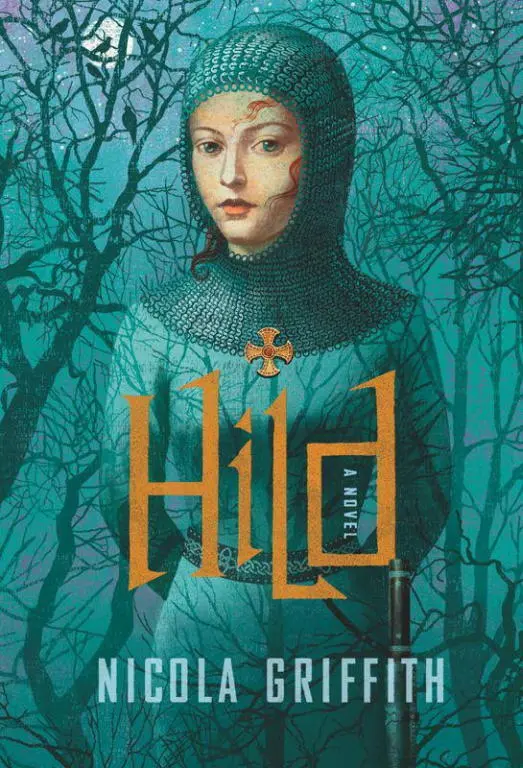
- Название:Hild
- Автор:
- Издательство:Farrar, Straus and Giroux
- Жанр:
- Год:2013
- Город:New York
- ISBN:978-0-374-28087-1
- Рейтинг книги:5 / 5. Голосов: 1
-
Избранное:Добавить в избранное
- Отзывы:
-
Ваша оценка:
Hild: краткое содержание, описание и аннотация
Предлагаем к чтению аннотацию, описание, краткое содержание или предисловие (зависит от того, что написал сам автор книги «Hild»). Если вы не нашли необходимую информацию о книге — напишите в комментариях, мы постараемся отыскать её.
But now she has only the powerful curiosity of a bright child, a will of adamant, and a way of seeing the world—of studying nature, of matching cause with effect, of observing her surroundings closely and predicting what will happen next—that can seem uncanny, even supernatural, to those around her.
Her uncle, Edwin of Northumbria, plots to become overking of the Angles, ruthlessly using every tool at his disposal: blood, bribery, belief. Hild establishes a place for herself at his side as the king’s seer. And she is indispensable—unless she should ever lead the king astray. The stakes are life and death: for Hild, for her family, for her loved ones, and for the increasing numbers who seek the protection of the strange girl who can read the world and see the future.
Hild is a young woman at the heart of the violence, subtlety, and mysticism of the early Middle Ages—all of it brilliantly and accurately evoked by Nicola Griffith’s luminous prose. Working from what little historical record is extant, Griffith has brought a beautiful, brutal world—and one of its most fascinating, pivotal figures, the girl who would become St. Hilda of Whitby—to vivid, absorbing life.
Hild — читать онлайн бесплатно полную книгу (весь текст) целиком
Ниже представлен текст книги, разбитый по страницам. Система сохранения места последней прочитанной страницы, позволяет с удобством читать онлайн бесплатно книгу «Hild», без необходимости каждый раз заново искать на чём Вы остановились. Поставьте закладку, и сможете в любой момент перейти на страницу, на которой закончили чтение.
Интервал:
Закладка:
“Begu misses the sound of gulls,” she said. “She misses her home. I never had one. Do you miss yours?”
Æthelburh stroked her cross. “When Eanflæd fell asleep last night I listened for the sound of the wheat. In the Kentish summer it rattles and hisses in the breeze. Everywhere. Wherever you look, from every vill: golden wheat waving like the sea.”
Hild felt she should offer the queen something, as a comfort. If it were up to her she would climb the ash and watch the badgers, this was just the kind of weather that badgers liked: warm sun to drag out their bedding to air. But she doubted the queen would want to climb a tree and, besides, badgers reminded her of Osric.
“Do you want to go see the rookery?”
“I would be happy to watch the rooks with you.”
Hild led them onto another, barely discernible path and the scent changed from summery open green to something cooler and loamier. Apart from that once with Begu, on the day they became gemæcce, she was the only one who walked this way. After a week with no rain the rivulet ran clear and quiet, and instead of the vivid primroses of spring, its narrow banks bloomed with blue cornflowers and a spill of delicate creamy yellow petals, over which no butterflies flittered. Bitterwort. An antidote for several poisons, and good for fevers and fatigue. Her mother was always looking for it but the root was the best part and it wouldn’t be ready until autumn, when they wouldn’t be here.
After a little while, the small, densely packed ash and elder gave way to a clearing and, beyond that, a stand of tall elms. The ground beneath the rookery was white with bird shit. The kah-kah of young birds, recently fledged but still wanting to be by their parents, echoed through the trees.
They sat quietly on a rock, beyond the patch of shit. The breeze was soft and warm. They watched the birds.
“They look like crows,” Æthelburh said.
“They’re young. They’ll lose those face feathers in autumn and look like rooks. At least, that’s what happens at Goodmanham and York.”
Æthelburh’s face, pale and plump for a week or two after the birth, was beginning to plane down again. Her eyes were half closed.
Hild lost herself for a while in the gossiping to-and-fro of the young birds. The breeze changed slightly, coming now from the south as well as the west. Coming from where Cian was. Perhaps he was fighting. Perhaps he was hurt. Gradually she became aware that Æthelburh, no longer sleepy, was watching her.
“You look like that when you listen to music,” she said. “You watch everything, don’t you? Why?”
“It’s peaceful. I learn things.”
Æthelburh untied her braid and began combing through it with her fingers. “What things?”
“That rooks—dogs, cats, people—do some kinds of things depending on how old they are. Like those young rooks. In autumn they’ll lose their face feathers, and they’ll start playing—flying for the fun of it, only they’re not doing it for the fun of it, they’re proving they’re good enough for the rookery, that they can stay. Like gesiths with their boasting and fighting. And rooks are like jackdaws—like people. They have families. They talk. They don’t like change. There’s an ash spinney a mile away where they like to go pluck the twigs for their nest. Always the same place; one patch is almost bare of twigs. But they’re just twigs, why fly all that way? I don’t know. But that’s what they do.”
Æthelburh untangled a burr from her hair and flicked it away. “And what do dogs and cats do?”
“Dogs own space and cats own time.”
Æthelburh’s hands paused for a moment, then resumed their comb-and-pick.
“The cats share the barn and the byre. All of them. But you’ve seen the big ginger tom with the torn ear?” For a moment she couldn’t remember which vill he belonged to. It didn’t matter. “He gets to sit on the hay bale by the door at middæg. The two grey queens curl up there at æfen. The tom wouldn’t go there in the evening, and the queens wouldn’t go there at middæg. But a dog in hall or the kennel likes his own corner, morning, noon, and night. That’s his corner, no one else’s.”
“And people?”
“Kings travel from place to place like a cat but want to own those places like a dog. It’s why there are wars.”
The queen blinked. “And the queen?”
“The queen…” She was realising she’d just compared Æthelburh’s husband to a dog. “The queen is like a new bird in the colony. She finds new grubs, builds new nests as her price for belonging.” Hild tilted her head back, in the direction of the vill.
“Derventio was Paulinus’s idea. A lot of things are Paulinus’s idea.”
Ah. She waited.
“Like Eanflæd’s baptism. It was agreed as part of the marriage settlement—any girl would be mine to baptise—but the timing… That’s Paulinus.”
Some hint was moving, eellike, just out of Hild’s reach. “Have you had news?”
“No. But it will come. The king, my husband, will be victorious. He’ll return laden with gold and glory to Sancton, where Eanflæd will be baptised as my husband’s tribute to God, the first Yffing.”
It didn’t need a seer to foretell that. An Anglisc overking with a huge war band against a rabble of petty Saxon lords, all calling themselves king. The only question was how long it would take to subdue them, and who Edwin would install as his underking.
“Don’t you see, child, what I’m telling you? When we get to Sancton, Eanflæd will be baptised. She will need powerful sisters and brothers in baptism. I had thought of asking you, but you’re Yffing. Blood kin. My husband will not allow any greater tribute than an infant. You can’t be baptised until he is. And he won’t take baptism yet—though when he does, all must follow. Do you understand what I’m saying? Those who go first will find themselves in positions of favour. It happened in my father’s court.”
“But as you say, I’m blood kin.”
“Your mother is not. Nor your… your gemæcce’s foster-brother. You might mention it to them.”
In the half-light of the byre, Hild smoothed her girdle self-consciously.
“It suits you,” Fursey said. While his voice was as light as ever it sounded a little scratched, a little hollow, and she had not missed the way the bones of his wrist stuck out, the hole in his boot, and the small tear in his skirts. He smelt of dust, not horse. He had walked.
“What happened to your mount? We’re leaving for Sancton tomorrow. You nearly missed us. Why did you run? Why were you away so long?”
“I shouldn’t have come back at all.”
Hild just waited.
Fursey laughed. “Oh, you’ve learnt a vast great deal since Tinamutha. I’ll miss you.”
I’ll miss you. Sometimes if you ignored things they went away. “Eanflæd is to be baptised.”
He raised his eyebrows, which only emphasised how drawn his face seemed. “You’ve heard already? I thought I’d outpaced that news.”
“News?”
“Your king is proceeding in triumph to Sancton with most of the war band, claiming the death of five Saxon kings—if a kingdom is a stony field and a muddy stream. Though sadly Cwichelm and Cynegils are not among the dead. They’re still running, pursued by threescore of the war band under Eadfrith. And, no, I’ve no news of Cian.”
He’d be fine. He would. “How soon will they be in Sancton?”
“Six days from now perhaps. They have wounded.”
Not Cian. Cian would be fine. “The queen said a strange thing.”
“Yes?” He sounded so very tired.
“She said my mother, and Cian, should take baptism.”
“Did she now?”
“She said it would give them power and influence.” Fursey nodded. “But why would she want my mother to have that? I don’t think she likes her.”
Читать дальшеИнтервал:
Закладка:
Похожие книги на «Hild»
Представляем Вашему вниманию похожие книги на «Hild» списком для выбора. Мы отобрали схожую по названию и смыслу литературу в надежде предоставить читателям больше вариантов отыскать новые, интересные, ещё непрочитанные произведения.




Обсуждение, отзывы о книге «Hild» и просто собственные мнения читателей. Оставьте ваши комментарии, напишите, что Вы думаете о произведении, его смысле или главных героях. Укажите что конкретно понравилось, а что нет, и почему Вы так считаете.