Kathryn Davis - Versailles
Здесь есть возможность читать онлайн «Kathryn Davis - Versailles» весь текст электронной книги совершенно бесплатно (целиком полную версию без сокращений). В некоторых случаях можно слушать аудио, скачать через торрент в формате fb2 и присутствует краткое содержание. Год выпуска: 2003, Издательство: Back Bay Books, Жанр: Историческая проза, на английском языке. Описание произведения, (предисловие) а так же отзывы посетителей доступны на портале библиотеки ЛибКат.
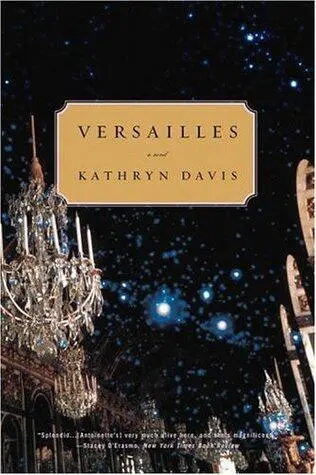
- Название:Versailles
- Автор:
- Издательство:Back Bay Books
- Жанр:
- Год:2003
- ISBN:нет данных
- Рейтинг книги:4 / 5. Голосов: 1
-
Избранное:Добавить в избранное
- Отзывы:
-
Ваша оценка:
Versailles: краткое содержание, описание и аннотация
Предлагаем к чтению аннотацию, описание, краткое содержание или предисловие (зависит от того, что написал сам автор книги «Versailles»). Если вы не нашли необходимую информацию о книге — напишите в комментариях, мы постараемся отыскать её.
Versailles — читать онлайн бесплатно полную книгу (весь текст) целиком
Ниже представлен текст книги, разбитый по страницам. Система сохранения места последней прочитанной страницы, позволяет с удобством читать онлайн бесплатно книгу «Versailles», без необходимости каждый раз заново искать на чём Вы остановились. Поставьте закладку, и сможете в любой момент перейти на страницу, на которой закончили чтение.
Интервал:
Закладка:
Spring rain, Tuesday of Holy Week. My leg hurt. My left leg, which I had injured at Christmas, our first in the Tuileries. "How will Père Noël know where to find us?" my little boy asked, and, really, I had no good answer. My darling Dauphin, my chou d'amour. "Let's hope he doesn't," replied his sister. "He's probably a Jacobin, in that red hat of his." I'd been racing to close the curtains, to block the faces mouthing threats at the window, when I felt my ankle twist.
Now my whole leg throbbed under the weight of the rest of me, which felt dead by comparison with the throbbing leg, and that leg, in turn, grotesquely heavy. Once I'd been light as a feather. And where was the girl with the cherry red lips? Still there, I suppose. Preparing to enter history, like her mother before her.
On the windowpanes? Just water.
On the skin? Just nothing.
No hand stroking back the hair.
But when I dragged myself from my solitary bed and down the long long hallway of the Tuileries — limping past the scaffolding and the pails of gilt and plaster, the smoke-darkened billiard room where Provence was lining up yet one more corner shot and Louis, having polished off yet one more roasted haunch of some poor dead creature, was noisily licking his fingers — and at last came limping into my daughter's room, overwhelmed by the wish to stroke her smooth blond hair back from her smooth white forehead, she swatted my hand away.
Such a cruel system, mothers and daughters. From the fear of being humiliated, deliver me, 0 Lord. Of course the God who made our world chose to put suffering and death at the heart of it. We are weak, like the Disciples, and our love is always disappointing.
For the past year she had been studying the catechism, the Serious One; the next day, Spy Wednesday, she would make her first Communion.
From the fear of being lonely, deliver me, 0 Lord.
From the fear of being forgotten, 0 Lord, deliver me.
Even then my daughter knew that tenderness had never saved anyone's life.
Outside the window the sound of pipes and drums; the sound of spring rain and with it the smell of gunpowder. That was the mood outside the Tuileries, while inside we strove to keep up appearances. The eternal lever. The eternal coucher. The eternal cavagnole. Dance, nobleman, dance, I could hear someone singing. Dance, meaning hang him from the lamppost.
I looked down at my sleeping daughter and imagined her kneeling before the Bishop in her white gown and shoes, her hair safely tucked beneath her white veil. An earnest expression on her face, as usual — her father's own daughter. The altar rail sweet with beeswax, the whisper of pages being turned, the delicate bones of her hands tightly clasped in prayer.
I could imagine that. I could imagine no further.
Grandes Eaux
From the Seine, from the Eure, from the Bièvre, from the Yvette, a vast underground network of pipes, some made of pottery, some of lead, some made of wood or cast iron, mile upon mile of them tunneling through the rich black dirt of the Îie-de-France before suddenly breaking free as aqueducts, their troughs filled with sparkling river water destined for Versailles. The rivers keep flowing no matter what the people living around them are up to. They keep idling the arched vaults of d'Orbay's immense reservoirs even after they're no longer needed, the people who relied on them for baths or fountain displays having run away the previous fall, taking refuge here and there throughout the countryside like mice.
It was Louis XIV who set the whole system in motion, sick as he was of the disgusting quality of the water he inherited from his predecessor, so green, so thick, so bad-smelling. "Never," wrote Madame de Sevigne in a letter to her daughter, "have I heard anything more agreeable than what you told me about this great beauty soon to appear at Versailles, fresh, pure, and unaffected, who will put all others to shame."
Later she'd be surprised to find out it wasn't a young woman her daughter had referred to but a river diverted from its course by an army of forty thousand men. So long as the Sun King strode the face of the earth, his dark curls gleaming with health, his virility bursting from every pore, it was possible to believe that, when summoned to him, even the water would arrive girlishly sub — missive and eager to jump into his bed.
Now it's June. The Swan drifts across the surface of the night sky, trailed by the Shepherd's Star. Time to pick the new greens, garden cress and chervil, lamb's lettuce, rocket, and sorrel. Also time to replant. Leeks, scallions. Turnips, cabbages, endive.
Meanwhile the rivers continue filling all the reservoirs of Versailles: d'Orbay's immense churchlike cisterns under the Water Terrace, three shallow rectangular basins along the Rue des Reservoirs, a water tower slyly hiding behind a trompe I'oeil facade on the Rue du Pein-tre-Le-Brun, a deep cylindrical holding tank on Mont-bauron Hill. The rivers fill the reservoirs and then spill from them into Versailles's many pools and lakes and canals. The Mirror Pool, the Pool of the Swiss Guards, the Nymphs' Bath, and the Grand Canal, as well as the basins of all the fountains, Latona and Saturn, Apollo, Flora, Bacchus, and Neptune. The fountains themselves aren't running, since no one's there to turn them on. Even if someone were, it would be a terrible waste — the usual display requiring over 220 gallons of water per second! — since also no one's there to watch.
The rivers feed the reservoirs that feed the millpond in the Queen's little village. Last fall's yellow leaves never got scooped away and now they're black and scummy, adhering to the banks or floating on the glaucous surface of the pond. The silver milk ladle is lying near the stone bench right where the Queen dropped it, its handle snapped in two. The orange Chinese goldfish are dead.
Before he made his getaway last October, Monsieur de La Tour du Pin saw to it that all the buildings were boarded up tight, with massive iron locks clamped on the gates, and guards standing sentry. A place under siege, Versailles, yet even so the sky is clear and blue, not a single cloud in sight. An abandoned place, sorrowful, yet things are coming back. Mignonette and starflower, anemone and rue. The water lilies are in bloom, the doves cooing and guarding their nests in the roof thatch. The farmer and his wife are still living in their little cottage on the far side of the wheat field, tending all the animals the Queen left behind — including the babies she'll never get a chance to feed, all those lambs and bunnies and chicks — and milking Blanchette and Brunette twice a day, though no longer into porcelain basins, but into tin pails.
Mirabeau
Early morning, July 3, 1790. A carriage has drawn up to the back gate of the royal estate at Saint-Cloud, where the King and Queen have been allowed to spend their summer months, provided they return to Paris every week for Sunday dinner. As the curtain rises a cloaked figure emerges from the carriage: Gabriel-Honoré Riqueti, the Comte de Mirabeau, a tall man with a body like a wrung sock and a big head sprouting dark bolts of hair he wears stuffed into a taffeta bag. Mirabeau has described himself as "the mad dog from whose bites despotism and privilege will die," but he's also a man who enjoys the finer things in life, specifically wine, women, and song, and happens to be, at the moment, heavily in debt. Today he has an appointment with the Queen, with whom he hopes to strike a deal: if she will agree to settle with his creditors and give him a sizable pension, he will give her and the King the full benefit of his persuasive powers in the Assembly, where he is currently leader of the dominant party, the Patriots.
Читать дальшеИнтервал:
Закладка:
Похожие книги на «Versailles»
Представляем Вашему вниманию похожие книги на «Versailles» списком для выбора. Мы отобрали схожую по названию и смыслу литературу в надежде предоставить читателям больше вариантов отыскать новые, интересные, ещё непрочитанные произведения.











Обсуждение, отзывы о книге «Versailles» и просто собственные мнения читателей. Оставьте ваши комментарии, напишите, что Вы думаете о произведении, его смысле или главных героях. Укажите что конкретно понравилось, а что нет, и почему Вы так считаете.