Kathryn Davis - Versailles
Здесь есть возможность читать онлайн «Kathryn Davis - Versailles» весь текст электронной книги совершенно бесплатно (целиком полную версию без сокращений). В некоторых случаях можно слушать аудио, скачать через торрент в формате fb2 и присутствует краткое содержание. Год выпуска: 2003, Издательство: Back Bay Books, Жанр: Историческая проза, на английском языке. Описание произведения, (предисловие) а так же отзывы посетителей доступны на портале библиотеки ЛибКат.
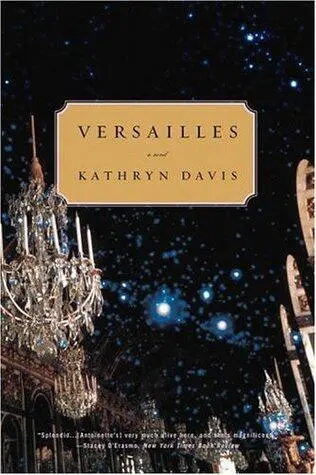
- Название:Versailles
- Автор:
- Издательство:Back Bay Books
- Жанр:
- Год:2003
- ISBN:нет данных
- Рейтинг книги:4 / 5. Голосов: 1
-
Избранное:Добавить в избранное
- Отзывы:
-
Ваша оценка:
Versailles: краткое содержание, описание и аннотация
Предлагаем к чтению аннотацию, описание, краткое содержание или предисловие (зависит от того, что написал сам автор книги «Versailles»). Если вы не нашли необходимую информацию о книге — напишите в комментариях, мы постараемся отыскать её.
Versailles — читать онлайн бесплатно полную книгу (весь текст) целиком
Ниже представлен текст книги, разбитый по страницам. Система сохранения места последней прочитанной страницы, позволяет с удобством читать онлайн бесплатно книгу «Versailles», без необходимости каждый раз заново искать на чём Вы остановились. Поставьте закладку, и сможете в любой момент перейти на страницу, на которой закончили чтение.
Интервал:
Закладка:
Quiet now, but soon enough an angry group will break into the Cour des Princes and swarm through the palace, smashing down doors with axes, looking for the Queen. Through the Salons of Hercules, Abundance, Diana, Mercury, and Apollo, down the long Hall of Mirrors and through the Salon of Peace, past the snoring body of Lafayette — henceforth to be known as General Morpheus — collapsed on a couch, and into the Queen's apartments. Soon enough they'll hack off the heads of two of her guardsmen and stick them on pikes, before stabbing through the Queen's bedclothes and into her mattress, stabbing again and again and again, though she won't be there, having fled earlier to the Bull's Eye Chamber, where she'll be cowering, stockingless and in her petticoats, waiting for dawn with her sleepy optimistic husband and her two darling children and her lumpish brother-in-law Provence and his mean-spirited wife and her two ancient aunts-in-law Adélaïde and Victoire and the brand-new governess and all the ministers and servants who won't have gotten away yet and, yes, even her lover. Even Axel Fersen.
It's too late; there's nothing anyone can do. They're going to get hauled back to Paris.
Yet why should it be sad, the end of privilege?
Why should it be sad that Marie Antoinette never sees the Trianon again, except for the fact that it's always sad when anything ends forever.
Sad to think that a beloved place should forever be denied us, water dripping into a millpond, a cow's soft brown nostrils. The smell of grass on her breath, of rain on moss. Her moist brown eyes.
Laclos, for instance — what made him tell the women of Paris that their Queen was sitting on a mountain of bread, unless he wanted them to be "in the picture," spoiling it?
Where would you hide a leaf? In a forest.
Where would you hide a pebble? On a beach.
Where would you hide a Queen? In a palace.
Where would you hide a peasant? In a mob.
As if it were a mystery, and there were a way to solve it. As if it were possible to figure out who slipped up, and where.
The Baker and His Wife
October 31, 1789. A bakehouse in Paris, near the Halle aux Bleds, its door chalked with an X. It's early morning, the sun just appearing over the lopsided chimney pots of the Marais; a beautiful bright autumn day is dawning. Gradually a small crowd assembles in front of the bakehouse door.
CROWD:
The hunger-swollen belly, restore, restore.
The hunger faintness, restore, restore.
The hunger drooping, restore, restore.
The utter famine, restore, restore.
They begin pounding on the door, politely at first, and then with increasing fury.
After several moments the door opens and the baker's wife peers out. She's a middle-aged woman of medium build, whose clothes and hair and face and arms are so completely covered in flour it's impossible to tell what she really looks like.
BAKER'S WIFE: Can I help you?
SKINNY YOUNG MAN, mimicking her: Can I help you? What kind of question is that?
BAKER'S WIFE: You'll have to excuse me, sir. We've been up all night baking.
BAKER, offstage: Tell them to come back in an hour. Tell them there'll be bread enough for everyone in an hour.
BAKER'S WIFE: An hour. You heard him.
SKINNY YOUNG MAN: I can hardly wait.
The baker's wife closes the door; immediately the crowd once again begins to pound on it.
PRETTY YOUNG WOMAN: Those eyes, that lip. Am I crazy, or does she remind anyone else of a certain royal someone…?
CROWD: Open up! Open up!
SKINNY YOUNG MAN: Yes! Open up now or I'll huff and I'll puff and I'll blow your house down!
FAT MAN: They think they can hide from us. They think they're so smart. He picks up a stone and throws it at the window.
GRAY-HAIRED WOMAN: Who do they think they are?
The door is flung open, this time by the baker himself. He's a middle-aged man, tall and heavyset, his flour-dusted features even more difficult to make out than his wife's.
BAKER: Didn't you hear? An hour. First the wheat was late to the mill, and then there was no salt.
SKINNY YOUNG MAN: Of course. And the moon is made of cheese. We know you've got bread in there.
The fat man grabs the baker around, the neck and hauls him out the door.
FAT MAN, menacingly, in the baker's ear: Do you love me?
CROWD: Feed my sheep.
FAT MAN: Do you love me?
CROWD: Feed my sheep.
FAT MAN: Do you love me?
SKINNY YOUNG MAN: They say the third time's the charm. He yanks the baker's head back by the hair, then shoves him to his knees.
CROWD: Feed my sheep.
The crowd quickly closes in, making it difficult to see what happens next. There's a raised arm, a scream, a flash of light as the sun glints off the blade of a large kitchen knife. A pool of blood begins to spread at their feet, spreading wider and wider; the gray-haired woman turns to address the audience.
GRAY-HAIRED WOMAN: The roots of the wheat plant are thin and form letters, as anyone can see who digs them carefully enough. The letters run on and on in the dirt before breaking and crumbling away; you can never get them all out. But you have to get them all, you have to find all their branchings for the letters to spell a word, the word of happiness.
PRETTY YOUNG WOMAN: Who's going to find that word now, the way the world is going?
CROWD:
Round the earth oven, restore, restore.
Round the hearthstones, restore, restore.
Round the foundation beams, restore, restore.
Round where the road starts.
The skinny young man suddenly raises a pike on which he's impaled the baker's head high above the crowd. Blood continues to pour in a steady stream from the baker's severed neck; the crowd breaks into loud cheers.
BBAKER'S WIFE, peering through the broken window: Oh my God! Oh no! My darling! She puts her face in her hands and sobs. He was only trying to do his job.
SKINNY YOUNG MAN, lowering the pike and positioning it so the baker and his wife are face to face, mocking: My darling! My darling!
BAKER'S WIFE, angry: He was only trying to give you what you wanted.
FAT MAN: He should have thought of that when he told us to come back in an hour.
PRETTY YOUNG WOMAN: He should have thought of that when he was born.
Holy Week, and fingers tapping lightly at my window. Mama? Gome in, come in, but it was only the rain, pattering on the new leaves of the chestnut trees and lilacs, soaking into the lawn. Filling the hole my little boy dug just that afternoon with his toy spade, attended by six bored grenadiers of the National Guard. A cool afternoon, storm clouds assembling in the west. Storm clouds darkening the far-off sky above Versailles, turning the surface of the Grand Canal to melted lead, and sending all the birds our way.
They love to dig, boys. Left to their own devices they'll dig forever and their cheeks will grow pink with exertion, their eyes like the eyes of the blind, fixed on invisible objects. Until they hit an impossibly big rock, that is, or their governess sails forth to fetch them home.
We'd been in the Tuileries for almost half a year. A monument to squalor and decay, the Tuileries. A prison disguised as a palace. Every mattress damp and swarming with silverfish, though at least by spring we had actual mattresses to sleep on instead of piles of clothes and billiard tables.
"Kings ought to proceed in their career undisturbed by the cries of the people, as the Moon pursues her course unimpeded by the howling of dogs," wrote Catherine the Great in a letter. "When Kings become prisoners," I wrote her back, "they haven't long to live." I had to write all my letters in cipher, and hide them in a chocolate box.
Читать дальшеИнтервал:
Закладка:
Похожие книги на «Versailles»
Представляем Вашему вниманию похожие книги на «Versailles» списком для выбора. Мы отобрали схожую по названию и смыслу литературу в надежде предоставить читателям больше вариантов отыскать новые, интересные, ещё непрочитанные произведения.











Обсуждение, отзывы о книге «Versailles» и просто собственные мнения читателей. Оставьте ваши комментарии, напишите, что Вы думаете о произведении, его смысле или главных героях. Укажите что конкретно понравилось, а что нет, и почему Вы так считаете.