Peter Straub - Koko
Здесь есть возможность читать онлайн «Peter Straub - Koko» — ознакомительный отрывок электронной книги совершенно бесплатно, а после прочтения отрывка купить полную версию. В некоторых случаях можно слушать аудио, скачать через торрент в формате fb2 и присутствует краткое содержание. Жанр: unrecognised, на английском языке. Описание произведения, (предисловие) а так же отзывы посетителей доступны на портале библиотеки ЛибКат.
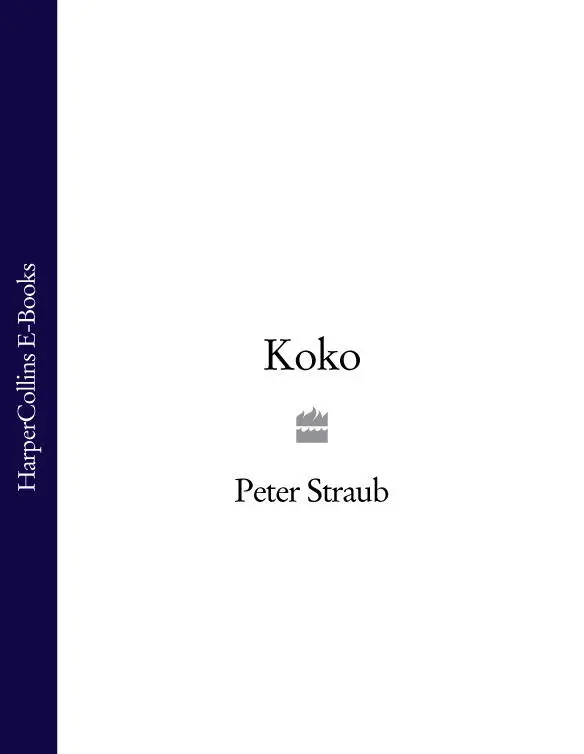
- Название:Koko
- Автор:
- Жанр:
- Год:неизвестен
- ISBN:нет данных
- Рейтинг книги:4 / 5. Голосов: 1
-
Избранное:Добавить в избранное
- Отзывы:
-
Ваша оценка:
Koko: краткое содержание, описание и аннотация
Предлагаем к чтению аннотацию, описание, краткое содержание или предисловие (зависит от того, что написал сам автор книги «Koko»). Если вы не нашли необходимую информацию о книге — напишите в комментариях, мы постараемся отыскать её.
Koko — читать онлайн ознакомительный отрывок
Ниже представлен текст книги, разбитый по страницам. Система сохранения места последней прочитанной страницы, позволяет с удобством читать онлайн бесплатно книгу «Koko», без необходимости каждый раз заново искать на чём Вы остановились. Поставьте закладку, и сможете в любой момент перейти на страницу, на которой закончили чтение.
Интервал:
Закладка:
What did he look like?
He looked like a dancing shadow. He looked like death.
Did he appear to you in a dream?
He appeared, if that is the word, on the street. Death appeared on the street, as the girl appeared on the street. Tremendous clamor accompanied the appearance of the girl, ordinary street noise, that earthly clamor, surrounded the shadow. He was covered, though not visibly, with the blood of others. The girl, who was visible only to me, was covered with her own. The Pan-feeling poured from both of them.
What feeling is that?
The feeling that we have only the shakiest hold on the central stories of our lives. Hal Esterhaz in The Divided Man. The girl comes to speak to me with her terror, with her extremity, she runs toward me out of chaos and night, she has chosen me. Because I chose Hal Esterhaz, and because I chose Nat Beasley. Not yet, she says, not yet. The story is not yet over.
Why did Hal Esterhaz kill himself?
Because he could no longer bear what he was only just beginning to know.
Is that where imagination takes you?
If it’s good enough.
Were you terrified when you saw the girl?
I blessed her.
13 Koko
As soon as the plane took off, Koko too would be a man in motion.
This is one thing Koko knew: all travel is travel in eternity. Thirty thousand feet above the earth, clocks run backward, darkness and light change places freely.
When it got dark, Koko thought, you could lean close to the little window, and if you were ready, if your soul was half in eternity already, you could see God’s tusked grey face leaning toward you in the blackness.
Koko smiled, and the pretty stewardess in first class smiled back at him. She leaned forward, bearing a tray. ‘Sir, would you prefer orange juice or champagne this morning?’
Koko shook his head.
The earth sucked at the feet of the plane, reached up through the body of the plane and tried to pull Koko down into itself, suck suck, the poor earth loved what was eternal and the eternal loved and pitied the earth.
‘Is there a movie on this flight?’
‘Never Say Never Again ,’ the stewardess said over her shoulder. ‘The new James Bond movie.’
‘Excellent,’ Koko said, with real inward hilarity. ‘I never say never, myself.’
She laughed dutifully and went on her way.
Other passengers filed down the aisles, carrying suitbags, shopping bags, wicker baskets, books. Two Chinese businessmen took the seats before Koko, who heard them snap open their briefcases as soon as they sat down.
A middle-aged blonde stewardess in a blue coat leaned down and smiled a false machine smile at him.
‘What shall we call you today, hmm?’ She raised a clipboard with a seating chart into his field of vision. Koko slowly lowered his newspaper. ‘You are…?’ She looked at him, waiting for a reply.
What shall we call you today, hmm? Dachau , let’s call you Lady Dachau. ‘Why don’t you call me Bobby?’
‘Well then, call you Bobby is what I’ll do,’ the woman said, and scrawled Bobby in the space marked 4B on the chart.
In his pockets, Roberto Ortiz had carried his passports and a pocketful of cards and ID, as well as six hundred dollars American and three hundred Singapore. Big time! In a pocket of his blazer Koko had found a room key from the Shangri-La, where else would an ambitious young American be staying?
In Miss Balandran’s bag Koko had found a hot comb, a diaphragm, a tube of spermicidal jelly, a little plastic holder containing a tube of Darkie toothpaste and a toothbrush, a fresh pair of underpants and a new pair of tights, a bottle of lip gloss and a lip brush, a vial of mascara, a blush brush, a rat-tailed comb, three inches of a cut-down white plastic straw, a little leather kit ranked with amyl nitrate poppers, a tattered Barbara Cartland paperback, a compact, half a dozen loose Valium, lots of crumpled-up Kleenex, several sets of keys, and a big roll of bills that turned out to be four hundred and fifty-three Singapore dollars.
Koko put the money in his pocket and dropped the rest onto the bathroom floor.
After he had washed his hands and face he took a cab to the Shangri-La.
Roberto Ortiz lived on West End Avenue in New York City.
On West End Avenue, could you feel how the lords of the earth, how God himself, hungered for mortality? Angels flew down West End Avenue, their raincoats billowing in the wind.
When Koko walked out of the Shangri-La he was wearing two pairs of trousers, two shirts, a cotton sweater, and a tweed jacket. In the carry-on bag in his left hand were two rolled-up suits, three more shirts, and a pair of excellent black shoes.
A cab took Koko down leafy Grove Road to Orchard Road and on through clean, orderly Singapore to an empty building on a circular street off Bahru Road, and on this journey he imagined that he stood in an open car going down Fifth Avenue. Ticker tape and confetti rained down upon him and all the other lords of the earth, cheers exploded from the crowds packing the sidewalks.
Beevers and Poole and Pumo and Underhill and Tattoo Tiano and Peters and sweet Spanky B, and everybody else, all the lords of the earth, who may abide the day of their coming? For behold, darkness shall cover the earth. And the lawyer boy, Ted Bundy, and Juan Corona who labored in fields, and he who dressed in Chicago as a clown, John Wayne Gacy, and Son of Sam, and Wayne Williams out of Atlanta, and the Zebra Killer, and they who left their victims on hillsides, and the little guy in the movie Ten Rillington Place , and Lucas, who was probably the greatest of them all. The warriors of heaven, having their day. Marching along with all those never to be caught, all those showing presentable faces to the world, living modestly, moving from town to town, paying their bills, all these deep embodied secrets.
The refiner’s fire.
Koko crawled in through his basement window and saw his father seated impatient and stormy on a packing crate. Goddamned idiot , his father said. You took too much, think they’ll ever give someone like you a parade? We waste no part of the animal.
He spread the money out on the gritty floor, and that did it, the old man smiled and said, There is no substitute for good butter , and Koko closed his eyes and saw a row of elephants trudging past, nodding with grave approval.
On his unrolled sleeping bag he placed Roberto Ortiz’s passports and spread out the five Rearing Elephant cards so he could read the names. Then he rooted in a box of papers and found the copy of the American magazine, New York , which he had picked up in a hotel lobby two days after the hostage parade. Beneath the title, letters of fire spelled out: TEN HOT NEW PLACES.
Ia Thuc, Hue, Da Nang, these were hot places. And Saigon. Here is a hot new place, here is Saigon. The magazine fell open automatically to the picture and the paragraphs about the hot new place. (The Mayor ate there.)
Koko lay sprawled on the floor in his new suit and looked as deeply as he could into the picture of the hot new place. Deep green fronds waved across the white walls. Vietnamese waiters in white shirts whipped between crowded tables, going so fast they were only blurs of light. Koko could hear loud voices, knives and forks clanking against china. Corks popped. In the picture’s foreground, Tina Pumo leaned against his bar and grimaced – Pumo the Puma leaned right out of the frame of the picture and spoke to Koko in a voice that stood out against the clamor of his restaurant the way a saxophone solo stands out against the sound of a big band.
Pumo said: ‘Don’t judge me, Koko.’ Pumo looked shitscared.
This was how they talked when they knew they stood before eternity’s door.
Читать дальшеИнтервал:
Закладка:
Похожие книги на «Koko»
Представляем Вашему вниманию похожие книги на «Koko» списком для выбора. Мы отобрали схожую по названию и смыслу литературу в надежде предоставить читателям больше вариантов отыскать новые, интересные, ещё непрочитанные произведения.






Обсуждение, отзывы о книге «Koko» и просто собственные мнения читателей. Оставьте ваши комментарии, напишите, что Вы думаете о произведении, его смысле или главных героях. Укажите что конкретно понравилось, а что нет, и почему Вы так считаете.