C. Lewis - Miracles
Здесь есть возможность читать онлайн «C. Lewis - Miracles» — ознакомительный отрывок электронной книги совершенно бесплатно, а после прочтения отрывка купить полную версию. В некоторых случаях можно слушать аудио, скачать через торрент в формате fb2 и присутствует краткое содержание. Жанр: unrecognised, на английском языке. Описание произведения, (предисловие) а так же отзывы посетителей доступны на портале библиотеки ЛибКат.
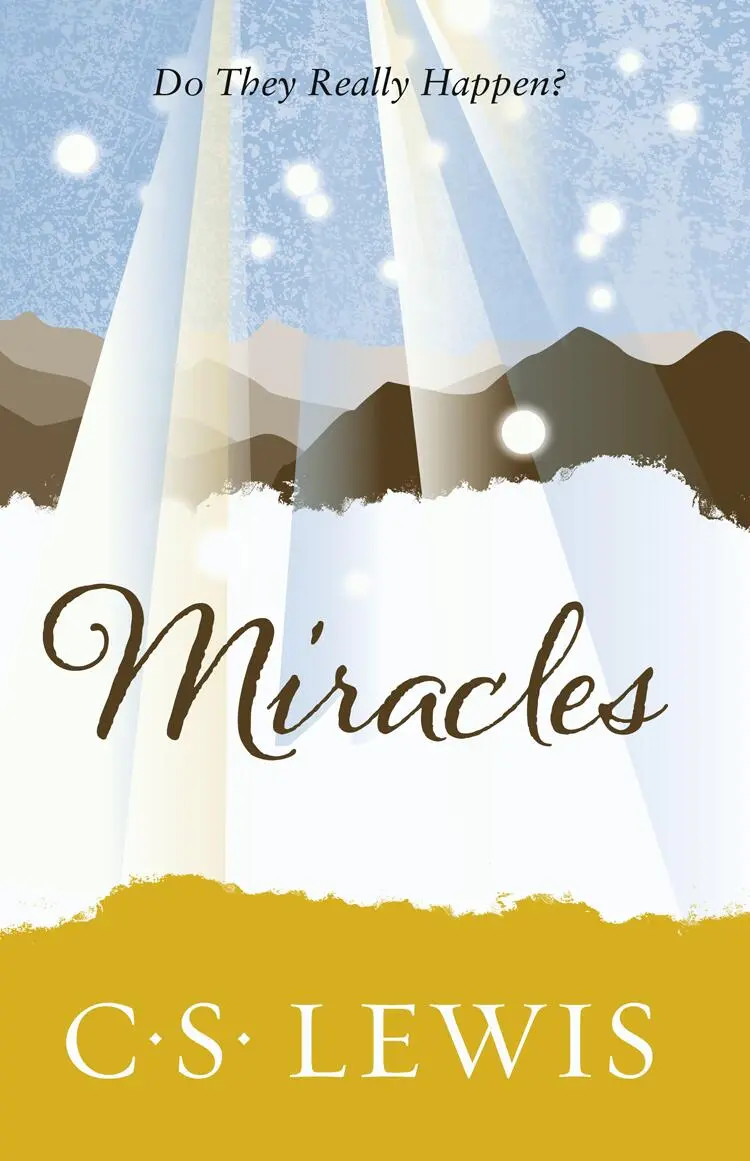
- Название:Miracles
- Автор:
- Жанр:
- Год:неизвестен
- ISBN:нет данных
- Рейтинг книги:5 / 5. Голосов: 1
-
Избранное:Добавить в избранное
- Отзывы:
-
Ваша оценка:
Miracles: краткое содержание, описание и аннотация
Предлагаем к чтению аннотацию, описание, краткое содержание или предисловие (зависит от того, что написал сам автор книги «Miracles»). Если вы не нашли необходимую информацию о книге — напишите в комментариях, мы постараемся отыскать её.
Miracles — читать онлайн ознакомительный отрывок
Ниже представлен текст книги, разбитый по страницам. Система сохранения места последней прочитанной страницы, позволяет с удобством читать онлайн бесплатно книгу «Miracles», без необходимости каждый раз заново искать на чём Вы остановились. Поставьте закладку, и сможете в любой момент перейти на страницу, на которой закончили чтение.
Интервал:
Закладка:
A still humbler position remains. You may, if you like, give up all claim to truth. You may say simply ‘Our way of thinking is useful’—without adding, even under your breath, ‘and therefore true’. It enables us to set a bone and build a bridge and make a Sputnik. And that is good enough. The old, high pretensions of reason must be given up. It is a behaviour evolved entirely as an aid to practice. That is why, when we use it simply for practice, we get along pretty well; but when we fly off into speculation and try to get general views of ‘reality’ we end in the endless, useless, and probably merely verbal, disputes of the philosopher. We will be humbler in future. Goodbye to all that. No more theology, no more ontology, no more metaphysics …
But then, equally, no more Naturalism. For of course Naturalism is a prime specimen of that towering speculation, discovered from practice and going far beyond experience, which is now being condemned. Nature is not an object that can be presented either to the senses or the imagination. It can be reached only by the most remote inferences. Or not reached, merely approached. It is the hoped for, the assumed, unification in a single interlocked system of all the things inferred from our scientific experiments. More than that, the Naturalist, not content to assert this, goes on to the sweeping negative assertion. ‘There is nothing except this’—an assertion surely, as remote from practice, experience, and any conceivable verification as has ever been made since men began to use their reason speculatively. Yet on the present view, the very first step into such a use was an abuse, the perversion of a faculty merely practical, and the source of all chimeras.
On these terms the Theist’s position must be a chimera nearly as outrageous as the Naturalist’s. (Nearly, not quite; it abstains from the crowning audacity of a huge negative). But the Theist need not, and does not, grant these terms. He is not committed to the view that reason is a comparatively recent development moulded by a process of selection which can select only the biologically useful. For him, reason—the reason of God—is older than Nature, and from it the orderliness of Nature, which alone enables us to know her, is derived. For him, the human mind in the act of knowing is illuminated by the Divine reason. It is set free, in the measure required, from the huge nexus of non-rational causation; free from this to be determined by the truth known. And the preliminary processes within Nature which led up to this liberation, if there were any, were designed to do so.
To call the act of knowing—the act, not of remembering that something was so in the past, but of ‘seeing’ that it must be so always and in any possible world—to call this act ‘supernatural’, is some violence to our ordinary linguistic usage. But of course we do not mean by this that it is spooky, or sensational, or even (in any religious sense) ‘spiritual’. We mean only that it ‘won’t fit in’; that such an act, to be what it claims to be—and if it is not, all our thinking is discredited—cannot be merely the exhibition at a particular place and time of that total, and largely mindless, system of events called ‘Nature’. It must break sufficiently free from that universal chain in order to be determined by what it knows.
It is of some importance here to make sure that, if vaguely spatial imagery intrudes (and in many minds it certainly will), it should not be of the wrong kind. We had better not envisage our acts of reason as something ‘above’ or ‘behind’ or ‘beyond’ Nature. Rather ‘this side of Nature’—if you must picture spatially, picture them between us and her. It is by inferences that we build up the idea of Nature at all. Reason is given before Nature and on reason our concept of Nature depends. Our acts of inference are prior to our picture of Nature almost as the telephone is prior to the friend’s voice we hear by it. When we try to fit these acts into the picture of Nature we fail. The item which we put into that picture and label ‘Reason’ always turns out to be somehow different from the reason we ourselves are enjoying and exercising while we put it in. The description we have to give of thought as an evolutionary phenomenon always makes a tacit exception in favour of the thinking which we ourselves perform at that moment. For the one can only, like any other particular feat, exhibit, at particular moments in particular consciousnesses, the general and for the most part non-rational working of the whole interlocked system. The other, our present act, claims and must claim, to be an act of insight, a knowledge sufficiently free from non-rational causation to be determined (positively) only by the truth it knows. But the imagined thinking which we put into the picture depends—because our whole idea of Nature depends—on the thinking we are actually doing, not vice versa. This is the prime reality, on which the attribution of reality to anything else rests. If it won’t fit into Nature, we can’t help it. We will certainly not, on that account, give it up. If we do, we should be giving up Nature too.
4 4 Nature and Supernature 5 A Further Difficulty in Naturalism 6 Answers to Misgivings 7 A Chapter of Red Herrings 8 Miracles and the Laws of Nature 9 A Chapter not Strictly Necessary 10 ‘Horrid Red Things’ 11 Christianity and ‘Religion’ 12 The Propriety of Miracles 13 On Probability 14 The Grand Miracle 15 Miracles of the Old Creation 16 Miracles of the New Creation 17 Epilogue Appendix A: On the Words ‘spirit’ and ‘spiritual’ Appendix B: On ‘special Providences’ About the Author Other Books by C. S. Lewis About the Publisher Конец ознакомительного фрагмента. Текст предоставлен ООО «ЛитРес». Прочитайте эту книгу целиком, купив полную легальную версию на ЛитРес. Безопасно оплатить книгу можно банковской картой Visa, MasterCard, Maestro, со счета мобильного телефона, с платежного терминала, в салоне МТС или Связной, через PayPal, WebMoney, Яндекс.Деньги, QIWI Кошелек, бонусными картами или другим удобным Вам способом.
NATURE AND SUPERNATURE 4 Nature and Supernature 5 A Further Difficulty in Naturalism 6 Answers to Misgivings 7 A Chapter of Red Herrings 8 Miracles and the Laws of Nature 9 A Chapter not Strictly Necessary 10 ‘Horrid Red Things’ 11 Christianity and ‘Religion’ 12 The Propriety of Miracles 13 On Probability 14 The Grand Miracle 15 Miracles of the Old Creation 16 Miracles of the New Creation 17 Epilogue Appendix A: On the Words ‘spirit’ and ‘spiritual’ Appendix B: On ‘special Providences’ About the Author Other Books by C. S. Lewis About the Publisher Конец ознакомительного фрагмента. Текст предоставлен ООО «ЛитРес». Прочитайте эту книгу целиком, купив полную легальную версию на ЛитРес. Безопасно оплатить книгу можно банковской картой Visa, MasterCard, Maestro, со счета мобильного телефона, с платежного терминала, в салоне МТС или Связной, через PayPal, WebMoney, Яндекс.Деньги, QIWI Кошелек, бонусными картами или другим удобным Вам способом.
Throughout the long tradition of European thought it has been said, not by everyone but by most people, or at any rate by most of those who have proved that they have a right to be heard, that Nature, though it is a thing that really exists, is not a thing that exists in itself or in its own right, but a thing which depends for its existence upon something else.
Читать дальшеИнтервал:
Закладка:
Похожие книги на «Miracles»
Представляем Вашему вниманию похожие книги на «Miracles» списком для выбора. Мы отобрали схожую по названию и смыслу литературу в надежде предоставить читателям больше вариантов отыскать новые, интересные, ещё непрочитанные произведения.







Обсуждение, отзывы о книге «Miracles» и просто собственные мнения читателей. Оставьте ваши комментарии, напишите, что Вы думаете о произведении, его смысле или главных героях. Укажите что конкретно понравилось, а что нет, и почему Вы так считаете.