C. Lewis - Miracles
Здесь есть возможность читать онлайн «C. Lewis - Miracles» — ознакомительный отрывок электронной книги совершенно бесплатно, а после прочтения отрывка купить полную версию. В некоторых случаях можно слушать аудио, скачать через торрент в формате fb2 и присутствует краткое содержание. Жанр: unrecognised, на английском языке. Описание произведения, (предисловие) а так же отзывы посетителей доступны на портале библиотеки ЛибКат.
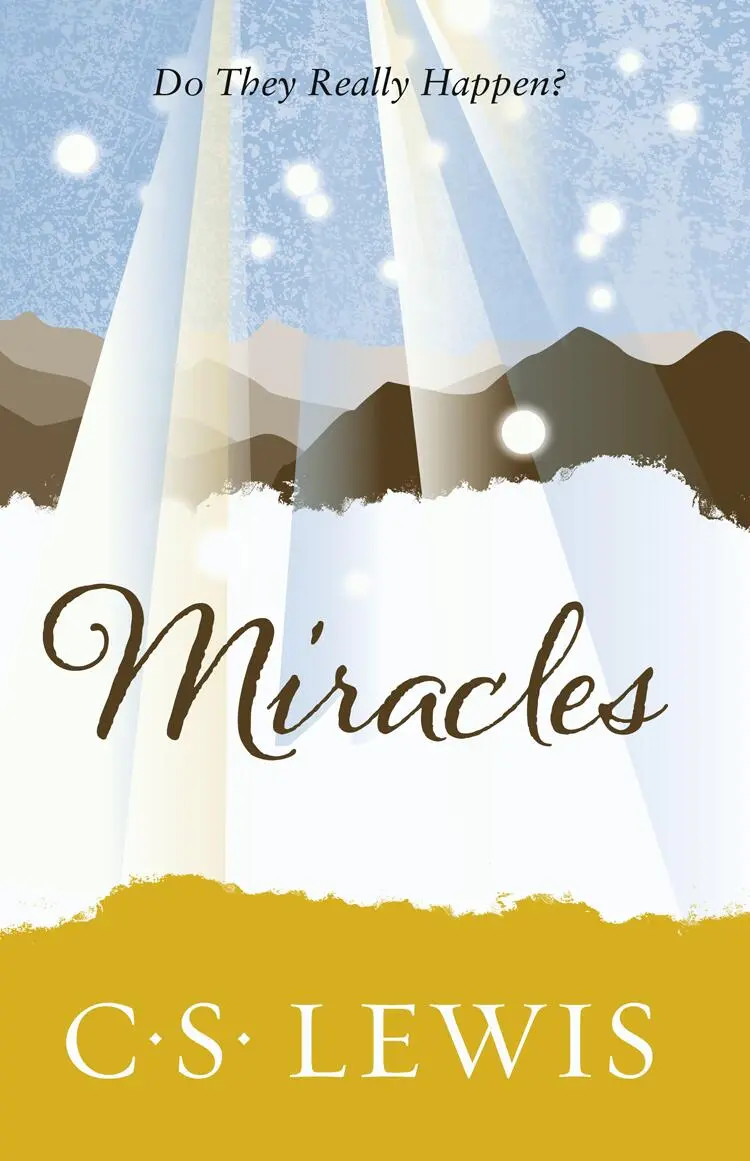
- Название:Miracles
- Автор:
- Жанр:
- Год:неизвестен
- ISBN:нет данных
- Рейтинг книги:5 / 5. Голосов: 1
-
Избранное:Добавить в избранное
- Отзывы:
-
Ваша оценка:
Miracles: краткое содержание, описание и аннотация
Предлагаем к чтению аннотацию, описание, краткое содержание или предисловие (зависит от того, что написал сам автор книги «Miracles»). Если вы не нашли необходимую информацию о книге — напишите в комментариях, мы постараемся отыскать её.
Miracles — читать онлайн ознакомительный отрывок
Ниже представлен текст книги, разбитый по страницам. Система сохранения места последней прочитанной страницы, позволяет с удобством читать онлайн бесплатно книгу «Miracles», без необходимости каждый раз заново искать на чём Вы остановились. Поставьте закладку, и сможете в любой момент перейти на страницу, на которой закончили чтение.
Интервал:
Закладка:
3 3 The Cardinal Difficulty of Naturalism 4 Nature and Supernature 5 A Further Difficulty in Naturalism 6 Answers to Misgivings 7 A Chapter of Red Herrings 8 Miracles and the Laws of Nature 9 A Chapter not Strictly Necessary 10 ‘Horrid Red Things’ 11 Christianity and ‘Religion’ 12 The Propriety of Miracles 13 On Probability 14 The Grand Miracle 15 Miracles of the Old Creation 16 Miracles of the New Creation 17 Epilogue Appendix A: On the Words ‘spirit’ and ‘spiritual’ Appendix B: On ‘special Providences’ About the Author Other Books by C. S. Lewis About the Publisher Конец ознакомительного фрагмента. Текст предоставлен ООО «ЛитРес». Прочитайте эту книгу целиком, купив полную легальную версию на ЛитРес. Безопасно оплатить книгу можно банковской картой Visa, MasterCard, Maestro, со счета мобильного телефона, с платежного терминала, в салоне МТС или Связной, через PayPal, WebMoney, Яндекс.Деньги, QIWI Кошелек, бонусными картами или другим удобным Вам способом.
THE CARDINAL DIFFICULTY OF NATURALISM 3 The Cardinal Difficulty of Naturalism 4 Nature and Supernature 5 A Further Difficulty in Naturalism 6 Answers to Misgivings 7 A Chapter of Red Herrings 8 Miracles and the Laws of Nature 9 A Chapter not Strictly Necessary 10 ‘Horrid Red Things’ 11 Christianity and ‘Religion’ 12 The Propriety of Miracles 13 On Probability 14 The Grand Miracle 15 Miracles of the Old Creation 16 Miracles of the New Creation 17 Epilogue Appendix A: On the Words ‘spirit’ and ‘spiritual’ Appendix B: On ‘special Providences’ About the Author Other Books by C. S. Lewis About the Publisher Конец ознакомительного фрагмента. Текст предоставлен ООО «ЛитРес». Прочитайте эту книгу целиком, купив полную легальную версию на ЛитРес. Безопасно оплатить книгу можно банковской картой Visa, MasterCard, Maestro, со счета мобильного телефона, с платежного терминала, в салоне МТС или Связной, через PayPal, WebMoney, Яндекс.Деньги, QIWI Кошелек, бонусными картами или другим удобным Вам способом.
We cannot have it both ways, and no sneers at the limitations of logic … amend the dilemma.
I. A. RICHARDS,
Principles of Literary Criticism, chap. xxv.
If Naturalism is true, every finite thing or event must be (in principle) explicable in terms of the Total System. I say ‘explicable in principle’ because of course we are not going to demand that naturalists, at any given moment, should have found the detailed explanation of every phenomenon. Obviously many things will only be explained when the sciences have made further progress. But if Naturalism is to be accepted we have a right to demand that every single thing should be such that we see, in general, how it could be explained in terms of the Total System. If any one thing exists which is of such a kind that we see in advance the impossibility of ever giving it that kind of explanation, then Naturalism would be in ruins. If necessities of thought force us to allow to any one thing any degree of independence from the Total System—if any one thing makes good a claim to be on its own, to be something more than an expression of the character of Nature as a whole—then we have abandoned Naturalism. For by Naturalism we mean the doctrine that only Nature—the whole interlocked system—exists. And if that were true, every thing and event would, if we knew enough, be explicable without remainder (no heel-taps) as a necessary product of the system. The whole system being what it is, it ought to be a contradiction in terms if you were not reading this book at the moment; and, conversely, the only cause why you are reading it ought to be that the whole system, at such and such a place and hour, was bound to take that course.
One threat against strict Naturalism has recently been launched on which I myself will base no argument, but which it will be well to notice. The older scientists believed that the smallest particles of matter moved according to strict laws: in other words, that the movements of each particle were ‘interlocked’ with the total system of Nature. Some modern scientists seem to think—if I understand them—that this is not so. They seem to think that the individual unit of matter (it would be rash to call it any longer a ‘particle’) moves in an indeterminate or random fashion; moves, in fact, ‘on its own’ or ‘of its own accord’. The regularity which we observe in the movements of the smallest visible bodies is explained by the fact that each of these contains millions of units and that the law of averages therefore levels out the idiosyncrasies of the individual unit’s behaviour. The movement of one unit is incalculable, just as the result of tossing a coin once is incalculable: the majority movement of a billion units can however be predicted, just as, if you tossed a coin a billion times, you could predict a nearly equal number of heads and tails. Now it will be noticed that if this theory is true we have really admitted something other than Nature. If the movements of the individual units are events ‘on their own’, events which do not interlock with all other events, then these movements are not part of Nature. It would be, indeed, too great a shock to our habits to describe them as super-natural. I think we should have to call them sub-natural. But all our confidence that Nature has no doors, and no reality outside herself for doors to open on, would have disappeared. There is apparently something outside her, the Sub-natural; it is indeed from this Subnatural that all events and all ‘bodies’ are, as it were, fed into her. And clearly if she thus has a back door opening on the Subnatural, it is quite on the cards that she may also have a front door opening on the Supernatural—and events might be fed into her at that door too.
I have mentioned this theory because it puts in a fairly vivid light certain conceptions which we shall have to use later on. But I am not, for my own part, assuming its truth. Those who like myself have had a philosophical rather than a scientific education find it almost impossible to believe that the scientists really mean what they seem to be saying. I cannot help thinking they mean no more than that the movements of individual units are permanently incalculable to us, not that they are in themselves random and lawless. And even if they mean the latter, a layman can hardly feel any certainty that some new scientific development may not tomorrow abolish this whole idea of a lawless Subnature. For it is the glory of science to progress. I therefore turn willingly to other ground.
It is clear that everything we know, beyond our own immediate sensations, is inferred from those sensations. I do not mean that we begin as children, by regarding our sensations as ‘evidence’ and thence arguing consciously to the existence of space, matter, and other people. I mean that if, after we are old enough to understand the question, our confidence in the existence of anything else (say, the solar system or the Spanish Armada) is challenged, our argument in defence of it will have to take the form of inferences from our immediate sensations. Put in its most general form the inference would run, ‘Since I am presented with colours, sounds, shapes, pleasures and pains which I cannot perfectly predict or control, and since the more I investigate them the more regular their behaviour appears, therefore there must exist something other than myself and it must be systematic’. Inside this very general inference, all sorts of special trains of inference lead us to more detailed conclusions. We infer Evolution from fossils: we infer the existence of our own brains from what we find inside the skulls of other creatures like ourselves in the dissecting room.
Читать дальшеИнтервал:
Закладка:
Похожие книги на «Miracles»
Представляем Вашему вниманию похожие книги на «Miracles» списком для выбора. Мы отобрали схожую по названию и смыслу литературу в надежде предоставить читателям больше вариантов отыскать новые, интересные, ещё непрочитанные произведения.







Обсуждение, отзывы о книге «Miracles» и просто собственные мнения читателей. Оставьте ваши комментарии, напишите, что Вы думаете о произведении, его смысле или главных героях. Укажите что конкретно понравилось, а что нет, и почему Вы так считаете.