C. Lewis - Miracles
Здесь есть возможность читать онлайн «C. Lewis - Miracles» — ознакомительный отрывок электронной книги совершенно бесплатно, а после прочтения отрывка купить полную версию. В некоторых случаях можно слушать аудио, скачать через торрент в формате fb2 и присутствует краткое содержание. Жанр: unrecognised, на английском языке. Описание произведения, (предисловие) а так же отзывы посетителей доступны на портале библиотеки ЛибКат.
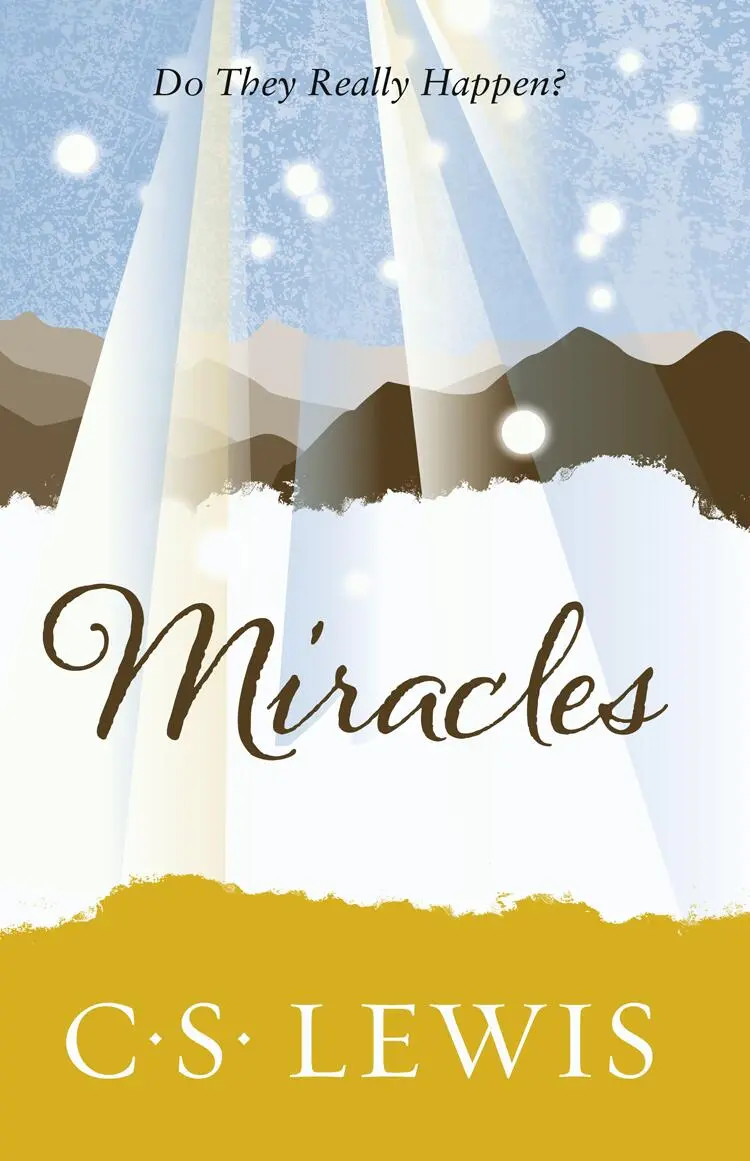
- Название:Miracles
- Автор:
- Жанр:
- Год:неизвестен
- ISBN:нет данных
- Рейтинг книги:5 / 5. Голосов: 1
-
Избранное:Добавить в избранное
- Отзывы:
-
Ваша оценка:
Miracles: краткое содержание, описание и аннотация
Предлагаем к чтению аннотацию, описание, краткое содержание или предисловие (зависит от того, что написал сам автор книги «Miracles»). Если вы не нашли необходимую информацию о книге — напишите в комментариях, мы постараемся отыскать её.
Miracles — читать онлайн ознакомительный отрывок
Ниже представлен текст книги, разбитый по страницам. Система сохранения места последней прочитанной страницы, позволяет с удобством читать онлайн бесплатно книгу «Miracles», без необходимости каждый раз заново искать на чём Вы остановились. Поставьте закладку, и сможете в любой момент перейти на страницу, на которой закончили чтение.
Интервал:
Закладка:
All possible knowledge, then, depends on the validity of reasoning. If the feeling of certainty which we express by words like must be and therefore and since is a real perception of how things outside our own minds really ‘must’ be, well and good. But if this certainty is merely a feeling in our own minds and not a genuine insight into realities beyond them—if it merely represents the way our minds happen to work—then we can have no knowledge. Unless human reasoning is valid no science can be true.
It follows that no account of the universe can be true unless that account leaves it possible for our thinking to be a real insight. A theory which explained everything else in the whole universe but which made it impossible to believe that our thinking was valid, would be utterly out of court. For that theory would itself have been reached by thinking, and if thinking is not valid that theory would, of course, be itself demolished. It would have destroyed its own credentials. It would be an argument which proved that no argument was sound—a proof that there are no such things as proofs—which is nonsense.
Thus a strict materialism refutes itself for the reason given long ago by Professor Haldane: ‘If my mental processes are determined wholly by the motions of atoms in my brain, I have no reason to suppose that my beliefs are true … and hence I have no reason for supposing my brain to be composed of atoms.’ (Possible Worlds)
But Naturalism, even if it is not purely materialistic, seems to me to involve the same difficulty, though in a somewhat less obvious form. It discredits our processes of reasoning or at least reduces their credit to such a humble level that it can no longer support Naturalism itself.
The easiest way of exhibiting this is to notice the two senses of the word because. We can say, ‘Grandfather is ill today because he ate lobster yesterday.’ We can also say, ‘Grandfather must be ill today because he hasn’t got up yet (and we know he is an invariably early riser when he is well).’ In the first sentence because indicates the relation of Cause and Effect: The eating made him ill. In the second, it indicates the relation of what logicians call Ground and Consequent. The old man’s late rising is not the cause of his disorder but the reason why we believe him to be disordered. There is a similar difference between ‘He cried out because it hurt him’ (Cause and Effect) and ‘It must have hurt him because he cried out’ (Ground and Consequent). We are especially familiar with the Ground and Consequent because in mathematical reasoning: ‘A = C because, as we have already proved, they are both equal to B.’
The one indicates a dynamic connection between events or ‘states of affairs’; the other, a logical relation between beliefs or assertions.
Now a train of reasoning has no value as a means of finding truth unless each step in it is connected with what went before in the Ground-Consequent relation. If our B does not follow logically from our A, we think in vain. If what we think at the end of our reasoning is to be true, the correct answer to the question, ‘Why do you think this?’ must begin with the Ground-Consequent because.
On the other hand, every event in Nature must be connected with previous events in the Cause and Effect relation. But our acts of thinking are events. Therefore the true answer to ‘Why do you think this?’ must begin with the Cause-Effect because.
Unless our conclusion is the logical consequent from a ground it will be worthless and could be true only by a fluke. Unless it is the effect of a cause, it cannot occur at all. It looks therefore, as if, in order for a train of thought to have any value, these two systems of connection must apply simultaneously to the same series of mental acts.
But unfortunately the two systems are wholly distinct. To be caused is not to be proved. Wishful thinkings, prejudices, and the delusions of madness, are all caused, but they are ungrounded. Indeed to be caused is so different from being proved that we behave in disputation as if they were mutually exclusive. The mere existence of causes for a belief is popularly treated as raising a presumption that it is groundless, and the most popular way of discrediting a person’s opinions is to explain them causally—‘You say that because (Cause and Effect) you are a capitalist, or a hypochondriac, or a mere man, or only a woman’. The implication is that if causes fully account for a belief, then, since causes work inevitably, the belief would have had to arise whether it had grounds or not. We need not, it is felt, consider grounds for something which can be fully explained without them.
But even if grounds do exist, what exactly have they got to do with the actual occurrence of the belief as a psychological event? If it is an event it must be caused. It must in fact be simply one link in a causal chain which stretches back to the beginning and forward to the end of time. How could such a trifle as lack of logical grounds prevent the belief’s occurrence or how could the existence of grounds promote it?
There seems to be only one possible answer. We must say that just as one way in which a mental event causes a subsequent mental event is by Association (when I think of parsnips I think of my first school), so another way in which it can cause it, is simply by being a ground for it. For then being a cause and being a proof would coincide.
But this, as it stands, is clearly untrue. We know by experience that a thought does not necessarily cause all, or even any, of the thoughts which logically stand to it as Consequents to Ground. We should be in a pretty pickle if we could never think ‘This is glass’ without drawing all the inferences which could be drawn. It is impossible to draw them all; quite often we draw none. We must therefore amend our suggested law. One thought can cause another not by being, but by being seen to be, a ground for it.
If you distrust the sensory metaphor in seen, you may substitute apprehended or grasped or simply known. It makes little difference for all these words recall us to what thinking really is. Acts of thinking are no doubt events; but they are a very special sort of events. They are ‘about’ something other than themselves and can be true or false. Events in general are not ‘about’ anything and cannot be true or false. (To say ‘these events, or facts are false’ means of course that someone’s account of them is false). Hence acts of inference can, and must, be considered in two different lights. On the one hand they are subjective events, items in somebody’s psychological history. On the other hand, they are insights into, or knowings of, something other than themselves. What from the first point of view is the psychological transition from thought A to thought B, at some particular moment in some particular mind, is, from the thinker’s point of view a perception of an implication (if A, then B). When we are adopting the psychological point of view we may use the past tense. ‘B followed A in my thoughts.’ But when we assert the implication we always use the present—‘B follows from A’. If it ever ‘follows from’ in the logical sense, it does so always. And we cannot possibly reject the second point of view as a subjective illusion without discrediting all human knowledge. For we can know nothing, beyond our own sensations at the moment unless the act of inference is the real insight that it claims to be.
But it can be this only on certain terms. An act of knowing must be determined, in a sense, solely by what is known; we must know it to be thus solely because it is thus. That is what knowing means. You may call this a Cause and Effect because, and call ‘being known’ a mode of causation if you like. But it is a unique mode. The act of knowing has no doubt various conditions, without which it could not occur: attention, and the states of will and health which this presupposes. But its positive character must be determined by the truth it knows. If it were totally explicable from other sources it would cease to be knowledge, just as (to use the sensory parallel) the ringing in my ears ceases to be what we mean by ‘hearing’ if it can be fully explained from causes other than a noise in the outer world—such as, say, the tinnitus produced by a bad cold. If what seems an act of knowledge is partially explicable from other sources, then the knowing (properly so called) in it is just what they leave over, just what demands, for its explanation, the thing known, as real hearing is what is left after you have discounted the tinnitus. Any thing which professes to explain our reasoning fully without introducing an act of knowing thus solely determined by what is known, is really a theory that there is no reasoning.
Читать дальшеИнтервал:
Закладка:
Похожие книги на «Miracles»
Представляем Вашему вниманию похожие книги на «Miracles» списком для выбора. Мы отобрали схожую по названию и смыслу литературу в надежде предоставить читателям больше вариантов отыскать новые, интересные, ещё непрочитанные произведения.





Обсуждение, отзывы о книге «Miracles» и просто собственные мнения читателей. Оставьте ваши комментарии, напишите, что Вы думаете о произведении, его смысле или главных героях. Укажите что конкретно понравилось, а что нет, и почему Вы так считаете.