C. Lewis - Miracles
Здесь есть возможность читать онлайн «C. Lewis - Miracles» — ознакомительный отрывок электронной книги совершенно бесплатно, а после прочтения отрывка купить полную версию. В некоторых случаях можно слушать аудио, скачать через торрент в формате fb2 и присутствует краткое содержание. Жанр: unrecognised, на английском языке. Описание произведения, (предисловие) а так же отзывы посетителей доступны на портале библиотеки ЛибКат.
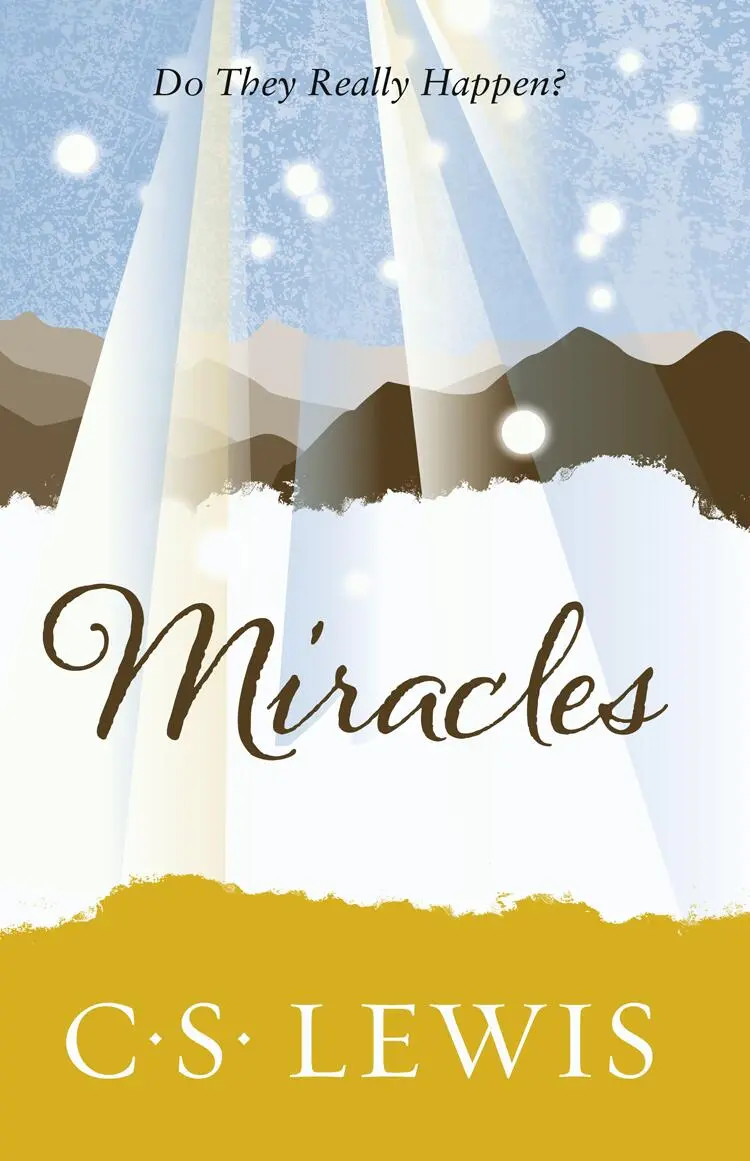
- Название:Miracles
- Автор:
- Жанр:
- Год:неизвестен
- ISBN:нет данных
- Рейтинг книги:5 / 5. Голосов: 1
-
Избранное:Добавить в избранное
- Отзывы:
-
Ваша оценка:
Miracles: краткое содержание, описание и аннотация
Предлагаем к чтению аннотацию, описание, краткое содержание или предисловие (зависит от того, что написал сам автор книги «Miracles»). Если вы не нашли необходимую информацию о книге — напишите в комментариях, мы постараемся отыскать её.
Miracles — читать онлайн ознакомительный отрывок
Ниже представлен текст книги, разбитый по страницам. Система сохранения места последней прочитанной страницы, позволяет с удобством читать онлайн бесплатно книгу «Miracles», без необходимости каждый раз заново искать на чём Вы остановились. Поставьте закладку, и сможете в любой момент перейти на страницу, на которой закончили чтение.
Интервал:
Закладка:
But this, as it seems to me, is what Naturalism is bound to do. It offers what professes to be a full account of our mental behaviour; but this account, on inspection, leaves no room for the acts of knowing or insight on which the whole value of our thinking, as a means to truth, depends.
It is agreed on all hands that reason, and even sentience, and life itself are late comers in Nature. If there is nothing but Nature, therefore, reason must have come into existence by a historical process. And of course, for the Naturalist, this process was not designed to produce a mental behaviour that can find truth. There was no Designer; and indeed, until there were thinkers, there was no truth or falsehood. The type of mental behaviour we now call rational thinking or inference must therefore have been ‘evolved’ by natural selection, by the gradual weeding out of types less fitted to survive.
Once, then, our thoughts were not rational. That is, all our thoughts once were, as many of our thoughts still are, merely subjective events, not apprehensions of objective truth. Those which had a cause external to ourselves at all were (like our pains) responses to stimuli. Now natural selection could operate only by eliminating responses that were biologically hurtful and multiplying those which tended to survival. But it is not conceivable that any improvement of responses could ever turn them into acts of insight, or even remotely tend to do so. The relation between response and stimulus is utterly different from that between knowledge and the truth known. Our physical vision is a far more useful response to light than that of the cruder organisms which have only a photo-sensitive spot. But neither this improvement nor any possible improvements we can suppose could bring it an inch nearer to being a knowledge of light. It is admittedly something without which we could not have had that knowledge. But the knowledge is achieved by experiments and inferences from them, not by refinement of the response. It is not men with specially good eyes who know about light, but men who have studied the relevant sciences. In the same way our psychological responses to our environment—our curiosities, aversions, delights, expectations—could be indefinitely improved (from the biological point of view) without becoming anything more than responses. Such perfection of the non-rational responses, far from amounting to their conversion into valid inferences, might be conceived as a different method of achieving survival—an alternative to reason. A conditioning which secured that we never felt delight except in the useful nor aversion save from the dangerous, and that the degrees of both were exquisitely proportional to the degree of real utility or danger in the object, might serve us as well as reason or in some circumstances better.
Besides natural selection there is, however, experience—experience originally individual but handed on by tradition and instruction. It might be held that this, in the course of millennia, could conjure the mental behaviour we call reason—in other words, the practice of inference—out of a mental behaviour which was originally not rational. Repeated experiences of finding fire (or the remains of fire) where he had seen smoke would condition a man to expect fire whenever he saw smoke. This expectation, expressed in the form ‘If smoke, then fire’ becomes what we call inference. Have all our inferences originated in that way?
But if they did they are all invalid inferences. Such a process will no doubt produce expectation. It will train men to expect fire when they see smoke in just the same way as it trained them to expect that all swans would be white (until they saw a black one) or that water would always boil at 212° (until someone tried a picnic on a mountain). Such expectations are not inferences and need not be true. The assumption that things which have been conjoined in the past will always be conjoined in the future is the guiding principle not of rational but of animal behaviour. Reason comes in precisely when you make the inference ‘Since always conjoined, therefore probably connected’ and go on to attempt the discovery of the connection. When you have discovered what smoke is you may then be able to replace the mere expectation of fire by a genuine inference. Till this is done reason recognises the expectation as a mere expectation. Where this does not need to be done—that is, where the inference depends on an axiom—we do not appeal to past experience at all. My belief that things which are equal to the same thing are equal to one another is not at all based on the fact that I have never caught them behaving otherwise. I see that it ‘must’ be so. That some people nowadays call axioms tautologies seems to me irrelevant. It is by means of such ‘tautologies’ that we advance from knowing less to knowing more. And to call them tautologies is another way of saying that they are completely and certainly known. To see fully that A implies B does (once you have seen it) involve the admission that the assertion of A and the assertion of B are at bottom in the same assertion. The degree to which any true proportion is a tautology depends on the degree of your insight into it. 9 × 7 = 63 is a tautology to the perfect arithmetician, but not to the child learning its tables nor to the primitive calculator who reached it, perhaps, by adding seven nines together. If Nature is a totally interlocked system, then every true statement about her (e.g. there was a hot summer in 1959) would be a tautology to an intelligence that could grasp that system in its entirety. ‘God is love’ may be a tautology to the seraphim; not to men.
‘But’, it will be said, ‘it is incontestable that we do in fact reach truths by inferences’. Certainly. The Naturalist and I both admit this. We could not discuss anything unless we did. The difference I am submitting is that he gives, and I do not, a history of the evolution of reason which is inconsistent with the claims that he and I both have to make for inference as we actually practise it. For his history is, and from the nature of the case can only be, an account, in Cause and Effect terms, of how people came to think the way they do. And this of course leaves in the air the quite different question of how they could possibly be justified in so thinking. This imposes on him the very embarrassing task of trying to show how the evolutionary product which he has described could also be a power of ‘seeing’ truths.
But the very attempt is absurd. This is best seen if we consider the humblest and almost the most despairing form in which it could be made. The Naturalist might say, ‘Well, perhaps we cannot exactly see—not yet—how natural selection would turn sub-rational mental behaviour into inferences that reach truth. But we are certain that this in fact has happened. For natural selection is bound to preserve and increase useful behaviour. And we also find that our habits of inference are in fact useful. And if they are useful they must reach truth’. But notice what we are doing. Inference itself is on trial: that is, the Naturalist has given an account of what we thought to be our inferences which suggests that they are not real insights at all. We, and he, want to be reassured. And the reassurance turns out to be one more inference (if useful, then true)—as if this inference were not, once we accept his evolutionary picture, under the same suspicion as all the rest. If the value of our reasoning is in doubt, you cannot try to establish it by reasoning. If, as I said above, a proof that there are no proofs is nonsensical, so is a proof that there are proofs. Reason is our starting point. There can be no question either of attacking or defending it. If by treating it as a mere phenomenon you put yourself outside it, there is then no way, except by begging the question, of getting inside again.
Читать дальшеИнтервал:
Закладка:
Похожие книги на «Miracles»
Представляем Вашему вниманию похожие книги на «Miracles» списком для выбора. Мы отобрали схожую по названию и смыслу литературу в надежде предоставить читателям больше вариантов отыскать новые, интересные, ещё непрочитанные произведения.



Обсуждение, отзывы о книге «Miracles» и просто собственные мнения читателей. Оставьте ваши комментарии, напишите, что Вы думаете о произведении, его смысле или главных героях. Укажите что конкретно понравилось, а что нет, и почему Вы так считаете.