C. Lewis - Miracles
Здесь есть возможность читать онлайн «C. Lewis - Miracles» — ознакомительный отрывок электронной книги совершенно бесплатно, а после прочтения отрывка купить полную версию. В некоторых случаях можно слушать аудио, скачать через торрент в формате fb2 и присутствует краткое содержание. Жанр: unrecognised, на английском языке. Описание произведения, (предисловие) а так же отзывы посетителей доступны на портале библиотеки ЛибКат.
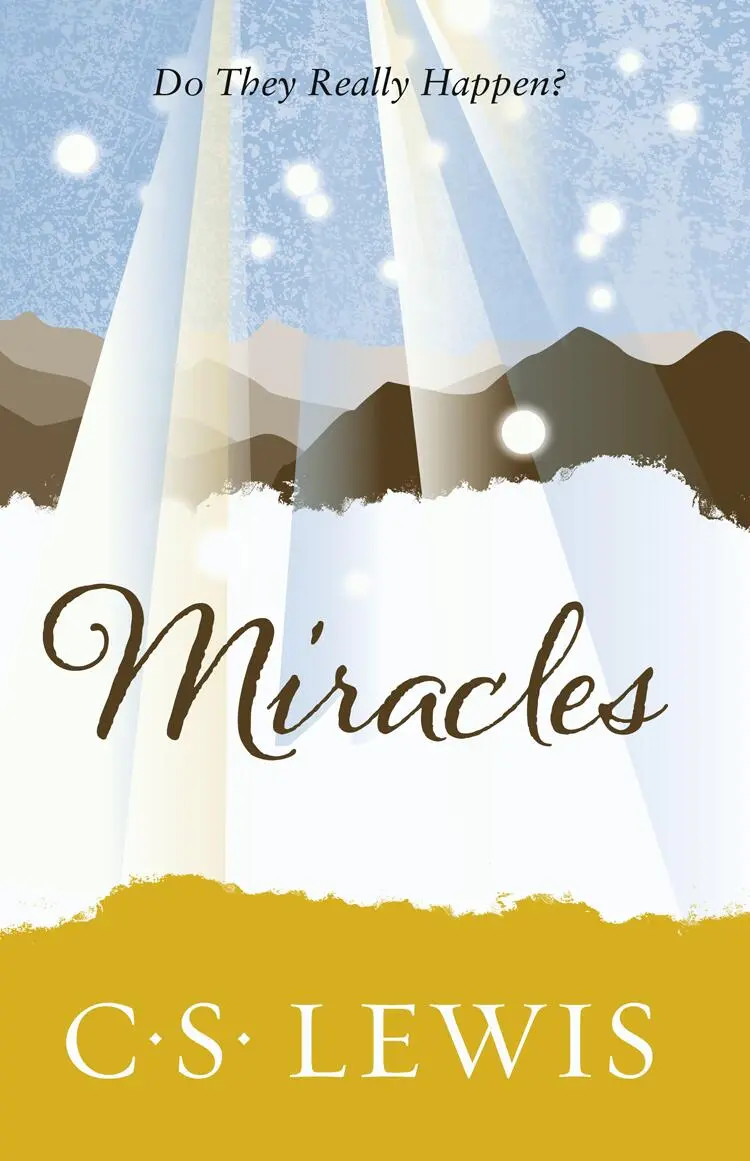
- Название:Miracles
- Автор:
- Жанр:
- Год:неизвестен
- ISBN:нет данных
- Рейтинг книги:5 / 5. Голосов: 1
-
Избранное:Добавить в избранное
- Отзывы:
-
Ваша оценка:
Miracles: краткое содержание, описание и аннотация
Предлагаем к чтению аннотацию, описание, краткое содержание или предисловие (зависит от того, что написал сам автор книги «Miracles»). Если вы не нашли необходимую информацию о книге — напишите в комментариях, мы постараемся отыскать её.
Miracles — читать онлайн ознакомительный отрывок
Ниже представлен текст книги, разбитый по страницам. Система сохранения места последней прочитанной страницы, позволяет с удобством читать онлайн бесплатно книгу «Miracles», без необходимости каждый раз заново искать на чём Вы остановились. Поставьте закладку, и сможете в любой момент перейти на страницу, на которой закончили чтение.
Интервал:
Закладка:
I do not maintain that God’s creation of Nature can be proved as rigorously as God’s existence, but it seems to me overwhelmingly probable, so probable that no one who approached the question with an open mind would very seriously entertain any other hypothesis. In fact one seldom meets people who have grasped the existence of a supernatural God and yet deny that He is the Creator. All the evidence we have points in that direction, and difficulties spring up on every side if we try to believe otherwise. No philosophical theory which I have yet come across is a radical improvement on the words of Genesis, that ‘In the beginning God made Heaven and Earth’. I say ‘radical’ improvement, because the story in Genesis—as St Jerome said long ago—is told in the manner ‘of a popular poet’, or as we should say, in the form of folk tale. But if you compare it with the creation legends of other peoples—with all these delightful absurdities in which giants to be cut up and floods to be dried up are made to exist before creation—the depth and originality of this Hebrew folk tale will soon be apparent. The idea of creation in the rigorous sense of the word is there fully grasped.
5 5 A Further Difficulty in Naturalism 6 Answers to Misgivings 7 A Chapter of Red Herrings 8 Miracles and the Laws of Nature 9 A Chapter not Strictly Necessary 10 ‘Horrid Red Things’ 11 Christianity and ‘Religion’ 12 The Propriety of Miracles 13 On Probability 14 The Grand Miracle 15 Miracles of the Old Creation 16 Miracles of the New Creation 17 Epilogue Appendix A: On the Words ‘spirit’ and ‘spiritual’ Appendix B: On ‘special Providences’ About the Author Other Books by C. S. Lewis About the Publisher Конец ознакомительного фрагмента. Текст предоставлен ООО «ЛитРес». Прочитайте эту книгу целиком, купив полную легальную версию на ЛитРес. Безопасно оплатить книгу можно банковской картой Visa, MasterCard, Maestro, со счета мобильного телефона, с платежного терминала, в салоне МТС или Связной, через PayPal, WebMoney, Яндекс.Деньги, QIWI Кошелек, бонусными картами или другим удобным Вам способом.
A FURTHER DIFFICULTY IN NATURALISM 5 A Further Difficulty in Naturalism 6 Answers to Misgivings 7 A Chapter of Red Herrings 8 Miracles and the Laws of Nature 9 A Chapter not Strictly Necessary 10 ‘Horrid Red Things’ 11 Christianity and ‘Religion’ 12 The Propriety of Miracles 13 On Probability 14 The Grand Miracle 15 Miracles of the Old Creation 16 Miracles of the New Creation 17 Epilogue Appendix A: On the Words ‘spirit’ and ‘spiritual’ Appendix B: On ‘special Providences’ About the Author Other Books by C. S. Lewis About the Publisher Конец ознакомительного фрагмента. Текст предоставлен ООО «ЛитРес». Прочитайте эту книгу целиком, купив полную легальную версию на ЛитРес. Безопасно оплатить книгу можно банковской картой Visa, MasterCard, Maestro, со счета мобильного телефона, с платежного терминала, в салоне МТС или Связной, через PayPal, WebMoney, Яндекс.Деньги, QIWI Кошелек, бонусными картами или другим удобным Вам способом.
Even as rigorous a determinist as Karl Marx, who at times described the social behaviour of the bourgeoisie in terms which suggested a problem in social physics, could subject it at other times to a withering scorn which only the presupposition of moral responsibility could justify.
R. NIEBUHR, An Interpretation of Christian Ethics, chap. iii.
Some people regard logical thinking as the deadest and driest of our activities and may therefore be repelled by the privileged position I gave it in the last chapter. But logical thinking—Reasoning—had to be the pivot of the argument because, of all the claims which the human mind puts forward, the claim of Reasoning to be valid is the only one which the Naturalist cannot deny without (philosophically speaking) cutting his own throat. You cannot, as we saw, prove that there are no proofs. But you can if you wish regard all human ideals as illusions and all human loves as biological by-products. That is, you can do so without running into flat self-contradiction and nonsense. Whether you can do so without extreme unplausibility—without accepting a picture of things which no one really believes—is another matter.
Besides reasoning about matters of fact, men also make moral judgements—‘I ought to do this’—‘I ought not to do that’—‘This is good’—‘That is evil.’ Two views have been held about moral judgements. Some people think that when we make them we are not using our Reason, but are employing some different power. Other people think that we make them by our Reason. I myself hold this second view. That is, I believe that the primary moral principles on which all others depend are rationally perceived. We ‘just see’ that there is no reason why my neighbour’s happiness should be sacrificed to my own, as we ‘just see’ that things which are equal to the same thing are equal to one another. If we cannot prove either axiom, that is not because they are irrational but because they are self-evident and all proofs depend on them. Their intrinsic reasonableness shines by its own light. It is because all morality is based on such self-evident principles that we say to a man, when we would recall him to right conduct, ‘Be reasonable.’
But this is by the way. For our present purpose it does not matter which of these two views you adopt. The important point is to notice that moral judgements raise the same sort of difficulty for Naturalism as any other thoughts. We always assume in discussions about morality, as in all other discussions, that the other man’s views are worthless if they can be fully accounted for by some non-moral and non-rational cause. When two men differ about good and evil we soon hear this principle being brought into play. ‘He believes in the sanctity of property because he’s a millionaire’—‘He believes in Pacifism because he’s a coward’—‘He approves of corporal punishment because he’s a sadist.’ Such taunts may often be untrue: but the mere fact that they are made by the one side, and hotly rebutted by the other, shows clearly what principle is being used. Neither side doubts that if they were true they would be decisive. No one (in real life) pays attention to any moral judgement which can be shown to spring from non-moral and non-rational causes. The Freudian and the Marxist attack traditional morality precisely on this ground—and with wide success. All men accept the principle.
But, of course, what discredits particular moral judgements must equally discredit moral judgement as a whole. If the fact that men have such ideas as ought and ought not at all can be fully explained by irrational and non-moral causes, then those ideas are an illusion. The Naturalist is ready to explain how the illusion arose. Chemical conditions produce life. Life, under the influence of natural selection, produces consciousness. Conscious organisms which behave in one way live longer than those which behave in another. Living longer, they are more likely to have offspring. Inheritance, and sometimes teaching as well, pass on their mode of behaviour to their young. Thus in every species a pattern of behaviour is built up. In the human species conscious teaching plays a larger part in building it up, and the tribe further strengthens it by killing individuals who don’t conform. They also invent gods who are said to punish departures from it. Thus, in time, there comes to exist a strong human impulse to conform. But since this impulse is often at variance with the other impulses, a mental conflict arises, and the man expresses it by saying ‘I want to do A but I ought to do B.’
Читать дальшеИнтервал:
Закладка:
Похожие книги на «Miracles»
Представляем Вашему вниманию похожие книги на «Miracles» списком для выбора. Мы отобрали схожую по названию и смыслу литературу в надежде предоставить читателям больше вариантов отыскать новые, интересные, ещё непрочитанные произведения.




Обсуждение, отзывы о книге «Miracles» и просто собственные мнения читателей. Оставьте ваши комментарии, напишите, что Вы думаете о произведении, его смысле или главных героях. Укажите что конкретно понравилось, а что нет, и почему Вы так считаете.