Richard Holmes - Sidetracks
Здесь есть возможность читать онлайн «Richard Holmes - Sidetracks» — ознакомительный отрывок электронной книги совершенно бесплатно, а после прочтения отрывка купить полную версию. В некоторых случаях можно слушать аудио, скачать через торрент в формате fb2 и присутствует краткое содержание. Жанр: unrecognised, на английском языке. Описание произведения, (предисловие) а так же отзывы посетителей доступны на портале библиотеки ЛибКат.
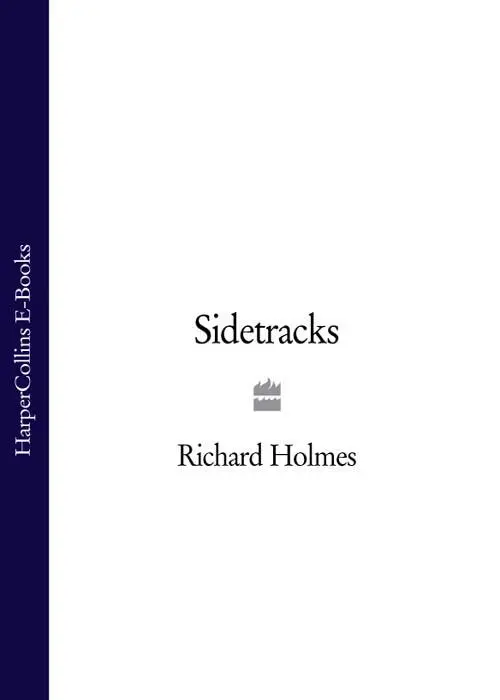
- Название:Sidetracks
- Автор:
- Жанр:
- Год:неизвестен
- ISBN:нет данных
- Рейтинг книги:5 / 5. Голосов: 1
-
Избранное:Добавить в избранное
- Отзывы:
-
Ваша оценка:
Sidetracks: краткое содержание, описание и аннотация
Предлагаем к чтению аннотацию, описание, краткое содержание или предисловие (зависит от того, что написал сам автор книги «Sidetracks»). Если вы не нашли необходимую информацию о книге — напишите в комментариях, мы постараемся отыскать её.
Sidetracks — читать онлайн ознакомительный отрывок
Ниже представлен текст книги, разбитый по страницам. Система сохранения места последней прочитанной страницы, позволяет с удобством читать онлайн бесплатно книгу «Sidetracks», без необходимости каждый раз заново искать на чём Вы остановились. Поставьте закладку, и сможете в любой момент перейти на страницу, на которой закончили чтение.
Интервал:
Закладка:
But Nerval’s life appeared to be a disaster, increasingly rootless and poverty-stricken, ending in a series of internments in an asylum in Passy and eventual suicide in an alley leading down to the river Seine. The stark contrast in their destinies seemed to me to tell an essential story about Romanticism. So I felt my way along the interwoven paths of their biographies, beginning with a first journalistic sketch of Gautier, like a mirror image, visiting London. I then assembled and translated a collection of his autobiographical fantasy tales, My Fantoms, and out of this collection arose the story of ‘Poor Pierrot’. Here was a haunting mythical figure from the Commedia dell’ Arte, who came literally to life in the career of the mime artist Deburau. This Pierrot’s biography had a sadness and sudden violence which foreshadowed Nerval’s.
But when I came directly to Nerval himself, I found the path of traditional biography blocked, for the reasons I have explained in Footsteps. I wrote a 400-page biography of the two friends, ‘Poets in Paris’, but it never cohered and I felt gradually that I was lost in a maze of shifting journeys and identities. I was lost in France. When I came back to England in 1976, all that seemed to remain was a kind of echo-chamber of voices in my head, a kind of fragmented sound-track of their friendship.
As a last effort to record those voices, and at least mark the fading contours of my research before they disappeared entirely, I wrote a radio-play in that odd hybrid but fascinating form of ‘drama-documentary’ which was eventually produced for Radio Three by Hallam Tennyson. (It was a strange production, almost surreal in its unsettling effect on the actors, with Timothy West – a big, solid, confident figure like Gautier – superbly transforming his voice into the slight, unstable, tortured Nerval.) This is the last piece in this section, although the story itself–and my wanderings in France – were far from over. The discovery of radio, as a vehicle for biographical story-telling, moving effortlessly inside and outside its characters’ minds, shifting with magical ease between different times and locations, was a revelation and an inspiration to me.
MONSIEUR NADAR
OPPOSITE THE GOLD AND DORIO of the modern Hôtel Scribe, about three minutes’ walk under the plane trees from the Place de l’Opéra, stands a crazed and yellowing façade of taciturn stucco, surmounted by a triplet of broken urns. This is 35 boulevard des Capucines, Paris 75008. It carries no plaque, no prefectural plate, no memorial. Yet there was a time when Victor Hugo, exiled in the Channel Islands, could have a letter delivered to this address with nothing more than the proprietor’s name on the envelope.
A hundred years ago, the building was red: a bright, republican red. Its top two floors consisted of studio rooms into which the morning sun poured unhindered, by a daring system of plate-glass windows set in a trellis of wrought-iron that curved gracefully across the entire façade. Its corniches were capped by alabaster busts of three generously proportioned Muses, and its roof cluttered by a series of glass sheds, not unlike greenhouses, interspersed somewhat eccentrically by pots of ferns and small Christmas trees in tubs. At pavement level, a constant coming and going of hired cabs and smart landaus, a dashing of commissionaires with giant parasols (also red), of strollers and gapers – les flâneurs de Paris – indicated some unusually attractive centre of business, art or scandal.
As night fell, and the street-lamps swaying from their iron gibbets filled the thoroughfare with a garish, orange gaslight, and the cab-lamps jerked down the uncertain asphalting of the boulevard, a great arc of clear white light, the output from fifty Bunsen Static Batteries linked in series, flooded down from the windows of number 35. This unearthly glow was occasionally punctuated by the livid flash from a pan of magnesium, which gave rise – not altogether unreasonably – to rumours of spirit-raising and necromancy.
Across the whole frontage, at the level of the third-storey balcony, in bold cursive lettering 10 feet high and 50 feet long, in a system of gas-tubes designed exclusively by Antoine Lumière, ran the proprietorial name: nadar. That too was in red.
In the 1860s Felix Nadar was certainly the most celebrated photographer in France. In retrospect, his reputation still stands with David Octavius Hill and Julia Margaret Cameron, as one of the three indisputably great portrait photographers of the nineteenth century. His famous atelier at number 35 boulevard des Capucines had long been linked with the pioneering days of French photography, since the time when it had been rented as an undecorated shell of a building, in a then unfashionable quarter, by the early landscape daguerreotypers, the frères Bisson, and the painter turned seascape photographer Gustave Le Gray, in the 1850s. The building was to conclude its controversial associations on a high note, when after the fall of the Second Empire, and the crushing tragedy of the Commune, Nadar moved to smaller premises, and hired the studio out to the ‘Société Anonyme des Artistes Peintres’ for a public exposition which became known to posterity as the First Impressionist Exhibition of 1874.
The aesthetic revolution brought about by the early photographers, and especially Nadar, was no less far-reaching than that achieved by the Impressionists. But the impact of photography on European society was too rapid, and too widespread, to be grasped at the time. The Impressionists asserted new standards of private, idiosyncratic vision, which penetrated only slowly, and among the elite of the art world. But photographers established, in little more than a decade, entirely new and universal ideas about visual reality, and about what everyone could commonly accept and recognize as ‘lifelikeness’. Photography was, from the start, irretrievably popular in its appeal and suspiciously democratic in its tendencies. Not surprisingly it took Paris by storm: in 1850 there were less than a dozen professional studios in the city; by the 1860s something over 200, with more than 33,000 people directly or indirectly employed. Of these, Nadar was the doyen.
Especially in these early days, photography gave rise to a host of questions and suspicions. Was the photographer an artist, or a scientist? Would he destroy painting? Would his portraits somehow dehumanize nature, and banish the soul? And how was it that photography, with all its mechanistic and chemical crudeness, had suddenly created a golden age of the human image? As Nadar himself put it with typical trenchancy: ‘Photography is a fantastic discovery: a science which engages the most advanced intellects, and an art which provokes the most profound minds: and yet its use lies within the capacity of the shallowest idiot.’
The story of Nadar’s early career is a reflection and to some extent an explanation of many of these issues. It is also a kind of comic-epic, continuously larger and more colourful than life, like his own person. For the Nadar who eventually occupied the boulevard des Capucines was 6 feet 4 inches tall, with blazing red hair once described by the poet de Banville as ‘comet’s fire’, and having for his motto the untranslatable Parisian shrug in the face of an intractable universe: mais, quand même!
In fact Felix Nadar created himself. As he was born in 1820, he was merely Felix Tournachon, the eldest son of a provincial printer and publisher from Lyons. After a long but unsuccessful attempt to establish a business in Paris, selling translations of radical texts by Diderot, d’Holbach and Lamennais, his father Victor Tournachon went bankrupt and returned to die at the Lyons asylum in 1837. Felix, forced at seventeen to assume responsibility for his mother and his younger brother Adrien, worked in the local Lyons journals and studied medicine at night. One story persisted in the memory about his father: he was once said to have swum the Rhône for a dare, carrying an open book in one hand, and a hunting horn – which he blew occasionally – in the other. A Byronic gesture perhaps; but also something more à la mode, a brilliant act of self-publicity.
Читать дальшеИнтервал:
Закладка:
Похожие книги на «Sidetracks»
Представляем Вашему вниманию похожие книги на «Sidetracks» списком для выбора. Мы отобрали схожую по названию и смыслу литературу в надежде предоставить читателям больше вариантов отыскать новые, интересные, ещё непрочитанные произведения.










Обсуждение, отзывы о книге «Sidetracks» и просто собственные мнения читателей. Оставьте ваши комментарии, напишите, что Вы думаете о произведении, его смысле или главных героях. Укажите что конкретно понравилось, а что нет, и почему Вы так считаете.