Iain Finlayson - Browning
Здесь есть возможность читать онлайн «Iain Finlayson - Browning» — ознакомительный отрывок электронной книги совершенно бесплатно, а после прочтения отрывка купить полную версию. В некоторых случаях можно слушать аудио, скачать через торрент в формате fb2 и присутствует краткое содержание. Жанр: unrecognised, на английском языке. Описание произведения, (предисловие) а так же отзывы посетителей доступны на портале библиотеки ЛибКат.
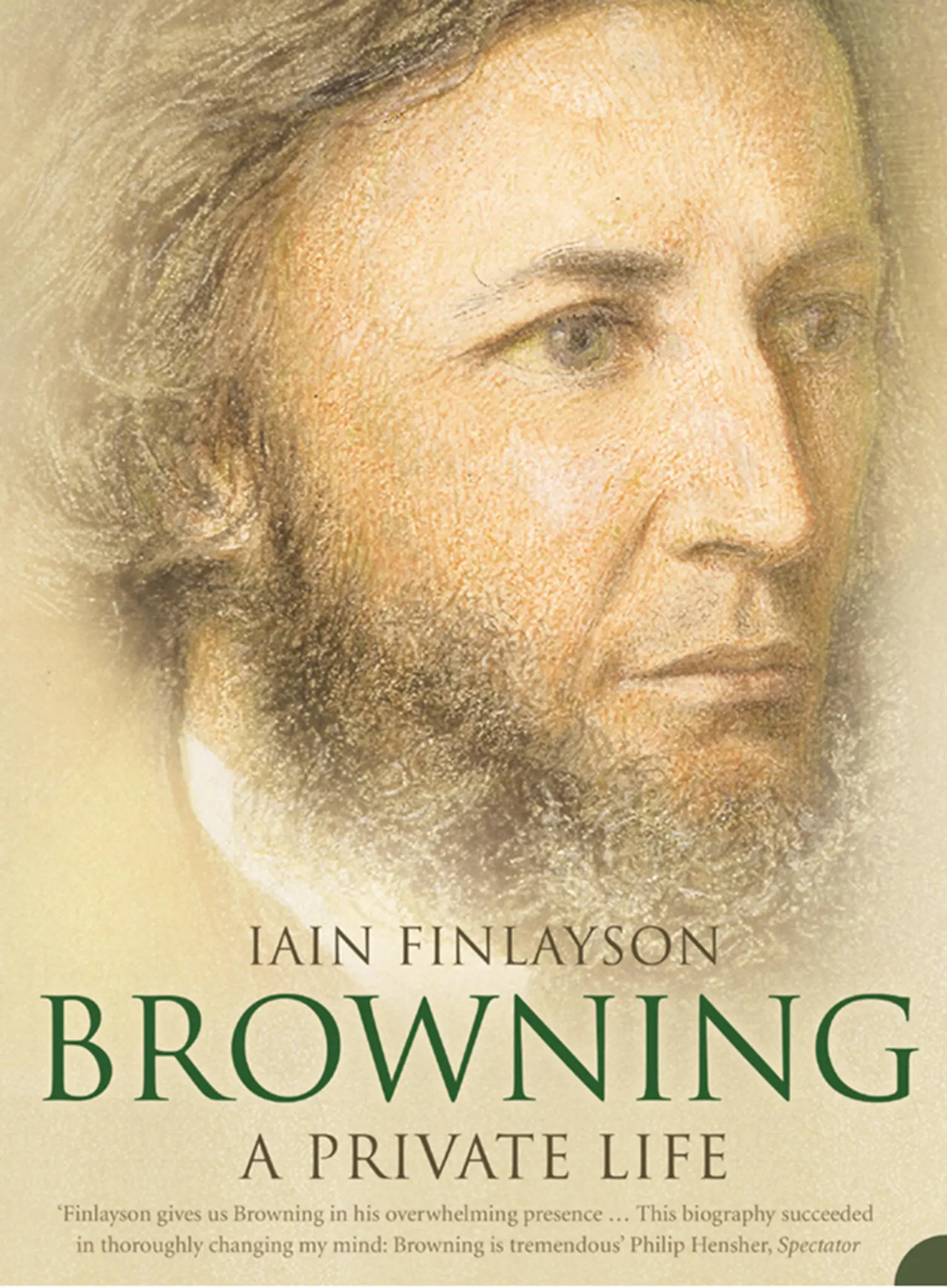
- Название:Browning
- Автор:
- Жанр:
- Год:неизвестен
- ISBN:нет данных
- Рейтинг книги:5 / 5. Голосов: 1
-
Избранное:Добавить в избранное
- Отзывы:
-
Ваша оценка:
Browning: краткое содержание, описание и аннотация
Предлагаем к чтению аннотацию, описание, краткое содержание или предисловие (зависит от того, что написал сам автор книги «Browning»). Если вы не нашли необходимую информацию о книге — напишите в комментариях, мы постараемся отыскать её.
Browning — читать онлайн ознакомительный отрывок
Ниже представлен текст книги, разбитый по страницам. Система сохранения места последней прочитанной страницы, позволяет с удобством читать онлайн бесплатно книгу «Browning», без необходимости каждый раз заново искать на чём Вы остановились. Поставьте закладку, и сможете в любой момент перейти на страницу, на которой закончили чтение.
Интервал:
Закладка:
That said, introductory notes by Reuben Browning to a small volume of sketches by Robert Browning senior refer kindly to his stepbrother’s bibliophily and store of learning—however much at random and magpie-like it may have been acquired: ‘The love of reading attracted him by sympathy to books: old books were his delight, and by his continual search after them he not only knew all the old books-stalls in London, but their contents, and if any scarce work were spoken of, he could tell forthwith where a copy of it might be had. Nay, he would even describe in what part of the shop it was placed, and the price likely to be asked for it.’ 8 So, ‘with the scent of a hound and the snap of a bull-dog’ for an old or rare book, Mr Browning acquired learning and a library.
‘Thus his own library became his treasure,’ remarked Reuben Browning. ‘His books, however, were confessedly not remarkable for costly binding, but for their rarity or for interesting remarks he had to make on most of them; and his memory was so good that not infrequently, when a conversation at his table had reference to any particular subject, has he quietly left the room and in the dark, from a thousand volumes in his library, brought two or three illustrations of the point under discussion.’ The point under discussion, however esoteric, would rarely defeat Mr Browning senior’s search for an apposite reference: ‘His wonderful store of information,’ wrote Reuben Browning, ‘might really be compared to an inexhaustible mine. It comprised not merely a thorough scholastic outline of the world, but the critical points of ancient and modern history, the lore of the Middle Ages, all political combinations of parties, their descriptions and consequences; and especially the lives of the poets and painters, concerning whom he ever had to communicate some interesting anecdote not generally known.’
A portrait of Mr Browning senior, preserved throughout their lives by his children, was ‘blue-eyed and “fresh-coloured”’ and, attested Mr Browning’s daughter Sarianna to Alfred Domett, the man himself ‘had not an unsound tooth in his head’ when he died at the age of 84. In his youth he had been a vigorous sportsman, afflicted only by sore throats and a minor liver complaint. Altogether, his general health and recuperative powers were strongly marked. Alfred Domett took these facts of paternal health and heredity seriously, on the ground that ‘they have their significance with reference to the physical constitution of their son, the poet; which goes so far as to make up what is called “genius”’.
So far as Domett was aware, no cloud shadowed the home life of the Brownings: ‘Altogether, father, mother, only son and only daughter formed a most suited, harmonious and intellectual family, as appeared to me.’ Mr Browning senior, to Domett, was not often a physically significant presence: his friend’s father, ‘of whom I did not see much, seemed in my recollection, what I should be inclined to call a dry adust [ sic ] undersized man; rather reserved; fond particularly of old engravings, of which I believe he had a choice collection.’ Mr Browning took pleasure not only in collecting pictures but also in making them. He was liable to sketch the heads of his colleagues and visitors to the Bank of England, a habit so much encouraged by his employers that hundreds of these whiskered heads survive to this day.
Mr Browning also wrote poetry of a traditional kind. His son in later life praised his father’s verses to Edmund Gosse, declaring ‘that his father had more true poetic genius than he has’. Gosse, taking this with scarcely too gross a pinch of salt and allowing for filial piety, kindly but rigorously comments that, ‘Of course the world at large will answer, “By their fruits shall ye know them,” and of palpable fruit in the way of published verse the elder Mr Browning has nothing to show.’ The elder Browning’s poetic taste was more or less exclusively for double or triple rhyme, and especially for the heroic couplet, which he employed with ‘force and fluency’. Gosse goes on to quote the more celebrated son describing the moral and stylistic vein of the father’s vigorous verses ‘as that of a Pope born out of due time’. Mr Browning had been a great classicist and a lover of eighteenth-century literature, the poetry of that period having achieved, in his estimation, its finest flowering in the work of Alexander Pope. Though his son’s early poetry, Pauline and Paracelsus , confounded him, Mr Browning senior forgave the otherwise impenetrable Sordello because—says William Sharp in his Life of Browning —‘it was written in rhymed couplets’.
Pope, according to the critic Mark Pattison, ‘was very industrious, and had read a vast number of books, yet he was very ignorant; that is, of everything but the one thing which he laboured with all his might to acquire, the art of happy expression. He read books to find ready-made images and to feel for the best collocations of words. His memory was a magazine of epithets and synonyms, and pretty turns of language.’ Mr Browning senior’s satirical portraits of friends and colleagues are said to be very Pope-ish in expression, quick sketches reminiscent in their style of Pope’s rhetorical (often oratorical) couplets. It is further said that he was incapable of portraying anyone other than as a grotesque. The sketch of his wife is certainly none too flattering.
This domestic, middle-class idyll, quiet-flowing and given muted colour by art, poetry, music, bibliophily and decent religious observances, was touching to Alfred Domett, who recollected his serene memories of the Browning family in the tranquillity that fell upon him after leaving public office in New Zealand and returning to London to look up an old friend now celebrated as an important poet and public figure.
Mr Browning, like his wife, became a Dissenter and a Nonconformist in middle life, though it had taken Sarah Anna Browning time and energy to persuade him from the Episcopal communion. In his youth, he had held principles and expressed opinions, uncompromisingly liberal, that had all but brought him to ruin—certainly had distanced him from the prospect of maintaining at least, perhaps increasing, the family fortune that derived from estates and commercial interests in the West Indies. His father, the first Robert Browning, had been born the eldest son in 1749 to Jane Morris of Cranborne, Dorset, wife to Thomas Browning who in 1760 had become landlord of Woodyates Inn, close to the Dorset-Wiltshire border, which he had held on a 99-year lease from the Earl of Shaftesbury. Thomas and Jane Browning produced five more children, three sons (one of whom died young) and two daughters.
Robert the First, as he may here be styled, was to become grandfather of the poet. He was recommended by Lord Shaftesbury for employment in the Bank of England, where he served for the whole of his working life, fifty years, from August 1769, when he would have been about the age of twenty, becoming Principal of the Bank Stock Office, a post of some considerable prestige which implied wide contact with influential financiers. This first Robert Browning was no man, merely, of balance sheets and bottom-polished trousers: at about the age of forty, he vigorously assisted, as a lieutenant in the Honourable Artillery Company, in the defence of the Bank of England during the Gordon Riots of 1780.
In 1778, he married Margaret Morris Tittle, a lady who had been born in the West Indies, reputedly a Creole (and said, by some, to have been darker than was then thought decent), by whom he sired three children—Robert, the eldest, being born on 6 July 1782 at Battersea. A second son, William, was born and died in 1784. A daughter, Margaret—who remained unmarried and lived quietly until her death in 1857 (or 1858, according to a descendant, Vivienne Browning)—was born in 1783. Nothing more is heard of Margaret, beyond a reference by Cyrus Mason, a Browning cousin, who in later life composed a memoir in which he wrote that ‘Aunt Margaret was detected mysteriously crooning prophecies over her Nephew, behind a door at the house at Camberwell.’
Читать дальшеИнтервал:
Закладка:
Похожие книги на «Browning»
Представляем Вашему вниманию похожие книги на «Browning» списком для выбора. Мы отобрали схожую по названию и смыслу литературу в надежде предоставить читателям больше вариантов отыскать новые, интересные, ещё непрочитанные произведения.





Обсуждение, отзывы о книге «Browning» и просто собственные мнения читателей. Оставьте ваши комментарии, напишите, что Вы думаете о произведении, его смысле или главных героях. Укажите что конкретно понравилось, а что нет, и почему Вы так считаете.