Sharan B. Merriam - Learning in Adulthood
Здесь есть возможность читать онлайн «Sharan B. Merriam - Learning in Adulthood» — ознакомительный отрывок электронной книги совершенно бесплатно, а после прочтения отрывка купить полную версию. В некоторых случаях можно слушать аудио, скачать через торрент в формате fb2 и присутствует краткое содержание. Жанр: unrecognised, на английском языке. Описание произведения, (предисловие) а так же отзывы посетителей доступны на портале библиотеки ЛибКат.
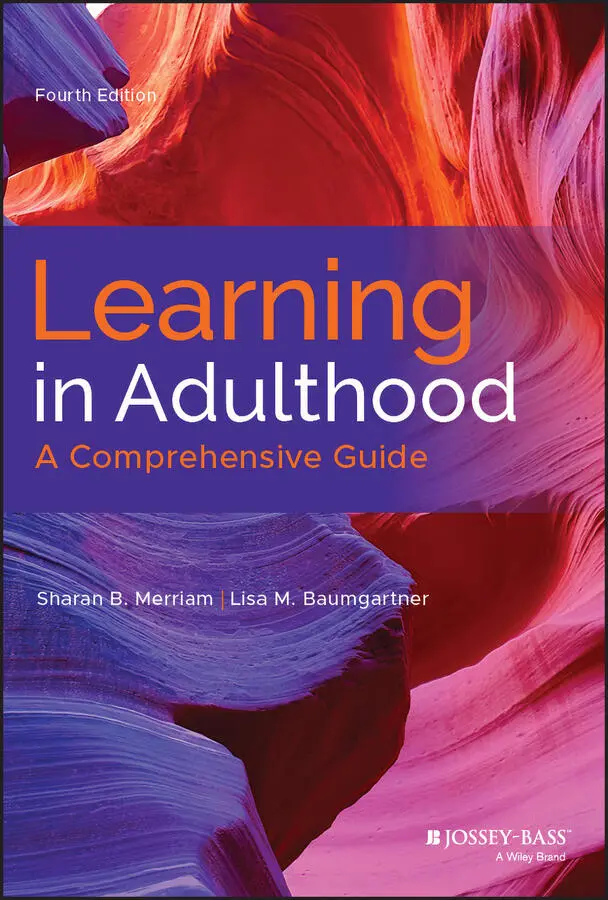
- Название:Learning in Adulthood
- Автор:
- Жанр:
- Год:неизвестен
- ISBN:нет данных
- Рейтинг книги:4 / 5. Голосов: 1
-
Избранное:Добавить в избранное
- Отзывы:
-
Ваша оценка:
Learning in Adulthood: краткое содержание, описание и аннотация
Предлагаем к чтению аннотацию, описание, краткое содержание или предисловие (зависит от того, что написал сам автор книги «Learning in Adulthood»). Если вы не нашли необходимую информацию о книге — напишите в комментариях, мы постараемся отыскать её.
has been the definitive guide in the field of adult education. Now in its fourth edition, this comprehensive volume is fully revised to reflect the latest developments in theory, research, and practice. The authors integrate foundational research and current knowledge to present fresh, original perspectives on teaching and learning in adulthood. Written by internationally-recognized experts, this market-leading guide draws from work in sociology, philosophy, critical social theory, psychology, and education to provide an inclusive overview of adult learning.
Designed primarily for educators of adults, this book is accessible for readers new to adult education, yet suitably rigorous for those more familiar with the subject. Content is organized into four practical parts, covering topics such as the social context of adult learning, self-directed and transformational learning, postmodern and feminist perspectives, cognitive development in adulthood, and more. Offering the most comprehensive single-volume treatment of adult learning available, this landmark text:
Offers a wide-ranging perspective on adult learning Synthesizes the latest thinking and work in the field Includes coverage of the sociocultural perspectives of adult learning Explores the broader social implications of adult education
is an indispensable resource for educators and administrators involved in teaching adults, as well as faculty and students in graduate programs in adult education.
Learning in Adulthood — читать онлайн ознакомительный отрывок
Ниже представлен текст книги, разбитый по страницам. Система сохранения места последней прочитанной страницы, позволяет с удобством читать онлайн бесплатно книгу «Learning in Adulthood», без необходимости каждый раз заново искать на чём Вы остановились. Поставьте закладку, и сможете в любой момент перейти на страницу, на которой закончили чтение.
Интервал:
Закладка:
The most vexing issue, one raised earlier with regard to online learning, is the question of access. As Boshier (2005, p. 376) points out, “[L]ifelong learning is used as a rationale for inflicting (often oppressive and authoritarian) forms of mandatory continuing education on citizens already marginalized and experiencing social difficulties.” Illeris (2004a) notes that although all the international reports “are quite explicit about the necessity of giving priority to those who are poorest in economic, social, and educational terms,” he wonders if in reality this is happening “in a way that is relevant seen from the life situation and perspectives of these participants” (p. 34). Finally, Holford and Jarvis (2000) raise the fundamental question of who benefits in the learning society, pointing out that the rhetoric and the reality do not match. For example, lifelong learning with regard to the workplace “will emphasize types of learning and knowledge that make sense in concrete contexts and will be widely available. Unfortunately—whatever the potential benefits to all of privileging practical knowledge—access to learning opportunities at work remains highly unequal” (p. 655).
Despite the issues involved in a promoting the notion of lifelong learning, the concept does seem to have some usefulness in conveying the wide variety of learning activities and sites (including formal, nonformal, and informal) where it can occur. UNESCO's Institute for Lifelong Learning (UIL), for example, has identified three themes central to promoting lifelong learning: “(1) advocacy for lifelong learning through global policy dialogue; (2) advancing research and practice in the recognition, validation and accreditation of non-formal and informal learning; and (3) building capacity in UNESCO Member States for lifelong learning policy-making” (UIL, 2011, p. 11). Lifelong learning also reflects what some see as the “postmodern” condition, full of change and opportunity. As Edwards and Usher (2000) write, “[C]hange and uncertainty require lifelong learning and ‘lifelong learning’ is itself a signifier of the uncertainty and change of the contemporary” (p. 99).
This notion of change and uncertainty also underlies the concept of the learning society. Just as the learning organization is designed to respond to environmental and economic developments, the learning society acts in response to social change: “The more prevalent or profound the changes that occur in a society, the greater the likelihood that it will be regarded as a learning society” (Jarvis, 2004, p. 15). China is a prime example. Undergoing enormous change, the Sixteenth Congress of the Chinese Communist Party in 2002 declared China's intention to promote lifelong learning and create a learning society. To bring about this learning society, the government has set up and is supporting 61 experimental learning communities throughout the nation. In China, lifelong learning is operated through different social sectors in the community, which includes not only efforts from educational institutions but also non-educational sectors such as community agencies, health care, and business arenas (Chang, 2015). Using the present administrative infrastructure, which links provinces, municipalities, districts, streets, and neighborhoods, these communities are engaging people of all ages in nonformal and informal learning activities designed to bring learning to the fore as a priority in their lives and in their communities. Local governments in the experiment areas have integrated the work of building the learning community into their administrative responsibilities; learning streets and learning families in these local learning communities attest to the scope of these efforts (Bo Chang, personal communication, March 15, 2018). In fact, by 2012, 80% of the streets in Beijing had established community education or learning centers (Yuan, 2012).
The magnitude of China's efforts to create a learning society makes the concept difficult to grasp. It is perhaps easier to think in terms of learning “regions” or learning communities, cities, towns, or villages. Learning regions, according to Walters (2005), refer to a geographic area of any size that has made a commitment to linking “lifelong learning with economic development to compete globally” (p. 360). Scott (2017) explains that the concept of learning cities “transcends education and learning from formative schools and expands across diverse sectors of communities including business, environment, arts, recreation, technology, public health, and community service” (p. 559). Watson and Wu (2015) emphasize the fluidity of the concept, pointing out that in the United States, “learning cities evolved from the learning society and lifelong education and learning movements and advances multiple forms of communities of learning” (p. 20).
Also, according to Kearns (2015), three generations of the learning city can be detected. The first generation was in the West (United Kingdom, Germany, Canada, Australia), but this early development “has not been sustained” (p. 153). The second generation occurred in East Asia (especially China, Korea, and Taiwan) in response to socioeconomic transformations. As Han and Makino (2013) note in their analysis of learning cities in Japan, China, and Korea, learning cities was an efficient mechanism for governing bodies “to mobilise citizens' learning that enhanced personal development, economic prosperity and social inclusion” (p. 144). The third generation is marked by innovative initiatives spurred by UNES-CO international conferences on learning cities in Beijing in 2013, Hamburg in 2015, and Mexico City in 2016. The important characteristics of learning regions such as a city, state, or province is that all forms of learning—informal, nonformal, and formal—are promoted for all ages. As Boshier (2005) explains:
In a learning city (town or village) there are attempts to foster all forms of learning for citizens old and young in many contexts… . Learning cities are committed to learning as a core aspect of development. As well as catching dogs and servicing sewers, the city fosters learning. They seek to sustain economic activity by building social capital… . A learning city (town or village) is: a form of community development in which local people from every community sector act together to enhance the social, economic, cultural and environmental conditions of their community. (pp. 376–377)
Boshier also includes learning festivals as part of the learning society. Such learning festivals are part learning, part cultural expression, and part entertainment. What is key to learning regions, cities, or festivals is not technology, which “helps but is not essential. What matters most are local places and spaces” (Boshier, 2005, p. 376).
The learning society then can be considered as an expression of lifelong learning, one that is place-bound. What it means to be a learning society (or learning city, community, or region) will differ according to the particular society. What does the learning society look like, for example, in “middle-income countries like Brazil, India and South Africa” or “in contexts of widespread poverty and social polarization” (Walters, 2005, p. 360)? Certainly, this concept of the learning society, along with the concept of lifelong learning, will undergo change as societies grapple with implementing learning for all across all segments of society.
Summary
Learning opportunities for adults are found in a variety of settings, from formal institutions to the Internet, to one's home or place of employment. The importance of understanding this vast array of learning opportunities for adults is twofold. First, acknowledging prior knowledge and experiences of learners, wherever gained, is important to the practice of adult educators. Second, if more than just formal types of adult education are made visible, individual learners, even those without formal schooling, may be better able to recognize their abilities and skills as lifelong learners.
Читать дальшеИнтервал:
Закладка:
Похожие книги на «Learning in Adulthood»
Представляем Вашему вниманию похожие книги на «Learning in Adulthood» списком для выбора. Мы отобрали схожую по названию и смыслу литературу в надежде предоставить читателям больше вариантов отыскать новые, интересные, ещё непрочитанные произведения.











Обсуждение, отзывы о книге «Learning in Adulthood» и просто собственные мнения читателей. Оставьте ваши комментарии, напишите, что Вы думаете о произведении, его смысле или главных героях. Укажите что конкретно понравилось, а что нет, и почему Вы так считаете.