Sharan B. Merriam - Learning in Adulthood
Здесь есть возможность читать онлайн «Sharan B. Merriam - Learning in Adulthood» — ознакомительный отрывок электронной книги совершенно бесплатно, а после прочтения отрывка купить полную версию. В некоторых случаях можно слушать аудио, скачать через торрент в формате fb2 и присутствует краткое содержание. Жанр: unrecognised, на английском языке. Описание произведения, (предисловие) а так же отзывы посетителей доступны на портале библиотеки ЛибКат.
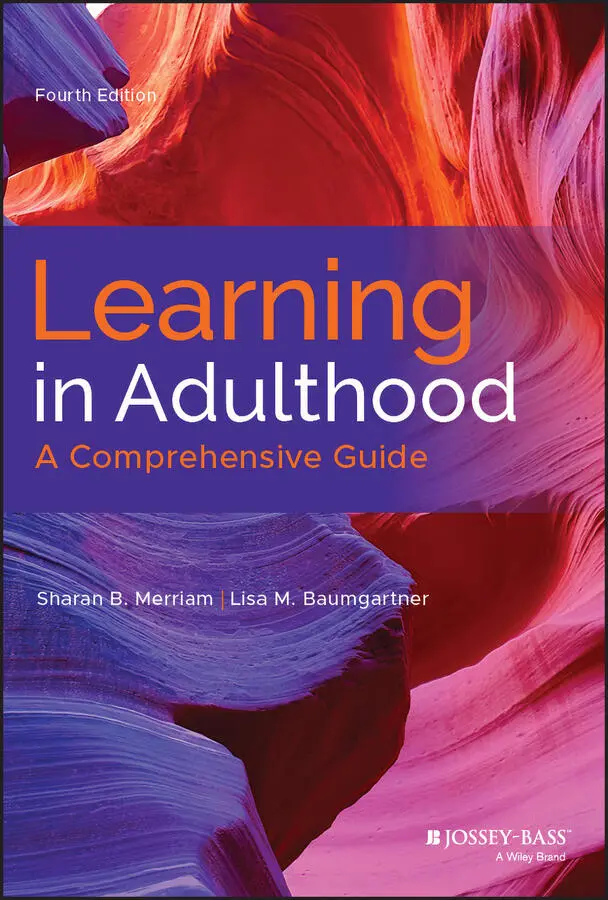
- Название:Learning in Adulthood
- Автор:
- Жанр:
- Год:неизвестен
- ISBN:нет данных
- Рейтинг книги:4 / 5. Голосов: 1
-
Избранное:Добавить в избранное
- Отзывы:
-
Ваша оценка:
Learning in Adulthood: краткое содержание, описание и аннотация
Предлагаем к чтению аннотацию, описание, краткое содержание или предисловие (зависит от того, что написал сам автор книги «Learning in Adulthood»). Если вы не нашли необходимую информацию о книге — напишите в комментариях, мы постараемся отыскать её.
has been the definitive guide in the field of adult education. Now in its fourth edition, this comprehensive volume is fully revised to reflect the latest developments in theory, research, and practice. The authors integrate foundational research and current knowledge to present fresh, original perspectives on teaching and learning in adulthood. Written by internationally-recognized experts, this market-leading guide draws from work in sociology, philosophy, critical social theory, psychology, and education to provide an inclusive overview of adult learning.
Designed primarily for educators of adults, this book is accessible for readers new to adult education, yet suitably rigorous for those more familiar with the subject. Content is organized into four practical parts, covering topics such as the social context of adult learning, self-directed and transformational learning, postmodern and feminist perspectives, cognitive development in adulthood, and more. Offering the most comprehensive single-volume treatment of adult learning available, this landmark text:
Offers a wide-ranging perspective on adult learning Synthesizes the latest thinking and work in the field Includes coverage of the sociocultural perspectives of adult learning Explores the broader social implications of adult education
is an indispensable resource for educators and administrators involved in teaching adults, as well as faculty and students in graduate programs in adult education.
Learning in Adulthood — читать онлайн ознакомительный отрывок
Ниже представлен текст книги, разбитый по страницам. Система сохранения места последней прочитанной страницы, позволяет с удобством читать онлайн бесплатно книгу «Learning in Adulthood», без необходимости каждый раз заново искать на чём Вы остановились. Поставьте закладку, и сможете в любой момент перейти на страницу, на которой закончили чтение.
Интервал:
Закладка:
Formal education institutions are experimenting with eLearning using various platforms and technologies in an effort to draw learners. The use of social media, virtual reality, podcasting, and MOOCs (Massive Open Online Courses) are just some examples. In addition to various platforms, there is growing attention to designing course offerings in this mode (Bierema, 2014; Harasim, 2017; King, 2017) and to issues of support for instructors, students, and the technology itself (Gibson, 2017).
The phenomenal growth of online learning is reflected in some statistics that will be outdated before this book is published. Pew Research Center (Anderson, Perrin, Jiang, & Kumar, 2019) estimates that 90% of Americans use the Internet. The 10% who do not use the Internet tend to be older, living in more rural areas, and of lower income. As online learning has become almost commonplace in higher education, research has shifted from its technical aspects and its staying power to more pedagogical concerns including curriculum design and online facilitation methods (see Bierema, 2014; King, 2017). At the same time, there are overarching concerns about this forum for learning. One big concern is with access, what some are characterizing as the digital divide. Distance education began in the nineteenth century to serve those who had little or no access to the traditional education system. Although online learning is also designed to open up access, and does so for thousands of adults who need the flexibility of time and space for their learning, it may also be widening the gap between the haves and the have-nots:
Roughly three in ten adults with household incomes below $30,000 a year (29%) don't own a smartphone. More than four in ten don't have home broadband services (44%) or a traditional computer (46%)…. Roughly two-thirds of adults living in high-earning households (64%) have home broadband services, a smartphone, a desktop or laptop computer and a tablet, compared with 18% of those living in lower-income households. (Anderson & Kumar, 2019, para. 2–3)
A more recent study on health-related Internet use among older adults found that “overall, the digital health divide between different demographic groups has narrowed, especially in terms of gender, racial/ethnic group, rural/urban residence and various health statuses; however, age, education, and household income remain persistent predictors of the digital divide” (Hong & Cho, 2017, p. 856).
From a global perspective, it is estimated that of the world's 6.4 billion people, 54.4% are Internet users (Internet World Stats, 2018). But the digital divide is not a matter of access alone. In a study of rural learners who had access to computers in community settings, Page (2005) found that other sociocultural and psychological factors impeded their use. Factors such as “uncertainty about change, fear of technology, need for guidance, inexperience, relevance, the social context of the persistently impoverished county, and the perceived need” revealed the complexity of the digital divide (p. 334).
There are other issues of concern to adult educators when considering the growth of online learning. Bok (2003) and others talk about the commercialization of Internet education. A number of private, for-profit institutions have sprung up promising learning anytime, anywhere, for anyone. But the promise of convenience and ease (for a price) may fool some students in terms of the commitment involved and the independent learning skills needed. Or, these institutions may have poor quality courses if instructors at the institution do not live up to its advertising. And, according to a September 22, 2016 Los Angeles Times (Associated Press, 2016) article, private, for-profit online higher education institutions are in fact experiencing major declines in enrollment. This decline seems to be benefiting traditional universities which have attracted students with innovative online programs.
In an analysis of the rhetoric of online learning, Kelland (2005) critiques three themes that characterize the promotion of online learning. The first theme, which she calls a myth, is that online learning is inclusive and democratic. In promoting online learning to disadvantaged groups (who, as we saw earlier, often do not have the cultural capital to take advantage of it), governments and institutions “continue to ignore barriers that discourage, and even prevent, disadvantaged learners from participating in on-campus programs” (p. 254). The second theme, that online learning is accessible and flexible, is countered by the digital divide that characterizes even Western countries such as the United States. The third theme, that online learning is cost effective, does not necessarily mean that lower institutional costs are passed on to students.
In summary, online or eLearning presents both opportunities and challenges to adult educators. As we have seen, online learning cuts across formal, nonformal, and informal settings. What we as adult educators need to think about is how the Internet is facilitating adult learning in all three settings and how we can maximize its potential. At the same time, online learning presents challenges particularly with regard to access, even in the information-rich, technologically advanced United States. Access issues, which are discussed more fully in the next chapter on participation, have haunted the field of adult education since its inception. It appears that online learning is yet another manifestation of this worrisome social issue at the heart of our adult education practice.
Organizational Learning and the Learning Organization
The concepts of organizational learning and the learning organization are so interrelated that it is difficult to speak of one without reference to the other. Illeris (2004b, p. 88) concurs, stating that “there is no clear distinction” between the two “except for the discussion on what exactly it means that an organization learns.” In his recent book, Illeris (2017) even suggests it might be a good idea to move away from these terms and instead focus on “learning in working life” (p. 209). Others have suggested merging the two concepts into one framework (see, for example, Ege, Esen, & Asik Dizdar, 2017). Indeed, sections on the learning organization and organizational learning in the International Encyclopedia of Adult Education (English, 2005b) position each term with reference to the other. Nevertheless, there is a vast interconnected and overlapping literature on this topic consisting of articles, books, and entire journals (see for example The Learning Organization , or HR, Learning, and Organization Studies ) devoted to this topic. Recognizing the embeddedness of one concept in the other, we begin with a discussion of organizational learning, a concept that preceded that of the learning organization.
Learning has always gone on in organizations. At least since the Industrial Revolution, employees have had to be trained in the technical skills needed for their jobs. This learning, or more precisely, training, was “removed from the immediate work environment on which it [was] expected to have an impact” through the “‘transfer’ of skills and understanding back to the milieu” (Laiken, 2001, p. 6). As much of this training failed to transfer, and as organizations entered a more competitive environment, broader thinking about learning in organizations emerged. Argyris and Schön's (1978) book, Organizational Learning: A Theory of Action Perspective , defined the concept of organizational learning. As described by them,
Organizational learning occurs when members of the organization act as learning agents of the organization, responding to changes in the internal and external environments of the organization by detecting and correcting errors in organizational theory-in-use, and embedding the results of their enquiry in private images and shared maps of organization (p. 16).
Читать дальшеИнтервал:
Закладка:
Похожие книги на «Learning in Adulthood»
Представляем Вашему вниманию похожие книги на «Learning in Adulthood» списком для выбора. Мы отобрали схожую по названию и смыслу литературу в надежде предоставить читателям больше вариантов отыскать новые, интересные, ещё непрочитанные произведения.











Обсуждение, отзывы о книге «Learning in Adulthood» и просто собственные мнения читателей. Оставьте ваши комментарии, напишите, что Вы думаете о произведении, его смысле или главных героях. Укажите что конкретно понравилось, а что нет, и почему Вы так считаете.