Tapas K. Das - Industrial Environmental Management
Здесь есть возможность читать онлайн «Tapas K. Das - Industrial Environmental Management» — ознакомительный отрывок электронной книги совершенно бесплатно, а после прочтения отрывка купить полную версию. В некоторых случаях можно слушать аудио, скачать через торрент в формате fb2 и присутствует краткое содержание. Жанр: unrecognised, на английском языке. Описание произведения, (предисловие) а так же отзывы посетителей доступны на портале библиотеки ЛибКат.
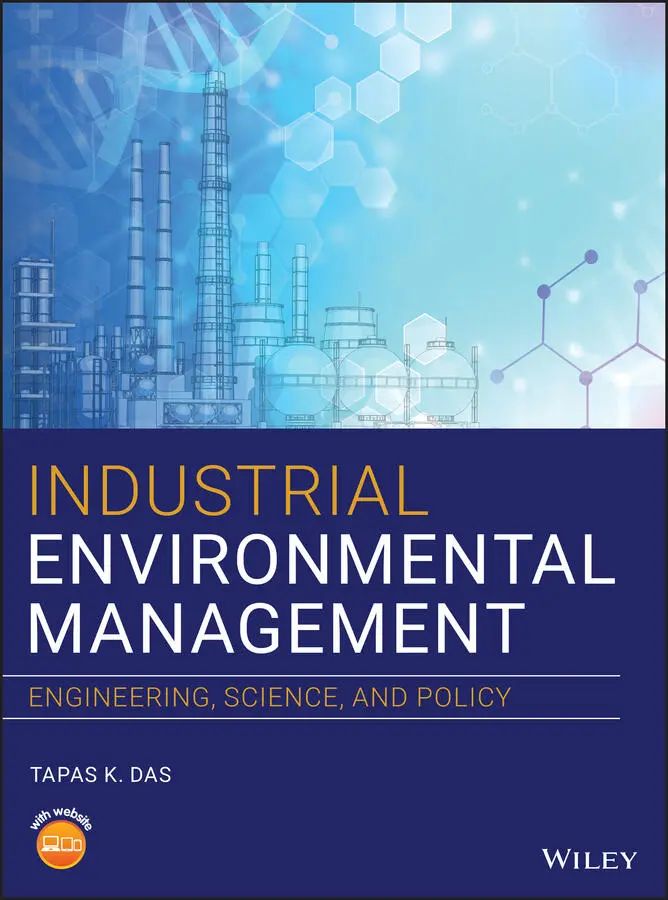
- Название:Industrial Environmental Management
- Автор:
- Жанр:
- Год:неизвестен
- ISBN:нет данных
- Рейтинг книги:5 / 5. Голосов: 1
-
Избранное:Добавить в избранное
- Отзывы:
-
Ваша оценка:
Industrial Environmental Management: краткое содержание, описание и аннотация
Предлагаем к чтению аннотацию, описание, краткое содержание или предисловие (зависит от того, что написал сам автор книги «Industrial Environmental Management»). Если вы не нашли необходимую информацию о книге — напишите в комментариях, мы постараемся отыскать её.
Industrial Environmental Management: Engineering, Science, and Policy Provides end-of-chapter questions along with a solutions manual for adopting professors Covers a wide range of interdisciplinary areas that makes it suitable for different branches of engineering such as wastewater management and treatment; pollutant sampling; health risk assessment; waste minimization; lean manufacturing; and regulatory information Shows how industrial environmental management is connected to areas like sustainable engineering, sustainable manufacturing, social policy, and more Contains theory, applications, and real-world problems along with their solutions Details waste recovery systems
is an ideal textbook for junior and senior level students in multidisciplinary engineering fields such as chemical, civil, environmental, and petroleum engineering. It will appeal to practicing engineers seeking information about sustainable design principles and methodology.
Industrial Environmental Management — читать онлайн ознакомительный отрывок
Ниже представлен текст книги, разбитый по страницам. Система сохранения места последней прочитанной страницы, позволяет с удобством читать онлайн бесплатно книгу «Industrial Environmental Management», без необходимости каждый раз заново искать на чём Вы остановились. Поставьте закладку, и сможете в любой момент перейти на страницу, на которой закончили чтение.
Интервал:
Закладка:
Example 2.3
National Ambient Air Quality Standards (NAAQS) are not promulgated by EPA for which of the following pollutants?
1 Nitrogen dioxide (NO2)
2 Sulfur dioxide (SO2)
3 Mercury
4 Ozone
Example 2.4
Primary NAAQS are established to
1 protect children from toxic air pollutants
2 protect the public welfare, including protection against decreased visibility, damage to animals, crops, vegetation, and buildings
3 protect the public health, including the health of “sensitive” populations such as asthmatics, children, and the elderly
4 both B and C
Example 2.5
A waste is determined to be characteristically toxic under the Resource Conservation and Recovery Act (RCRA) if
1 the waste contains specific compounds at greater than threshold concentrations
2 it is determined that chemicals in the waste are bioaccumulative, toxic, and persistent in the environment
3 leachate from the waste contains specific compounds at greater than threshold concentrations
4 exposure to the waste causes adverse health effects in laboratory animals
Solution
The leachability of specific compounds at greater than threshold concentration determines whether a waste is characteristically RCRA hazardous for toxicity.
Example 2.6
Under Superfund legislation, a company can be held liable for all costs associated with remediation of a contaminated site.
1 Only if the company disposed of wastes at the site illegally
2 Only if the company is solely responsible for contaminated at the site
3 Only if the company disposed of waste at the site illegally and is solely responsible for contamination at the site
4 If the company disposed of wastes at the site legally and contributed only a small fraction of wastes disposed of at the site
Solution
The strict, joint, and several provisions of the Superfund legislation mean that a company might be held responsible for all of the cleanup costs associated with a site, even if the company's activities were legal and contributed only a small fraction of the contamination at the site.
Example 2.7
ISO 14000 refers to a set of voluntary standards that include
1 worker safety standards
2 specific techniques for monitoring and sampling
3 standards for environmental management systems
4 concentrations of pollutants that are allowed after site remediation is completed
Solution
ISO 14000 includes standards for environmental management systems.
Example 2.8
A parts manufacturer uses a solvent degreaser for cleaning parts. The solvent used in the degreaser is a suspected carcinogen. The manufacturer reduces the amount of solvent it disposes of by filtering dirty solvent and returning it to the degreaser. This pollution prevention strategy is known as
1 source reduction
2 in‐process recycling
3 out‐of‐process recycling
4 end‐of‐pipe treatment
Solution
Source reduction would be a reduction in the amount of solvent used; in this case, no changes are made to eliminate or reduce the use of the solvent. An example of out‐of‐process recycle would be to send the solvent off‐site to be recycled. End‐of‐pipe treatment would consist of treating the solvent to make it less toxic before disposing of it. In this case, the solvent is filtered and returned to the same equipment that created the dirty solvent. Therefore, this is in‐process recycling.
Example 2.9
Mixed wastes are wastes that
1 contain radioactive wastes regulated under the Atomic Energy Act (AEA) and hazardous wastes regulated under the Resource Conservation and Recovery Act (RCRA)
2 are comprised of both solid and liquids
3 include both nonhazardous and hazardous wastes regulated under RCRA
4 contain municipal solid wastes and hazardous wastes regulated under RCRA
Solution
Mixed waste is defined as a waste mixture that contains both radioactive materials subject to the AEA and a hazardous waste component regulated under the RCRA.
Problems
1 2.1 Develop a short essay on the water law policies in a country of your choice.
2 2.2 Develop a short essay on the water law policies in a country in Africa.
3 2.3 Develop a short essay on the water law policies in a country in Europe.
4 2.4 Develop a short essay on the water law policies in a country in Asia.
5 2.5 Provide terms and definitions for “environmental management.”Defining the following terms:E Pollution preventionF Source reductionG In‐process vs on‐site vs off‐site recyclingH Waste treatmentI DisposalJ Direct release
6 2.6 Analysis of Federal Environmental Statutes.
7 2.7 The Federal Insecticide, Fungicide, and Rodenticide Act (FIFRA) of 1972.
8 2.8 Enforcement
9 2.9 The Occupational Safety and Health Act (OSH Act) of 1970.
10 2.10 Clean Air Act (CAA) of 1970.
11 2.11 The Clean Water Act (CWA) of 1972.
12 2.12 Resource Conservation and Recovery Act (RCRA) of 1976.
13 2.13 The Comprehensive Environmental Response, Compensation, and Liability Act (CERCLA) of 1980.
14 2.14 The Emergency Planning and Community Right to Know Act (EPCRA).
15 2.15 Pollution Prevention Act of 1990.
16 2.16 U.S. Supreme Court Decision on the Clean Air Act and Greenhouse Gases.
17 2.17 Superfund Site Investigation Go to the EPA Superfund website.
18 2.18 Premanufacturing Notice from the TSCA Go to the EPA website.
19 2.19 Worker Protection Standard under FIFRA.
20 2.20 Green Jobs and Occupational Safety Issues.
21 2.21 Programs of the Clean Air Act.
22 2.22 National Pollutant Discharge Elimination System of the Clean Water Act.
23 2.23 National Hazardous Waste Biennial Report of RCRA.
24 2.24 “Quality Improvement”: Define the ISO 14000 for an EMS and environmental policy pertinent to product QMS and industrial waste minimization.
References
1 Adler, J.H. (2003). Fables of the Cuyahoga reconstructing a history of environmental protection. Fordham Environmental Law Journal, Case Western Reserve University 14: 95–98, 103–104.
2 AECEN (Asian Environmental Compliance and Enforcement Network) (2018). https://aric.adb.org/initiative/asian‐environmental‐compliance‐and‐enforcement‐network(accessed 5 January 2018).
3 Aldred's Case (1610). 9 Co Rep 57b; (1610) 77 ER 816.
4 Alexiou, A.S. (2013). The Flatiron: The New York City Landmark and the Incomparable City that Arose with It. New York, NY: Thomas Dunne.
5 Allen, D.T. and Shonnard, D.R. (2002). Green Engineering: Environmentally Conscious Design of Chemical Processes. Upper Saddle River, NJ: Prentice‐Hall.
6 Associated Press (2008). Group: stronger warnings needed in Tenn. ash spill, 28 December 2008.
7 Ayres, R. (1989). Technological Transformations and Long Waves. IIASA Report, IIASA, Luxemburg, Austria, RR‐89‐001.
8 Babich, A. (2004). The Apolitical Clinic. Law School, Tulane University, Faculty Notebook.
9 Bajaj, R. (1996). Convention on International Trade in Endangered Species (CITES) and the Wildlife Trade in India. New Delhi, India: Center for Environmental Law.
10 Becker, M. (2011). Correa, indigenous movements, and the writing of a new constitution in Ecuador. Latin American Perspectives 38 (1): 47–62.
11 Beckert, S. (2014). Empire of Cotton: A Global History. New York: Vintage Books Division Penguin Random House.
12 Bell, M.L., Davis, D.L., and Fletcher, T. (2004). A retrospective assessment of mortality from the London Smog Episode of 1952: the role of influenza and pollution. Environmental Health Perspectives 112 (1): 6–8.
Читать дальшеИнтервал:
Закладка:
Похожие книги на «Industrial Environmental Management»
Представляем Вашему вниманию похожие книги на «Industrial Environmental Management» списком для выбора. Мы отобрали схожую по названию и смыслу литературу в надежде предоставить читателям больше вариантов отыскать новые, интересные, ещё непрочитанные произведения.






Обсуждение, отзывы о книге «Industrial Environmental Management» и просто собственные мнения читателей. Оставьте ваши комментарии, напишите, что Вы думаете о произведении, его смысле или главных героях. Укажите что конкретно понравилось, а что нет, и почему Вы так считаете.