Tapas K. Das - Industrial Environmental Management
Здесь есть возможность читать онлайн «Tapas K. Das - Industrial Environmental Management» — ознакомительный отрывок электронной книги совершенно бесплатно, а после прочтения отрывка купить полную версию. В некоторых случаях можно слушать аудио, скачать через торрент в формате fb2 и присутствует краткое содержание. Жанр: unrecognised, на английском языке. Описание произведения, (предисловие) а так же отзывы посетителей доступны на портале библиотеки ЛибКат.
- Название:Industrial Environmental Management
- Автор:
- Жанр:
- Год:неизвестен
- ISBN:нет данных
- Рейтинг книги:5 / 5. Голосов: 1
-
Избранное:Добавить в избранное
- Отзывы:
-
Ваша оценка:
Industrial Environmental Management: краткое содержание, описание и аннотация
Предлагаем к чтению аннотацию, описание, краткое содержание или предисловие (зависит от того, что написал сам автор книги «Industrial Environmental Management»). Если вы не нашли необходимую информацию о книге — напишите в комментариях, мы постараемся отыскать её.
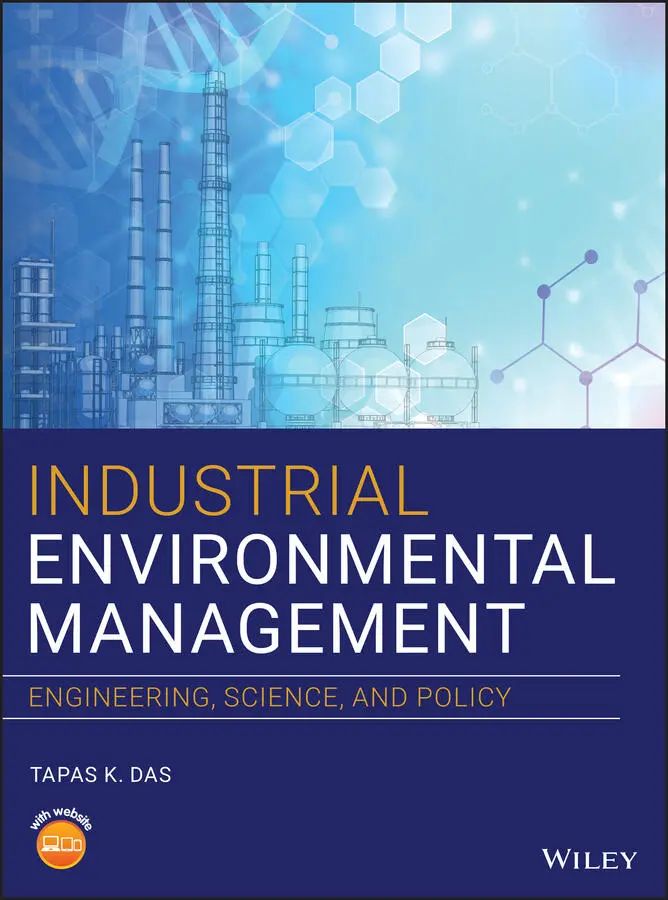
Industrial Environmental Management: Engineering, Science, and Policy Provides end-of-chapter questions along with a solutions manual for adopting professors Covers a wide range of interdisciplinary areas that makes it suitable for different branches of engineering such as wastewater management and treatment; pollutant sampling; health risk assessment; waste minimization; lean manufacturing; and regulatory information Shows how industrial environmental management is connected to areas like sustainable engineering, sustainable manufacturing, social policy, and more Contains theory, applications, and real-world problems along with their solutions Details waste recovery systems
is an ideal textbook for junior and senior level students in multidisciplinary engineering fields such as chemical, civil, environmental, and petroleum engineering. It will appeal to practicing engineers seeking information about sustainable design principles and methodology.
Industrial Environmental Management — читать онлайн ознакомительный отрывок
Ниже представлен текст книги, разбитый по страницам. Система сохранения места последней прочитанной страницы, позволяет с удобством читать онлайн бесплатно книгу «Industrial Environmental Management», без необходимости каждый раз заново искать на чём Вы остановились. Поставьте закладку, и сможете в любой момент перейти на страницу, на которой закончили чтение.
Интервал:
Закладка:
Chapter 3 : This chapter provides a summary of industrial wastewater sources, wastewater characteristics, wastewater treatment, reuse and discharge, industrial sources of air pollutions, inventories, air pollution control, solid waste and hazardous waste characteristics, treatments, and management.
Industrial waste is the waste produced by industrial activity which includes any material that is rendered unusable during a manufacturing process such as that of factories, industries, mills, and mining operations. Mass manufacturing has existed since the start of the Industrial Revolution. Some examples of industrial wastes are discussed including (but not limited to) chemical solvents, paints, sandpaper, paper products, industrial by‐products, metals, plastics, and radioactive wastes.
Toxic waste, chemical waste, industrial solid waste, and municipal solid waste are designations of industrial wastes. Sewage treatment plants can treat some industrial wastes, i.e. those consisting of conventional pollutants such as biochemical oxygen demand, COD, suspended solid, and total suspended solid. Industrial wastes containing toxic pollutants require specialized treatment systems.
Chapter 4 : This chapter describes and deals with various important aspects of selecting the best remedial control technologies for pollutants, managing wastes, monitoring, sampling industrial water, air, and solid and hazardous materials, modes of sample collections, sample analyses by various analytical, physical–chemical methods approved by governmental agency, as required quality control and quality assurance, properly conducted laboratory auditing, testing, monitoring, permitting, report keeping, reporting, and compliance with local, state, and federal governments for discharging wastewater, emitting air, pollutants, and safely disposing of solid and hazardous materials.
Chapter 5 : This chapter addresses risk assessment, which is an organized process used to describe and estimate the likelihood of adverse health and environmental impacts from exposures to chemicals released to air, water, and land. Risk assessment is also a systematic, analytical method used to determine the probability of adverse effects. A common application of risk assessment methods is to evaluate human health and ecological impacts of chemical releases into the environment. Information collected from environmental monitoring or modeling is incorporated into models of worker activity and exposure forms conclusion about the likelihood of adverse effects are formulated. As such, risk assessment is an important tool for making decisions with environmental and public health consequences, along with economic, societal, technological, and political consequences of proposed actions. This chapter addresses the assessment of risks to human health as well as ecological risks and, briefly, ecological risk management. In addition a major section is devoted to industrial and manufacturing process safety, federal and state occupational safety laws and regulations, and management occupational health.
Chapter 6 : This chapter describes the wastes produced by industrial activities, which include materials that are rendered unusable during manufacturing processes such as that of factories, industries, mills, and mining operations. This wastefulness has existed since the start of the Industrial Revolution. Some examples of industrial wastes and sources are chemicals and allied products, solvents, pigments, sludge, metals, ash, paints, furniture and fixtures, paper and allied products, plastics, rubber, leather, textile mill products, petroleum refining and related industries, electronic equipment and components, industrial by‐products, metals, radioactive wastes, miscellaneous manufacturing industries, and the list goes on. Hazardous or toxic wastes, chemical waste, industrial solid waste, and municipal solid waste are also designations of industrial wastes.
More than 12 billion T of industrial wastes are generated annually in the United States alone. This is roughly equivalent to more than 40 T of waste for every man, woman, and a child in the United States. The sheer magnitude of these numbers is cause for big environmental concern and drives us to identify the characteristics of the wastes, the various industrial operations that are generating the waste, the manner in which the waste are being managed, and the industrial pollution prevention policy and strategies. The first portion of this chapter is devoted to the pollution prevention hierarchy. Next there is an overview of how LCA tools can be applied to choose best available technologies (BACT) to minimize the waste at various stages of manufacturing processes of products. Finally, a few case studies on industrial competitive processes and products applying LCA tools are reviewed; and hence, also selections of BACT to demonstrate hierarch pollution prevention (P 2) and environmental performance strategies.
Chapter 7 : The role of economics in pollution prevention is of tantamount important, even as important as the ability to identify technologies changes to the process, new and emerging technologies, ZD technologies', technologies for biobased engineered chemicals, products, renewable energy sources, and associated costs. This chapter shows some methods that can be used to assess the costs of implementing pollution prevention technologies and making cost comparisons to evaluate the cost‐effectiveness of various operations. The concept of best available control technologies is introduced and we analyze the costs and benefits of manufacturing biobased products. The topics treated illustrate that biobased new development can lead to sustainable economic progress and a healthier planet.
Sustainable development is about creating a business climate in which better goods and services are produced using less energy and materials with no or less waste and pollution. Natural steps and systems are a model for thinking about how to produce, consume, and live in sustainable cycles: nature produces little or no waste, relies on free and abundant energy from sun, and uses renewable resources. In this chapter, we focus on a framework that integrates environmental, social, and economic interests into effective chemical and allied business strategies.
Chapter 8 : In this chapter our major focus is on lean manufacturing of various products while applying techniques and methodologies to achieve zero defects in products, and significantly eliminate waste and discharges to environment from the manufacturing process.
The quality of products, processes, and services has become a major decision factor in most industries and businesses today. Regardless of whether the consumer is an individual, a corporation, a military defense program, or a retail store, the consumer is making purchase decisions, he or she is likely to consider quality to be equal in importance to cost and schedule. Consequently, quality improvement has become a major concern to industries and businesses.
Quality means fitness for use with zero defects or zero effects in environmentally conscious manufacturing. For example, you or I may purchase automobiles that we expect to be free of manufacturing defects and that should provide reliable and economical transportation, a retailer buys finished goods with the expectation that they are properly packaged and arranged for easy storage and display, and a manufacturer buys raw material and expects to process it with no rework or scrap. In other words, all consumers expect that the products and services they buy will meet their requirements. These requirements define fitness for use.
Quality or fitness for use is determined through the interaction of quality of design and quality of conformance. Quality of design for environment and other aspects is defined by the different grades or levels of performance, reliability, serviceability, and function that are the result of deliberate engineering and environmental management decisions. By quality of conformance, we mean systematic reduction of variability and elimination of defects until every unit, batch, and product produced is identical in physical and chemical properties ( zero defect and zero effect ).
Читать дальшеИнтервал:
Закладка:
Похожие книги на «Industrial Environmental Management»
Представляем Вашему вниманию похожие книги на «Industrial Environmental Management» списком для выбора. Мы отобрали схожую по названию и смыслу литературу в надежде предоставить читателям больше вариантов отыскать новые, интересные, ещё непрочитанные произведения.






Обсуждение, отзывы о книге «Industrial Environmental Management» и просто собственные мнения читателей. Оставьте ваши комментарии, напишите, что Вы думаете о произведении, его смысле или главных героях. Укажите что конкретно понравилось, а что нет, и почему Вы так считаете.