Fog Computing
Здесь есть возможность читать онлайн «Fog Computing» — ознакомительный отрывок электронной книги совершенно бесплатно, а после прочтения отрывка купить полную версию. В некоторых случаях можно слушать аудио, скачать через торрент в формате fb2 и присутствует краткое содержание. Жанр: unrecognised, на английском языке. Описание произведения, (предисловие) а так же отзывы посетителей доступны на портале библиотеки ЛибКат.
- Название:Fog Computing
- Автор:
- Жанр:
- Год:неизвестен
- ISBN:нет данных
- Рейтинг книги:5 / 5. Голосов: 1
-
Избранное:Добавить в избранное
- Отзывы:
-
Ваша оценка:
Fog Computing: краткое содержание, описание и аннотация
Предлагаем к чтению аннотацию, описание, краткое содержание или предисловие (зависит от того, что написал сам автор книги «Fog Computing»). Если вы не нашли необходимую информацию о книге — напишите в комментариях, мы постараемся отыскать её.
focuses on the technological aspects of employing fog computing in various application domains, such as smart healthcare, industrial process control and improvement, smart cities, and virtual learning environments. In addition, the Machine-to-Machine (M2M) communication methods for fog computing environments are covered in depth.
Presented in two parts—Fog Computing Systems and Architectures, and Fog Computing Techniques and Application—this book covers such important topics as energy efficiency and Quality of Service (QoS) issues, reliability and fault tolerance, load balancing, and scheduling in fog computing systems. It also devotes special attention to emerging trends and the industry needs associated with utilizing the mobile edge computing, Internet of Things (IoT), resource and pricing estimation, and virtualization in the fog environments.
Includes chapters on deep learning, mobile edge computing, smart grid, and intelligent transportation systems beyond the theoretical and foundational concepts Explores real-time traffic surveillance from video streams and interoperability of fog computing architectures Presents the latest research on data quality in the IoT, privacy, security, and trust issues in fog computing
provides a platform for researchers, practitioners, and graduate students from computer science, computer engineering, and various other disciplines to gain a deep understanding of fog computing.
Fog Computing — читать онлайн ознакомительный отрывок
Ниже представлен текст книги, разбитый по страницам. Система сохранения места последней прочитанной страницы, позволяет с удобством читать онлайн бесплатно книгу «Fog Computing», без необходимости каждый раз заново искать на чём Вы остановились. Поставьте закладку, и сможете в любой момент перейти на страницу, на которой закончили чтение.
Интервал:
Закладка:
| DNN | Top-5 error (%) | Latency (ms) | Layers | FLOPs (billion) | Parameters (million) |
| AlexNet | 19.8 | 14.56 | 8 | 0.7 | 61 |
| GoogleNet | 10.07 | 39.14 | 22 | 1.6 | 6.9 |
| VGG-16 | 8.8 | 128.62 | 16 | 15.3 | 138 |
| ResNet-50 | 7.02 | 103.58 | 50 | 3.8 | 25.6 |
| ResNet-152 | 6.16 | 217.91 | 152 | 11.3 | 60.2 |
To address this challenge, the opportunities lie at exploiting the redundancy of DNN models in terms of parameter representation and network architecture. In terms of parameter representation redundancy, to achieve the highest accuracy, state-of-the-art DNN models routinely use 32 or 64 bits to represent model parameters. However, for many tasks like object classification and speech recognition, such high-precision representations are not necessary and thus exhibit considerable redundancy. Such redundancy can be effectively reduced by applying parameter quantization techniques that use 16, 8, or even fewer bits to represent model parameters. In terms of network architecture redundancy, state-of-the-art DNN models use overparameterized network architectures, and thus many of their parameters are redundant. To reduce such redundancy, the most effective technique is model compression. In general, DNN model compression techniques can be grouped into two categories. The first category focuses on compressing large DNN models that are pretrained into smaller ones. For example, [13] proposed a model compression technique that prunes out unimportant model parameters whose values are lower than a threshold. However, although this parameter pruning approach is effective at reducing model sizes, it does not necessarily reduce the number of operations involved in the DNN model. To overcome this issue, [14] proposed a model compression technique that prunes out unimportant filters which effectively reduces the computational cost of DNN models. The second category focuses on designing efficient small DNN models directly. For example, [15] proposed the use of depth-wise separable convolutions that are small and computationally efficient to replace conventional convolutions that are large and computationally expensive, which reduces not only model size but also computational cost. Being an orthogonal approach, [16] proposed a technique referred to as knowledge distillation to directly extract useful knowledge from large DNN models and pass it to a smaller model that achieves similar prediction performance as the large models, but with fewer model parameters and lower computational cost.
3.2.2 Data Discrepancy in Real-world Settings
The performance of a DNN model is heavily dependent on its training data, which is supposed to share the same or a similar distribution with the potential test data. Unfortunately, in real-world settings, there can be a considerable discrepancy between the training data and the test data. Such discrepancy can be caused by variation in sensor hardware of edge devices as well as various noisy factors in the real world that degrade the quality of the test data. For example, the quality of images taken in real-world settings can be degraded by factors such as illumination, shading, blurriness, and undistinguishable background [17] (see Figure 3.1as an example). Speech data sampled in noisy places such as busy restaurants can be contaminated by voices from surround people. The discrepancy between training and test data could degrade the performance of DNN models, which becomes a challenging problem.
To address this challenge, we envision that the opportunities lie at exploring data augmentation techniques as well as designing noise-robust loss functions. Specifically, to ensure the robustness of DNN models in real-world settings, a large volume of training data that contain significant variations is needed. Unfortunately, collecting such a large volume of diverse data that cover all types of variations and noise factors is extremely time consuming. One effective technique to overcome this dilemma is data augmentation. Data augmentation techniques generate variations that mimic the variations occurred in the real-world settings. By using the large amount of newly generated augmented data as part of the training data, the discrepancy between training and test data is minimized. As a result, the trained DNN models become more robust to the various noisy factors in the real world. A technique that complements data augmentation is to design loss functions that are robust to discrepancy between the training data and the test data. Examples of such noise-robust loss functions include triplet loss [18] and variational autoencoder [19]. These noise-robust loss functions are able to enforce a DNN model to learn features that are invariant to various noises that degrade the quality of test data even if the training data and test data do not share a similar distribution.
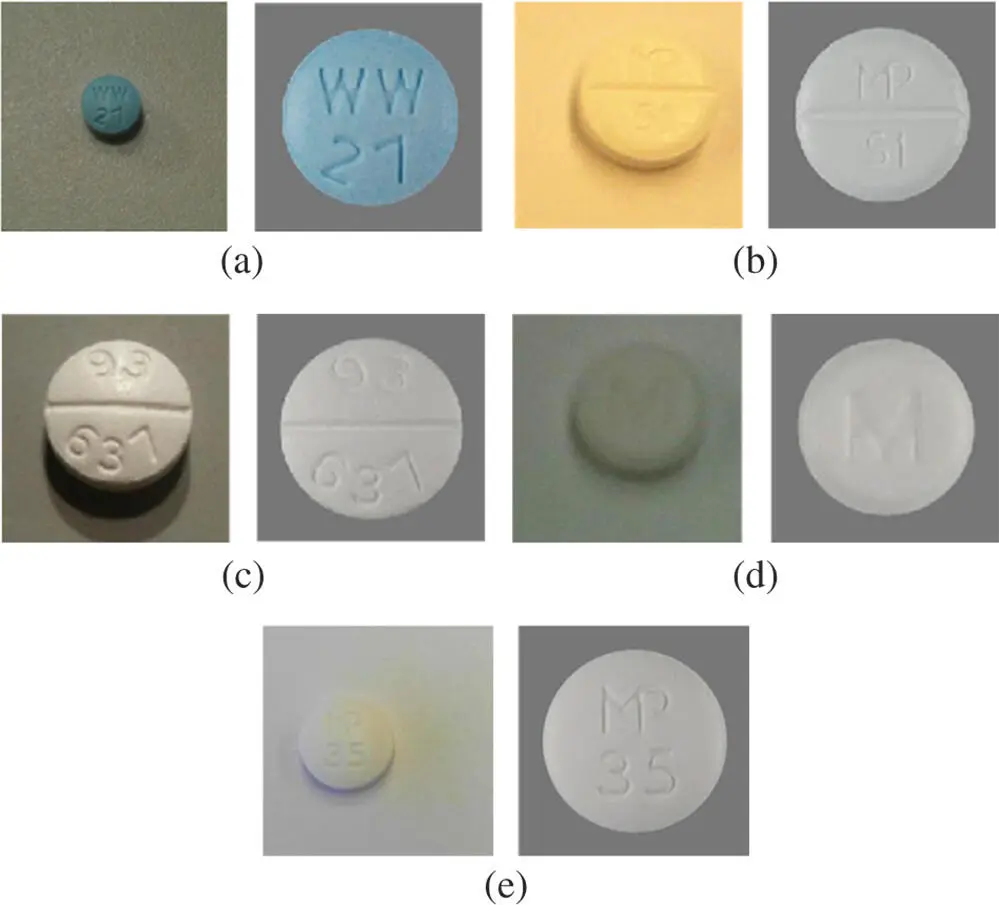
Figure 3.1 Illustration of differences between training and test images of the same pills under five different scenarios [17]. For each scenario, the image on the left is the training image; and the image on the right is the test image of the same pill. Due to the deterioration caused by a variety of real-world noisiness such as shading, blur, illumination, and background, training image and test image of the same pill look very different. (a) Size variation, (b) Illumination, (c) Shading, (d) Blur, (e) Undistinguishable background.
3.2.3 Constrained Battery Life of Edge Devices
For edge devices that are powered by batteries, reducing energy consumption is critical to extending devices' battery lives. However, some sensors that edge devices heavily count on to collect data from individuals and the physical world such as cameras are designed to capture high-quality data, which are power hungry. For example, video cameras incorporated in smartphones today have increasingly high resolutions to meet people's photographic demands. As such, the quality of images taken by smartphone cameras is comparable to images that are taken by professional cameras, and image sensors inside smartphones are consuming more energy than ever before, making energy consumption reduction a significant challenge.
To address this challenge, we envision that the opportunities lie in exploring smart data subsampling techniques, matching data resolution to DNN models, and redesigning sensor hardware to make it low-power. First, to reduce energy consumption, one commonly used approach is to turn on the sensors when needed. However, there are streaming applications that require sensors to be always on. As such, it requires DNN models to be run over the streaming data in a continuous manner. To reduce energy consumption in such a scenario, opportunities lie at subsampling the streaming data and processing those informative subsampled data points only while discarding data points that contain redundant information.
Second, while sensor data such as raw images are high resolution, DNN models are designed to process images at a much lower resolution. The mismatch between high-resolution raw images and low-resolution DNN models incurs considerable unnecessary energy consumption, including energy consumed to capture high-resolution raw images and energy consumed to convert high-resolution raw images to low-resolution ones to fit the DNN models. To address the mismatch, one opportunity is to adopt a dual-mode mechanism. The first mode is a traditional sensing mode for photographic purposes that captures high-resolution images. The second mode is a DNN processing mode that is optimized for deep learning tasks. Under this model, the resolutions of collected images are enforced to match the input requirement of DNN models.
Читать дальшеИнтервал:
Закладка:
Похожие книги на «Fog Computing»
Представляем Вашему вниманию похожие книги на «Fog Computing» списком для выбора. Мы отобрали схожую по названию и смыслу литературу в надежде предоставить читателям больше вариантов отыскать новые, интересные, ещё непрочитанные произведения.











Обсуждение, отзывы о книге «Fog Computing» и просто собственные мнения читателей. Оставьте ваши комментарии, напишите, что Вы думаете о произведении, его смысле или главных героях. Укажите что конкретно понравилось, а что нет, и почему Вы так считаете.