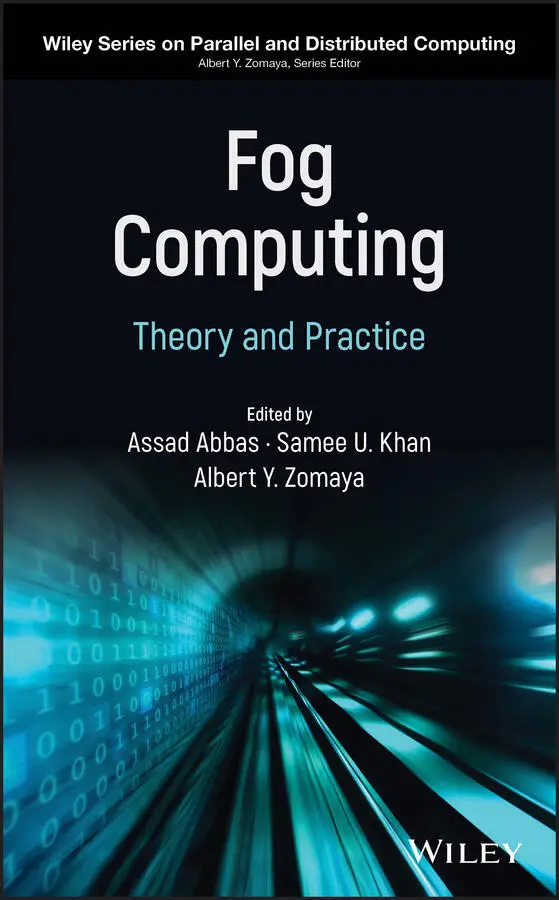
Fog Computing
Здесь есть возможность читать онлайн «Fog Computing» — ознакомительный отрывок электронной книги совершенно бесплатно, а после прочтения отрывка купить полную версию. В некоторых случаях можно слушать аудио, скачать через торрент в формате fb2 и присутствует краткое содержание. Жанр: unrecognised, на английском языке. Описание произведения, (предисловие) а так же отзывы посетителей доступны на портале библиотеки ЛибКат.
- Название:Fog Computing
- Автор:
- Жанр:
- Год:неизвестен
- ISBN:нет данных
- Рейтинг книги:5 / 5. Голосов: 1
-
Избранное:Добавить в избранное
- Отзывы:
-
Ваша оценка:
Fog Computing: краткое содержание, описание и аннотация
Предлагаем к чтению аннотацию, описание, краткое содержание или предисловие (зависит от того, что написал сам автор книги «Fog Computing»). Если вы не нашли необходимую информацию о книге — напишите в комментариях, мы постараемся отыскать её.
focuses on the technological aspects of employing fog computing in various application domains, such as smart healthcare, industrial process control and improvement, smart cities, and virtual learning environments. In addition, the Machine-to-Machine (M2M) communication methods for fog computing environments are covered in depth.
Presented in two parts—Fog Computing Systems and Architectures, and Fog Computing Techniques and Application—this book covers such important topics as energy efficiency and Quality of Service (QoS) issues, reliability and fault tolerance, load balancing, and scheduling in fog computing systems. It also devotes special attention to emerging trends and the industry needs associated with utilizing the mobile edge computing, Internet of Things (IoT), resource and pricing estimation, and virtualization in the fog environments.
Includes chapters on deep learning, mobile edge computing, smart grid, and intelligent transportation systems beyond the theoretical and foundational concepts Explores real-time traffic surveillance from video streams and interoperability of fog computing architectures Presents the latest research on data quality in the IoT, privacy, security, and trust issues in fog computing
provides a platform for researchers, practitioners, and graduate students from computer science, computer engineering, and various other disciplines to gain a deep understanding of fog computing.
Fog Computing — читать онлайн ознакомительный отрывок
Ниже представлен текст книги, разбитый по страницам. Система сохранения места последней прочитанной страницы, позволяет с удобством читать онлайн бесплатно книгу «Fog Computing», без необходимости каждый раз заново искать на чём Вы остановились. Поставьте закладку, и сможете в любой момент перейти на страницу, на которой закончили чтение.
Интервал:
Закладка:
Considering the volatile nature of the network, providing a seamless connectivity mechanism is critical since both mobile and stationary devices coexist in the network. Therefore, another aspect of network management is related to connectivity. This mechanism must be able to provide the possibility of connecting/disconnecting easily from the network such that the uncertainty introduced by mobile devices is accommodated. Moreover, providing this encourages an increased deployment of smart devices by users and manufacturers alike, without extra cost or expert knowledge.
An effort in this direction is made by the I3: the intelligent IoT integrator, developed by USC [34], having the purpose of creating a marketplace where users can share their private data with application developers and receive incentives for it. There are two main advantages of designing the marketplace like this: first, the users are encouraged to deploy more edge devices, which in return extends the IoT network with more resources that app developers can use; and second, there is a pool of data that developers can utilize to improve their IoT applications.
2.6 Conclusion
The never-ending increase in interconnected IoT devices and the stringent requirements of new IoT applications has posed severe challenges to the current cloud computing state-of-the-art architecture, such as network congestion and privacy of data. As a result, researchers have proposed a new solution to tackle these challenges by migrating some computational resources closer to the user. The approach taken in this solution made the cloud more efficient by extending its computational capabilities at the end of the network, solving its challenges in the process.
Continuing to improve this solution, multiple paradigms appeared, having as their underlying vision the same goal of deploying more resources at the edge of the network. Besides their common vision, some paradigms were influenced by their considered use case, e.g. MEC paradigm enables constrained devices like smartphones to offload parts of the applications to save resources. However, two of the most popular paradigms (i.e. fog and edge computing) are widely used in research today.
These two paradigms were designed to enable processing IoT applications at the endpoints of the network, sharing more similarities than others. Other than the naming convention, the difference at the beginning for the two, i.e. fog computing extends the cloud creating a cloud-to-things continuum and edge computing places the application directly on the edge devices, was represented by the location where computations are performed. Since in the past couple of years there were tremendous advances for edge devices, this difference between the two has disappeared, both fog and edge aiming to deploy applications as close as possible to the edge of the network. Considering the similarities they share, we argue that there is no difference between their purpose of them.
Acknowledgment
The research leading to these results has received funding from the European Union's Horizon 2020 research and innovation programme under the Marie Skłodowska-Curie grant agreement No. 764785, FORA (Fog Computing for Robotics and Industrial Automation). This publication was partially supported by the TUW Research Cluster Smart CT.
References
1 1 Chiang, M. and Zhang, T. (2016). Fog and IoT: an overview of research opportunities. IEEE Internet of Things Journal 3 (6): 854–864.
2 2 Bonomi, F., Milito, R., Zhu, J., and Addepali, S. (2012). Fog computing and its role in the Internet of Things, 1st ACM Mobile Cloud Computing Workshop, 13–15.
3 3 Shi, W., Cao, J., Zhang, Q. et al. (2016). Edge computing: vision and challenges. IEEE Internet of Things Journal 3 (5): 637–646.
4 4 Satyanarayanan, M., Bahl, P., Caceres, R., and Davies, N. (2009). The case for VM-based cloudlets in mobile computing. IEEE Pervasive Computing 8 (4): 14–23. [Online]. Available: http://dx.doi.org/10.1109/MPRV.2009.82 http://http://ieeexplore.ieee.org/document/5280678.
5 5 Rausch, T., Avasalcai, C., and Dustdar, S. (2018). Portable energy-aware cluster-based edge computers. In: 2018 IEEE/ACM Symposium on Edge Computing (SEC), 260–272.
6 6 Elias, A.R., Golubovic, N., Krintz, C., and Wolski, R. (2017). Where's the bear? Automating wildlife image processing using IoT and edge cloud systems. In: 2017 IEEE/ACM Second International Conference on Internet-of-Things Design and Implementation (IoTDI), 247–258.
7 7 M. T. Beck, M. Werner, S. Feld, and S. Schimper, Mobile edge computing: a taxonomy. Citeseer.
8 8 Fernando, N., Loke, S.W., and Rahayu, W. (2013). Mobile cloud computing: a survey. Future Generation Computer Systems 29 (1): 84–106, including Special section: AIRCC-NetCoM 2009 and Special section: Clouds and Service-Oriented Architectures. [Online]. Available: http://www.sciencedirect.com/science/article/pii/S0167739X12001318.
9 9 Yi, S., Li, C., and Li, Q. (2015). A survey of fog computing: concepts, applications and issues. In: Proceedings of the 2015 Workshop on Mobile Big Data, 37–42. ACM.
10 10 Bonomi, F., Milito, R., Natarajan, P., and Zhu, J. (2014). Fog Computing: A Platform for Internet of Things and Analytics, 169–186. Cham: Springer International Publishing [Online]. Available: https://doi.org/10.1007/978-3-319-05029-47.
11 11 Shi, W. and Dustdar, S. (2016). The promise of edge computing. Computer 49 (5): 78–81.
12 12 Gusev, M. and Dustdar, S. (2018). Going back to the roots|the evolution of edge computing, an IoT perspective. IEEE Internet Computing 22 (2): 5–15.
13 13 Pate, J. and Adegbija, T. (2018). Amelia: an application of the Internet of Things for aviation safety, in 15th. In: IEEE Annual on Consumer Communications & Networking Conference (CCNC), 2018, 1–6. IEEE.
14 14 Chen, B., Wan, J., Celesti, A. et al. (2018). Edge computing in IoT-based manufacturing. IEEE Communications Magazine 56 (9): 103–109.
15 15 Zhang, S., Li, W., Wu, Y. et al. Enabling edge intelligence for activity recognition in smart homes. In: 2018 IEEE 15th International Conference on Mobile Ad Hoc and Sensor Systems (MASS), vol. 2018, 228–236. IEEE.
16 16 Yu, W., Liang, F., He, X. et al. (2018). A survey on the edge computing for the Internet of Things. IEEE Access 6: 6900–6919.
17 17 Chen, Z., Xu, G., Mahalingam, V. et al. (2016). A cloud computing based network monitoring and threat detection system for critical infrastructures. Big Data Research 3: 10–23.
18 18 Xu, X., Sheng, Q.Z., Zhang, L.-J. et al. (2015). From big data to big service. Computer 48 (7): 80–83.
19 19 Yi, S., Hao, Z., Qin, Z., and Li, Q. (2015). Fog computing: platform and applications. In: 2015 Third IEEE Workshop on Hot Topics in Web Systems and Technologies (HotWeb) (HOTWEB), vol. 00, 73–78. [Online]. Available: http://doi.ieeecomputersociety.org/10.1109/HotWeb.2015.22.
20 20 Stojmenovic, I. and Wen, S. (2014). The fog computing paradigm: scenarios and security issues. In: 2014 Federated Conference on Computer Science and Information Systems, 1–8.
21 21 Osanaiye, O., Chen, S., Yan, Z. et al. (2017). From cloud to fog computing: a review and a conceptual live VM migration framework. IEEE Access 5: 8284–8300.
22 22 Dastjerdi, A.V. and Buyya, R. (2016). Fog computing: helping the Internet of Things realize its potential. Computer 49 (8): 112–116.
23 23 Sarkar, S., Chatterjee, S., and Misra, S. (2018). Assessment of the suitability of fog computing in the context of Internet of Things. IEEE Transactions on Cloud Computing 6 (1): 46–59.
24 24 Shi, Y., Ding, G., Wang, H. et al. (2015). The fog computing service for healthcare. In: 2015 2nd International Symposium on Future Information and Communication Technologies for Ubiquitous HealthCare (Ubi-HealthTech), 1–5.
Читать дальшеИнтервал:
Закладка:
Похожие книги на «Fog Computing»
Представляем Вашему вниманию похожие книги на «Fog Computing» списком для выбора. Мы отобрали схожую по названию и смыслу литературу в надежде предоставить читателям больше вариантов отыскать новые, интересные, ещё непрочитанные произведения.







Обсуждение, отзывы о книге «Fog Computing» и просто собственные мнения читателей. Оставьте ваши комментарии, напишите, что Вы думаете о произведении, его смысле или главных героях. Укажите что конкретно понравилось, а что нет, и почему Вы так считаете.