Boris Kolonitskii - Comrade Kerensky
Здесь есть возможность читать онлайн «Boris Kolonitskii - Comrade Kerensky» — ознакомительный отрывок электронной книги совершенно бесплатно, а после прочтения отрывка купить полную версию. В некоторых случаях можно слушать аудио, скачать через торрент в формате fb2 и присутствует краткое содержание. Жанр: unrecognised, на английском языке. Описание произведения, (предисловие) а так же отзывы посетителей доступны на портале библиотеки ЛибКат.
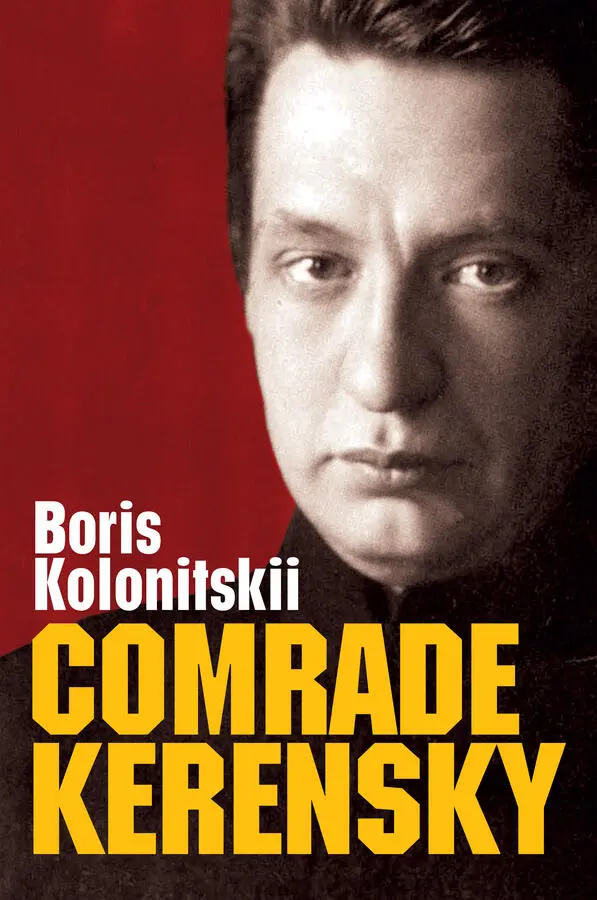
- Название:Comrade Kerensky
- Автор:
- Жанр:
- Год:неизвестен
- ISBN:нет данных
- Рейтинг книги:3 / 5. Голосов: 1
-
Избранное:Добавить в избранное
- Отзывы:
-
Ваша оценка:
Comrade Kerensky: краткое содержание, описание и аннотация
Предлагаем к чтению аннотацию, описание, краткое содержание или предисловие (зависит от того, что написал сам автор книги «Comrade Kerensky»). Если вы не нашли необходимую информацию о книге — напишите в комментариях, мы постараемся отыскать её.
Comrade Kerensky — читать онлайн ознакомительный отрывок
Ниже представлен текст книги, разбитый по страницам. Система сохранения места последней прочитанной страницы, позволяет с удобством читать онлайн бесплатно книгу «Comrade Kerensky», без необходимости каждый раз заново искать на чём Вы остановились. Поставьте закладку, и сможете в любой момент перейти на страницу, на которой закончили чтение.
Интервал:
Закладка:
An individual in early twentieth-century Russia reading the pamphlet might have recalled a number of writings prophesying the appearance of a ‘new kind of person’. Leonidov was not the only author to present Kerensky in this light, as we shall see.
In Odessa, Vlast’ naroda published a pamphlet titled A. F. Kerensky, the People’s Minister . 26Kerensky’s Odessan biographer was a sympathizer of the Socialist Revolutionary Party. We may speculate that he drew on Kiriakov’s writings. At all events, here too the biography is tied in with the history of the Socialist Revolutionaries, and both pamphlets are similar in style and in their choice of material. Like Kiriakov, the author quotes Kerensky’s speeches at length. He makes use of both documentary publications of 1917 and family photographs. In this biography too there are pen portraits made by someone who has been present when Kerensky was giving speeches. The final paragraph is devoted to Kerensky’s personality. His Odessan biographer is confident that the people’s minister will go down in history as the creator of a new social system and as the personification of the revolution.
When the peaceful life of the nations in obedience to the unseen operation of the laws of history bursts in full flood, people appear on the crest of the foaming waves of a turbulent sea whose names are later preserved with love and pride in the memory of the people. The great Russian Revolution has already brought forth a man so intimately identified with it that at times you are hard pressed to tell whether he is directing events or events are directing him That man is Alexander Fyodorovich Kerensky, the first love of free Russia. 27
In this text, too, the author, writing about a unique Leader and saviour, brings in the themes of love, first love, and the merging of the Leader with the people.
Spring 1917 saw the appearance in Petrograd of a weekly magazine titled Heroes of the Day: Biographical Essays . It was intended that it would include articles on the lives of prominent contemporaries. The names mentioned were the Swedish politician Karl Branting; the ‘Grandmother of the Russian Revolution’ Yekaterina Breshko-Breshkovskaya; General Alexey Brusilov; the revolutionary publisher Vladimir Burtsev; the Belgian socialist Emile Vandervelde; US President Woodrow Wilson; the writer Maxim Gorky; Kerensky’s predecessor as minister of war, Alexander Guchkov; the radical German Social Democrat Karl Liebknecht; the anarchist Peter Kropotkin; the Bolshevik leader Vladimir Lenin; the British prime minister David Lloyd George; and other Russian and foreign political and public figures. 28The first issue of this publication, A. F. Kerensky: the Love of the Russian Revolution , was devoted to the revolutionary minister. 29This is clear testimony to Kerensky’s popularity. The author, ‘Tan’ (Vladimir Bogoraz, 1865–1936), had been a member of the People’s Will circles and became famous as an ethnographer, linguist and writer. Tan, like Kiriakov, was active in the All-Russia Peasant Union and the organization of the Trud (Labour) Group, so was acquainted with and politically close to Kerensky.
The theme of political love for Kerensky, which Tan featured in his title, is found in other popular biographies but is particularly stressed by Tan. ‘I would call him “the Revolution’s love”, that first virginal love.’ He returns to the theme at the end of his study. ‘The Russian Revolution will have many favourites and special intimates, but that first, virginal love of the young revolution will never fade, never be forgotten.’ 30Like other biographers, Tan reminded the reader of Kerensky’s Socialist Revolutionary allegiance and pointed out the special place he had in the party: ‘Kerensky is the highest type of SR. He is a dazzling member of that heroic generation of heroes who threw at the struggle their personal fearlessness, their indomitable spirit and their sublime heroism.’ 31This endorsement from a veteran of the revolutionary movement would have carried special weight with readers, although it is unlikely that all the Socialist Revolutionary leaders would have gone along with it. Like other biographers, Tan writes of his subject’s ‘prophetic insights’ and calls him ‘the Leader’ and even ‘the spiritual focus of Russia’. He too writes about Kerensky’s singular hard gaze: ‘There is something leonine in the depths of those wide-open eyes.’ 32
After the July Crisis, 33when Kerensky became prime minister of the Provisional Government, the Moscow Educational Commission of the Provisional Committee of the State Duma brought out another biography of him. Its author, a certain Lieutenant Vysotsky, hailed the achievements of the ‘tamer of the unquiet spirits of the rank-and-file soldiers’. ‘The army obeyed him. It obeyed him as its Leader.’ 34
However, this is the only biography published in 1917 which contains some cautious criticism of Kerensky. Vysotsky felt that some of the reforms in the armed forces were unrealistic and that Kerensky, as the minister of war, had been too slow to recognize the need to fight Bolshevism. It was, nevertheless, on Kerensky that Vysotsky pinned his hopes for stabilization of the situation in the country. Even while criticizing him, Vysotsky laid the blame for the army’s collapse on ‘leading circles of Russia’s democratic forces’ – that is, the leaders of the moderate socialists. 35This could be read as a call for Kerensky to distance himself from the leaders of the Mensheviks and Socialist Revolutionaries.
Vysotsky notes both the extreme fatigue of an ‘ill and exhausted’ Kerensky and the inspired vitality of ‘the great enthusiast’ and ‘romantic’, which exercises an almost hypnotic effect on the masses. This writer too points out the special relationship between the Leader and the people, the emotional connection between the minister and his audiences. ‘Outbursts of that same inspiration and delight thunder towards him, reciprocation of the enthusiasm by which the speaker is himself possessed.’ ‘The people “feel” Kerensky, and Kerensky feels the people.’ ‘The people itself creates Kerensky, itself creates around him an atmosphere of boundless trust and love, in which his every word can assume almost biblical power.’ 36Like some of Kerensky’s other biographers, Vysotsky sees the source of Kerensky’s influence not only in his ability to mesmerize his listeners but also in the need of the people for a strong ruler. ‘Additionally there is alive in [the people] a longing for Kerenskys, for someone to believe in, to whom it can surrender its soul, whom it would want to follow, into whose hands it could surrender its power in order then to submit to him.’ 37This interpretation of the relationship between the Leader and the people may be in line with Leonidov’s writing, but it is far from the Narodnik canon of praise of famous heroes as practised by Kiriakov.
In the autumn of 1917, Lidiya Armand (née Tumpovskaya, 1887–1931) wrote a pamphlet titled Kerensky . She more usually wrote on pedagogy and popularization of culture, and also fiction. The main focus of her writing, however, was the organization of cooperatives and the cultural and educational work they did. In 1917 Armand was on the right of the Socialist Revolutionary Party, and in May the Left Socialist Revolutionaries had labelled her articles ‘social chauvinism’ and ‘social patriotism’. 38In other words, politically she was close to Kerensky. It seems safe to assume this item was published with the support of some grouping of the Right Socialist Revolutionaries.
Like other biographers of Kerensky, Armand includes reminiscences of occasions when she met him: ‘I knew him while he was still a lion cub. In 1906 in Petrograd I met him only in connection with party matters.’ 39Armand finished work on the text on 15 September, and it bears the impress of that time. Her main aim is to defend the Leader from increasingly threatening attacks from both the left and the right. ‘The lion is wounded. He has been wounded by slander and demagogy and just about everyone seems to be trying to kick him when he is down.’ The image of Kerensky sacrificing himself for the revolution is sanctified, Armand even comparing him to Christ. ‘Perhaps he is already at the top of his crimson Golgotha. The time will come when the crowds will demand that monuments be erected to Kerensky. They will compose legends and sing songs about him. For the present, however, they are under the spell of the high priests and are yelling, “Crucify him!”’ 40
Читать дальшеИнтервал:
Закладка:
Похожие книги на «Comrade Kerensky»
Представляем Вашему вниманию похожие книги на «Comrade Kerensky» списком для выбора. Мы отобрали схожую по названию и смыслу литературу в надежде предоставить читателям больше вариантов отыскать новые, интересные, ещё непрочитанные произведения.


Обсуждение, отзывы о книге «Comrade Kerensky» и просто собственные мнения читателей. Оставьте ваши комментарии, напишите, что Вы думаете о произведении, его смысле или главных героях. Укажите что конкретно понравилось, а что нет, и почему Вы так считаете.