M. V. Brian - Ants
Здесь есть возможность читать онлайн «M. V. Brian - Ants» — ознакомительный отрывок электронной книги совершенно бесплатно, а после прочтения отрывка купить полную версию. В некоторых случаях можно слушать аудио, скачать через торрент в формате fb2 и присутствует краткое содержание. Жанр: unrecognised, на английском языке. Описание произведения, (предисловие) а так же отзывы посетителей доступны на портале библиотеки ЛибКат.
- Название:Ants
- Автор:
- Жанр:
- Год:неизвестен
- ISBN:нет данных
- Рейтинг книги:3 / 5. Голосов: 1
-
Избранное:Добавить в избранное
- Отзывы:
-
Ваша оценка:
Ants: краткое содержание, описание и аннотация
Предлагаем к чтению аннотацию, описание, краткое содержание или предисловие (зависит от того, что написал сам автор книги «Ants»). Если вы не нашли необходимую информацию о книге — напишите в комментариях, мы постараемся отыскать её.
Ants — читать онлайн ознакомительный отрывок
Ниже представлен текст книги, разбитый по страницам. Система сохранения места последней прочитанной страницы, позволяет с удобством читать онлайн бесплатно книгу «Ants», без необходимости каждый раз заново искать на чём Вы остановились. Поставьте закладку, и сможете в любой момент перейти на страницу, на которой закончили чтение.
Интервал:
Закладка:
| scabrinodis is a smaller ant and has a less pronounced lateral ridge than sabuleti ; it also has more queens in each colony | ||
| B | Leptothorax | |
| O | Antennae with 11 segments; a relatively large species | acervorum |
| — | Antennae with 12 segments; a relatively small species | 1 |
| I | Club of funiculus no darker than the rest of the antenna; a distinct dorsal groove or depression across the middle of the mesosoma; nests in tree stumps and wood | nylanderi |
| — | Club of funiculus darker than the rest of the antenna; no transverse groove on the mesosoma; rare species | tuberum |
| and | interruptus |
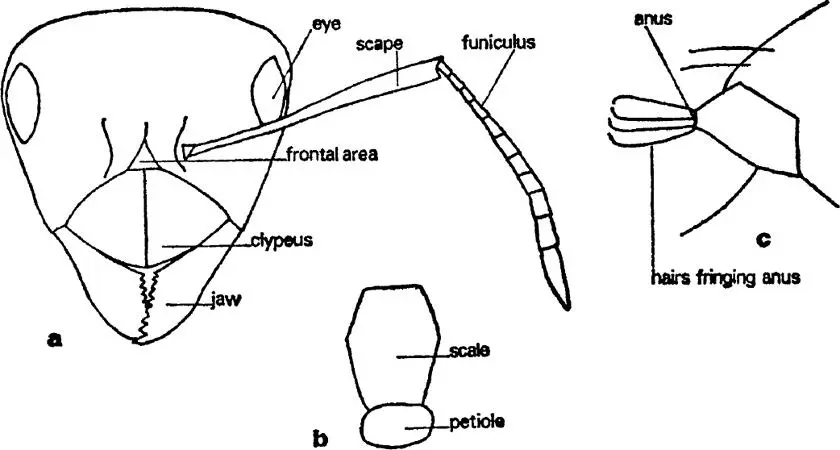
FIG. 7. Worker of Lasius niger : a. head; b. scale on petiole from behind; c. side view of tail segments to show ring of hairs around the circular orifice. The whole body is covered with a light pubescence and there are short, erect hairs on the scape of the antenna but none of these have been shown.
| C | Lasius | |
| O | Colour jet black, shiny, head heart-shaped | fuliginosus |
| — | Colour otherwise, head normal | 1 |
| 1 | Colour brown to dull black | 2 |
| — | Colour yellow | 4 |
| 2 | Scape of antenna and tibia of leg with short, upright hairs; body dark, almost black but hairy and matt | niger |
| — | No such hairs; body browner, less hairy | 3 |
| 3 | Frontal area indistinct; smaller, uniformly coloured, individuals living in open, sunny places | alienus |
| — | Frontal area distinct; larger individuals with gaster and head darker than the thorax; living in old trees | brunneus |
| 4 | Scape of antenna and tibia of leg with short, upright hairs | umbratus |
| and | rabaudi | |
| — | No such hairs | 5 |
| 5 | Hairs on top of gaster short, scale tapered above | mixtus |
| — | Hairs on top of gaster long, scale broad and low, not tapered above, no cheek hairs in front view; makes soil mounds in grassland | flavus |
| Three of the yellow species, umbratus , rabaudi and mixtus , are very variable and intergrade in the worker caste. | ||
| D | Formica | |
| O | Clypeus with central notch in lower margin; colour usually deep red | sanguinea |
| — | Clypeus without notch; colour reddish-brown to black | I |
| 1 | Back of head and top of scale notched | exsecta |
| — | Not so | 2 |
| 2 | Thorax reddish-brown, paler than head and gaster | 3 |
| — | Body black all over | 6 |
| 3 | Eyes with small hairs and back of head with prominent long hairs; wood ants making mound nests of vegetation near trees or in open moorland in northern Britain | 4 |
| — | Eyes and back of head bare | 5 |
| 4 | Thorax with many fine, long hairs | lugubris |
| — | Thorax with fewer, shorter hairs | aquilonia |
| 5 | Frontal area shiny, maxillary palp short and hairy; southern wood ants making large mound nests in open forest | rufa |
| — | Frontal area dull; individuals smaller, making very small mound nests or excavations in open, heathy places | cunicularia |
| 6 | Body shiny, black; building small vegetation mounds in wet heath and bog | transkaucasica |
| — | Body dull, black; excavating nests in drier places | lemani |
| and | fusca |
CHARACTERISTICS AND DISTRIBUTION
Only four of the nine or so sub-families of the family Formicidae are represented in this country. Two of these, Ponerinae and Dolichoderinae, have only one genus here. Of the other two the Myrmicinae have ten and the Formicinae two genera. The Ponerinae and Myrmicinae have certain similarities and are grouped together in a poneroid complex whereas the Dolichoderinae and Formicinae are included in a myrmecoid complex (named after the basic Australian sub-family Myrmeciinae).
The Ponerinae contain a mixture of very primitive and highly-evolved forms which are mainly tropical and Australian in distribution. In southern Europe there are at present some nine species but fossil evidence shows that there were once many more. Primitive features are the possession of a sting in the females (as in wasps) and the structural similarity between queens and workers; the latter lack only wings and ocelli. All ponerines have a constriction between the first and second segments of the gaster; here the integument forms, on the underside, an organ for stridulating. They feed largely on small animals and show foraging behaviour that ranges from the highly individual to the advanced legionary type. Larvae are able to eat prey directly and even to move about the nest slightly in the less advanced genera.
Ponera coarcta has a worldwide distribution but occurs in only 13 of the 152 vice-counties of the British Isles, all in southern England. Its colonies are small and inconspicuous and usually live in woodland amongst the stones and moss of the soil surface. There is another species, Hypoponera punctatissima, that is commonly found in glasshouses and, very rarely, in sunny situations outside.
The Myrmicinae are thought to have evolved from ponerine ants; both groups retain stings and have a tendency to a thick, wrinkled cuticle with spines on the mesosoma. The myrmicine workers have a much simpler and smaller form than the queens. Their waist comprises two segments; this waist gives extraordinary flexibility to the gaster, and enables the sting at its tip to be brought round under the body and pushed forwards in front of the head. The integuments of the second waist on the first gastral segments form a stridulatory organ on the upper side instead of the underside, as in the ponerines. Only in the more primitive genera do the workers lay eggs. Seed-eating is common in this sub-family; it also includes the only group to have perfected a method of culturing and eating fungi. Many genera have evolved social parasitism; of the ten indigenous here half show this tendency.
Undoubtedly the most widespread genus in the British Isles is Myrmica . It is a brownish-red ant found in many different habitats, in small colonies that rarely exceed 3000 workers. They sting effectively and painfully if disturbed. Myrmica reaches into every one of our islands. There are eight species; one, Myrmica ruginodis , is apparently the only ant to have colonized Shetland and the only species so far which has been found in all of the 152 vice-counties. At the opposite extreme there is Myrmica speciodes found only in Kent and Sussex, although it is more common in Europe. This is one genus which shows hardly any geographical bias here, for of the eight species which occur in southern England, six are also found in Scotland.
Читать дальшеИнтервал:
Закладка:
Похожие книги на «Ants»
Представляем Вашему вниманию похожие книги на «Ants» списком для выбора. Мы отобрали схожую по названию и смыслу литературу в надежде предоставить читателям больше вариантов отыскать новые, интересные, ещё непрочитанные произведения.



Обсуждение, отзывы о книге «Ants» и просто собственные мнения читателей. Оставьте ваши комментарии, напишите, что Вы думаете о произведении, его смысле или главных героях. Укажите что конкретно понравилось, а что нет, и почему Вы так считаете.