M. V. Brian - Ants
Здесь есть возможность читать онлайн «M. V. Brian - Ants» — ознакомительный отрывок электронной книги совершенно бесплатно, а после прочтения отрывка купить полную версию. В некоторых случаях можно слушать аудио, скачать через торрент в формате fb2 и присутствует краткое содержание. Жанр: unrecognised, на английском языке. Описание произведения, (предисловие) а так же отзывы посетителей доступны на портале библиотеки ЛибКат.
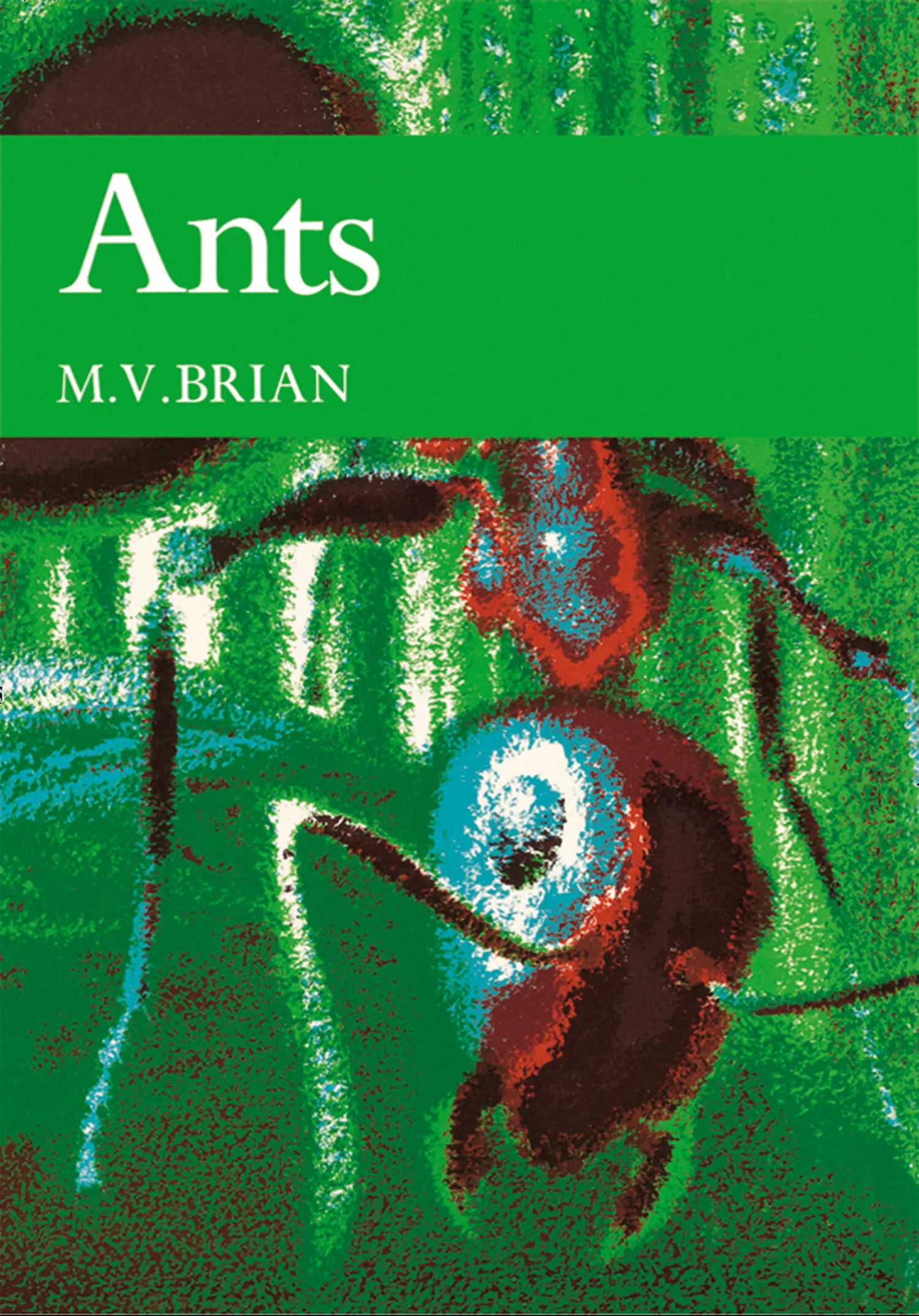
- Название:Ants
- Автор:
- Жанр:
- Год:неизвестен
- ISBN:нет данных
- Рейтинг книги:3 / 5. Голосов: 1
-
Избранное:Добавить в избранное
- Отзывы:
-
Ваша оценка:
Ants: краткое содержание, описание и аннотация
Предлагаем к чтению аннотацию, описание, краткое содержание или предисловие (зависит от того, что написал сам автор книги «Ants»). Если вы не нашли необходимую информацию о книге — напишите в комментариях, мы постараемся отыскать её.
Ants — читать онлайн ознакомительный отрывок
Ниже представлен текст книги, разбитый по страницам. Система сохранения места последней прочитанной страницы, позволяет с удобством читать онлайн бесплатно книгу «Ants», без необходимости каждый раз заново искать на чём Вы остановились. Поставьте закладку, и сможете в любой момент перейти на страницу, на которой закончили чтение.
Интервал:
Закладка:
Only one more moult is needed before the adult is produced. This forms with much less change in shape inside the pupal skin. The wings flatten, elongate and fold up and the legs and antennae and petiole segments narrow a little more. Colour appears as a gradually increasing brownness in the general body but the eyes change from pink to black. The adult emerges with a very soft flexible skin and the wings, if any, inflate, spread out and set hard.
The caste differences in the female do not develop until very near the end of larval life. In workers the wing buds stop growing when they are quite small and all traces vanish by the time the pupa is formed; their ovary never thickens and splits into egg tubes but simply elongates to meet the oviduct. Caste differences in ants thus depend quite simply on whether buds grow or not; there is no degeneration and reorganization as happens in the honeybee. It seems likely that the growth of wings and ovaries is specially delayed during the development of females so that caste determination can be left to the last moment.
In males, which have only one caste, the wing grows earlier and the testis is split longitudinally very early in the larval stage. Late caste determination presumably gives a more sensitive response to social conditions.
Males are either the same size or smaller than the females and they are usually darker. Their antennae are straighter and clumsier and cannot be folded back against the head. They have well-developed compound eyes and ocelli. Their thorax, like that of the sexual females, carries two pairs of wings linked by hooks and it is composed of plates separated by sutures but their petiole is not quite so well-developed. There is no sting at the end of the abdomen; in its place are appendages for locking on to the female during copulation. They do not possess large body reserves like the sexual females.
CHAPTER 3
TYPES OF BRITISH ANT
IDENTIFICATION
Three keys are given here: the first to sub-families, the second to genera and the third to species. These are based on characteristics shown by workers and, in those species which lack them, queens; males help a great deal but for simplicity have been left out. To identify ants as far as the species is difficult; indeed, experts are often not in agreement about some very similar forms. Nevertheless the four main genera, Myrmica , Leptothorax , Lasius and Formica , have been here divided into their most common and easily identified species. The key is not based solely on structural features but includes in a few places reference to habitat, nest site and shape and other aspects of natural history. A low-powered stereoscopic microscope is best for assessing many characteristics but a hand lens may sometimes be adequate. Many distinctions are comparative, e.g., hairy or not hairy, and it is obvious that in these cases experience and reference to a reliable, modern collection is essential.
Key to sub-families
| 1 | Waist of 2 small segments ( fig. 1) | Myrmicinae |
| — | Waist of 1 segment | 2 |
| 2 | Gaster constricted between segments 1 and 2, with a well-developed sting | Ponerinae |
| — | No constriction, no sting | 3 |
| 3 | Five segments of the gaster visible from above, a circular orifice for ejecting venom fringed by guide hairs ( fig. 7) | Formicinae |
| — | Four segments of gaster visible from above, no circular orifice but a slit through which viscous defensive fluid is passed, no hairs | Dolichoderinae |
Key to genera
| A | Ponerinae | |
| Only one certain British species, Ponera coarcta , exists; it is a slow, timid ant with small colonies | ||
| B | Myrmicinae | |
| 1 | Queens black, with shallow, longitudinal trough on gaster, no workers; in Tetramorium caespitum nests | Anergates |
| — | Otherwise | 2 |
| 2 | No spines on the rear of the mesosoma, antennae of 10 segments, the last 2 forming a club | Solenopsis |
| — | Mesosoma toothed or spined at the rear | 3 |
| 3 | Second waist segment with a forwards-directed spine underneath | 4 |
| — | No such spine | 5 |
| 4 | Antennae 11-segmented, tibial spurs on legs 2 and 3, in Formica rufa nests | Formicoxenus |
| — | Antennae 12-segmented, no tibial spurs on legs 2 and 3, no workers; in Myrmica nests | Sifolinia |
| 5 | Jaw sickle-shaped; in nests of Tetramorium caespitum | Strongylognathus |
| — | Jaw with teeth | 6 |
| 6 | First waist segment elongate, eyes minute | Stenamma |
| — | First waist segment not elongate, eyes normal | 7 |
| 7 | First waist segment oblong from side with 2 tubercles above | Myrmecina |
| — | Segment not so | 8 |
| 8 | Front of first thoracic segment squared dorsally, small black ants | Tetramorium |
| — | Front of first thoracic segment rounded dorsally, reddish-brown ants | 9 |
| 9 | Last 3 antennal segments shorter than the rest of the funiculus | Myrmica |
| — | Last 3 antennal segments about as long as the rest of the funiculus | Leptothorax |
| C | Formicinae | |
| I | Ocelli large and distinct, legs long, segments 2–5 of the funiculus longer than all the rest together | Formica |
| 2 | Ocelli very small and indistinct, legs short, segments 2–5 of the funiculus shorter than all the rest together | Lasius |
| D | Dolichoderinae | |
| Only one British species, Tapinoma erraticum, exists; it has small, black, agile workers which run about with their gaster raised |
Key to species
| A | Myrmica | |
| O | Scape of antenna near point of attachment to head bent gradually and smoothly without ridges; head relatively shiny, especially the frontal area ( fig. 6c) | 1 |
| — | Scape bent sharply through a right angle, with or without ridges, head dull, matt ( fig. 6d) | 2 |
| 1 | Epinotal spines long in relation to body size; either workers large, queens larger than workers, fewer than 10 in a colony ( macrogyna ) | |
| or | ||
| queens same size as workers, more than 10 in a colony ( microgyna ) | ruginodis | |
| — | Epinotal spines short in relation to body size; workers small, queens much larger, up to 100 in a colony | rubra |
| 2 | Antennal scape without ridge or teeth; frontal area with marked striations; a dark ant in moorland | sulcinodis |
| — | Antennal scape with ridges or teeth at the bend | 3 |
| 3 | Scape with very characteristic transverse ridge or plate at bend, almost tooth-like from some aspects; a small, dark species | lobicornis |
| — | Scape with lateral ridge at bend, reddish-brown | scabrinodis |
| ( fig. 6d) and | sabuleti |
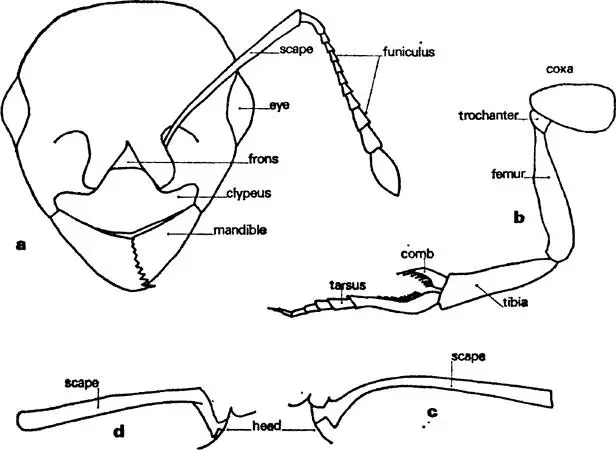
FIG. 6. Worker of Myrmica rubra : a. head, b. foreleg, c. scape of antenna, d. Myrmica scabrinodis: scape of antenna. c. and d. are viewed from behind. Hairs are abundant on the head which is strongly corrugated.
Читать дальшеИнтервал:
Закладка:
Похожие книги на «Ants»
Представляем Вашему вниманию похожие книги на «Ants» списком для выбора. Мы отобрали схожую по названию и смыслу литературу в надежде предоставить читателям больше вариантов отыскать новые, интересные, ещё непрочитанные произведения.





Обсуждение, отзывы о книге «Ants» и просто собственные мнения читателей. Оставьте ваши комментарии, напишите, что Вы думаете о произведении, его смысле или главных героях. Укажите что конкретно понравилось, а что нет, и почему Вы так считаете.