M. V. Brian - Ants
Здесь есть возможность читать онлайн «M. V. Brian - Ants» — ознакомительный отрывок электронной книги совершенно бесплатно, а после прочтения отрывка купить полную версию. В некоторых случаях можно слушать аудио, скачать через торрент в формате fb2 и присутствует краткое содержание. Жанр: unrecognised, на английском языке. Описание произведения, (предисловие) а так же отзывы посетителей доступны на портале библиотеки ЛибКат.
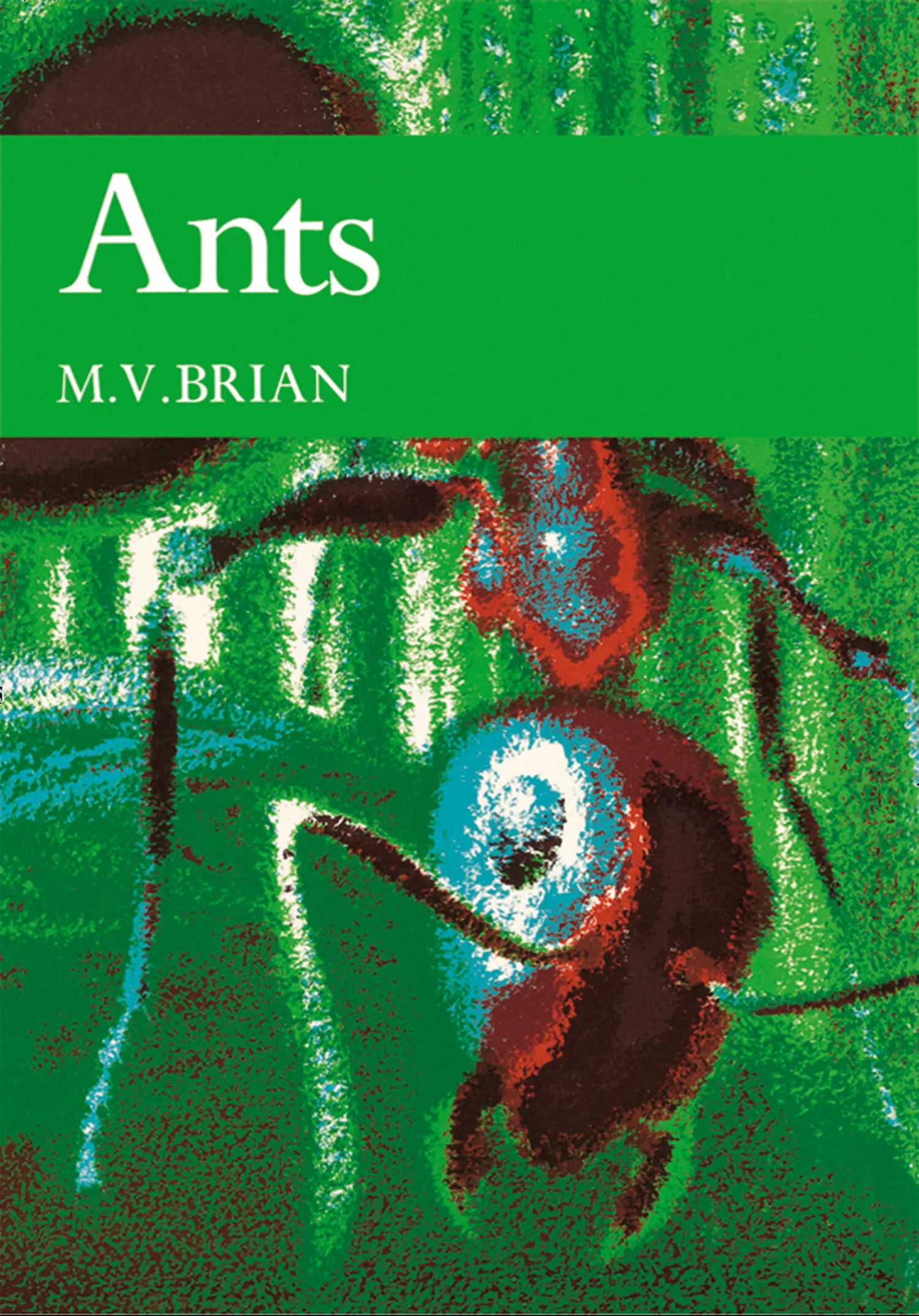
- Название:Ants
- Автор:
- Жанр:
- Год:неизвестен
- ISBN:нет данных
- Рейтинг книги:3 / 5. Голосов: 1
-
Избранное:Добавить в избранное
- Отзывы:
-
Ваша оценка:
Ants: краткое содержание, описание и аннотация
Предлагаем к чтению аннотацию, описание, краткое содержание или предисловие (зависит от того, что написал сам автор книги «Ants»). Если вы не нашли необходимую информацию о книге — напишите в комментариях, мы постараемся отыскать её.
Ants — читать онлайн ознакомительный отрывок
Ниже представлен текст книги, разбитый по страницам. Система сохранения места последней прочитанной страницы, позволяет с удобством читать онлайн бесплатно книгу «Ants», без необходимости каждый раз заново искать на чём Вы остановились. Поставьте закладку, и сможете в любой момент перейти на страницу, на которой закончили чтение.
Интервал:
Закладка:
The simplest Formica species are Formica fusca and Formica lemani . Both are black, have relatively small colonies and live in simple excavated nests in soil. They have strong workers that hunt and forage in bushes alone and are capable of carrying large prey back to the nest. These two species differ in several small ways; Formica fusca is less hairy, has up to half its pupae bare and is said to have fewer queens; it seems to be absent from all of Scotland except the Western Isles. Formica lemani occurs farther north than Formica fusca and is the only Formica in the Northern Isles. Both the species are common and widespread wherever they occur and in areas where they overlap Formica lemani tends to live in the cooler zones with the more northerly aspect.
There are also a number of rare Formica in this country, allied to Formica fusca ; Formica cunicularia occurs in England and is slightly browner and hairier than fusca and often collects some plant material to make a small mound nest; Formica rufibarbis is quite reddish and very local. These are both common on the mainland of Europe. Formica transkaucasica , a jet black and shiny ant, is very rare, even in the south, but extends widely into Asia and is said to be the species which lives highest in the Himalayas. In England it is a specialist bog liver and covers its nests with small domes of cut grass, often on the tops of Molinia tussocks. Formica sanguinea is a large, red ant allied to the wood ants and has the habit of collecting the pupae of Formica fusca ; many of these are eaten but some hatch out and the fusca workers stay on in the sanguinea nests, co-operating in the nest work; they have misleadingly been called ‘slaves’. The queens enter Formicafusca nests and replace the normal queen, thus living temporarily as social parasites. Formica sanguinea is widely but patchily distributed in the British Isles; it occurs in Scotland and southern England but not in northern England, Wales or Ireland. Formica exsecta is a small wood ant with a distribution like that of Formica sanguinea; it can be recognized by the cut-out scale and back of the head and by the fact that it builds mounds of vegetation in scrub and heath that are never very large and are really not much more than thatched soil mounds.
Finally in this cursory survey come the spectacular wood ants, well known for making huge mounds of vegetation debris with tracks to and up large forest trees on which they hunt for food. All have good sight and are expert with jets of formic acid which they can shoot several centimetres. There are three species. Formica rufa ranges over most of eastern and western England but is rare in the north and absent in Scotland and Ireland. Formica lugubris by contrast ranges from Wales and Ireland through northern England to Scotland, where it is widespread in the Highlands but apparently not in the Lowlands. The third, Formica aquilonia , is almost confined to the Scottish Highlands but has been recorded from one place in Ulster. It is an inhabitant of northern Europe and the High Alps. The differences in ecology between these species, so far as they are known, will be discussed later. On the European mainland there are two other species; one, Formicapolyctena , is very like rufa but has many more queens. Another, Formica pratensis, is less wood-bound than rufa and lives in meadows and roadsides, where it makes rather small nests. In central southern England it has recently been extinguished by suburban development.
The sub-family Dolichoderinae is represented only by the species Tapinoma erraticum , an active small, black ant with many queens in its colonies. This species makes nests in heathland; they are a mere 10 cm across and are covered with, and in part constructed of, vegetable debris. The ants seem always to be moving from one to another during the summer. Though widely distributed in Europe this species is confined to the central south of this country.
SPECIES RICHNESS
It is quite obvious from what has been said that the south is richer in species than the north. To be precise, of the 42 so far found in the British Isles, 33 occur in Dorset, 31 in Hampshire, 29 in Surrey, 27 in the Isle of Wight, 26 in East Kent and South Devon and 24 in Berkshire (see fig. 8). The regional divisions into which the Watsonian system groups its vice-counties show that Channel has 37, Thames 31 and Severn only 25 species. South Wales (24), Anglia (23), Trent (20), North Wales (18), and Lakes (18) come next. Not far behind are Humber (16), Mersey (15), Tyne (14) and the Scottish Lowlands West and East (14). The number rises to 15 in the West Highlands and 16 in the Eastern Highlands but drops again to 14 in the Northern Highlands. There are only 4 species in the Northern Isles. In Ireland, Leinster (18) and Munster (17) are twice as rich as Ulster (9); Connaught with 14 is intermediate.
This southerly tendency can be seen in ant distribution over the whole world. The humid Tropics have by far the greatest number. No doubt temperature is the most important single factor in this but rainfall, soil type, vegetation and humidity are subsidiary and of course highly interrelated. In this country the temperature of the soil where the ants live is probably more important than the air temperature and ant distribution is strongly influenced by the hours of sunshine in spring; this can be seen very clearly from fig. 8in which the hours of sunshine in May have been plotted over the number of species per vice-county.
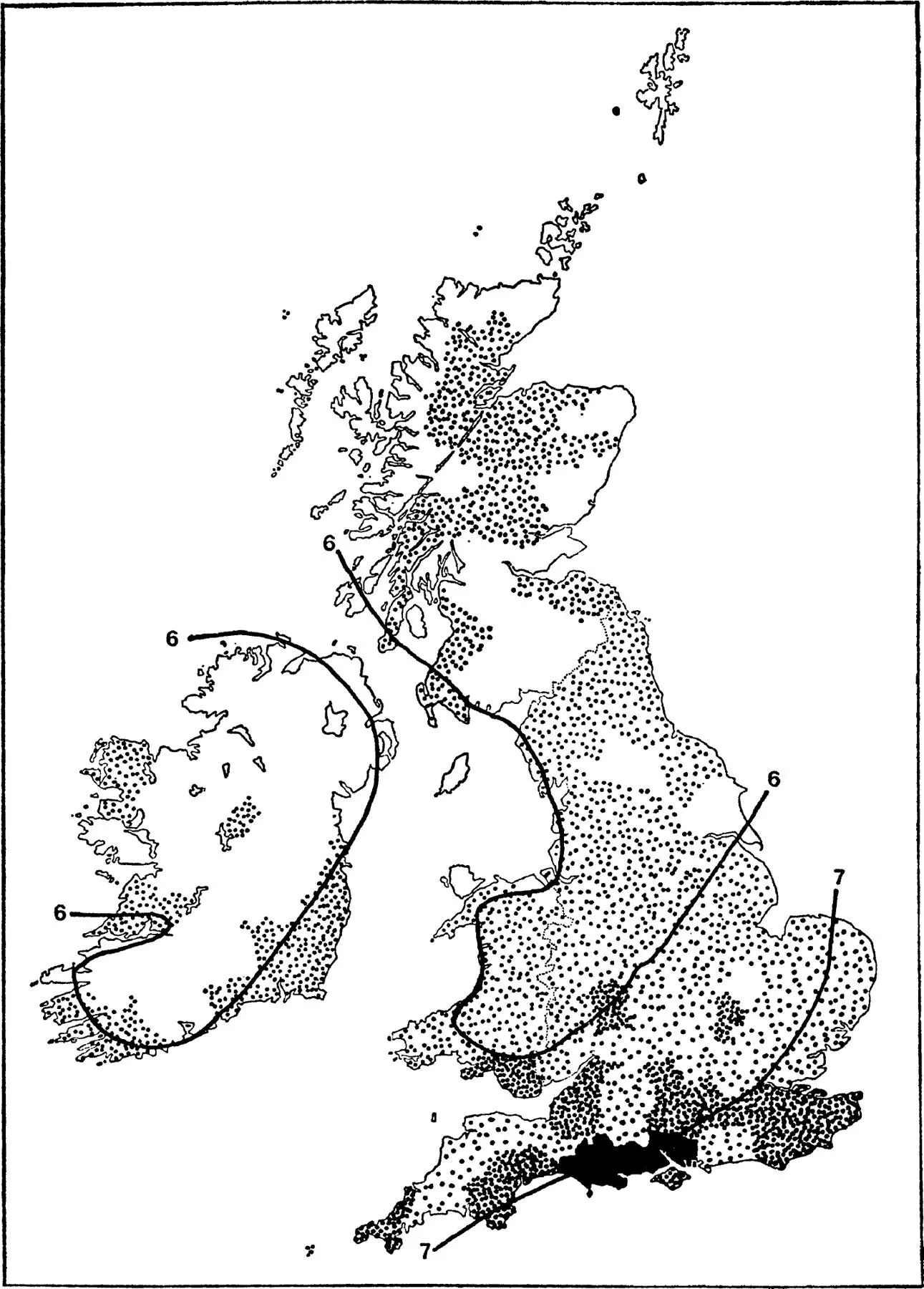
FIG. 8. The number of species of ant per vice-county and the zones where daily sunlight in May averages 6 to 7 hours. Black: over 30 species; densely dotted: over 20; lightly dotted: over 10; blank: between 1 and 10. The information on ants was obtained from the Transactions of the Society for British Entomology , Volume 16, Part 3, pages 93–121, Collingwood, C. A. and Barrett, K. E. J. The information on sunlight is from the Climatological Atlas of the British Isles , published by H.M.S.O. in 1952.
Конец ознакомительного фрагмента.
Текст предоставлен ООО «ЛитРес».
Прочитайте эту книгу целиком, купив полную легальную версию на ЛитРес.
Безопасно оплатить книгу можно банковской картой Visa, MasterCard, Maestro, со счета мобильного телефона, с платежного терминала, в салоне МТС или Связной, через PayPal, WebMoney, Яндекс.Деньги, QIWI Кошелек, бонусными картами или другим удобным Вам способом.
Интервал:
Закладка:
Похожие книги на «Ants»
Представляем Вашему вниманию похожие книги на «Ants» списком для выбора. Мы отобрали схожую по названию и смыслу литературу в надежде предоставить читателям больше вариантов отыскать новые, интересные, ещё непрочитанные произведения.





Обсуждение, отзывы о книге «Ants» и просто собственные мнения читателей. Оставьте ваши комментарии, напишите, что Вы думаете о произведении, его смысле или главных героях. Укажите что конкретно понравилось, а что нет, и почему Вы так считаете.