Museum Transformations
Здесь есть возможность читать онлайн «Museum Transformations» — ознакомительный отрывок электронной книги совершенно бесплатно, а после прочтения отрывка купить полную версию. В некоторых случаях можно слушать аудио, скачать через торрент в формате fb2 и присутствует краткое содержание. Жанр: unrecognised, на английском языке. Описание произведения, (предисловие) а так же отзывы посетителей доступны на портале библиотеки ЛибКат.
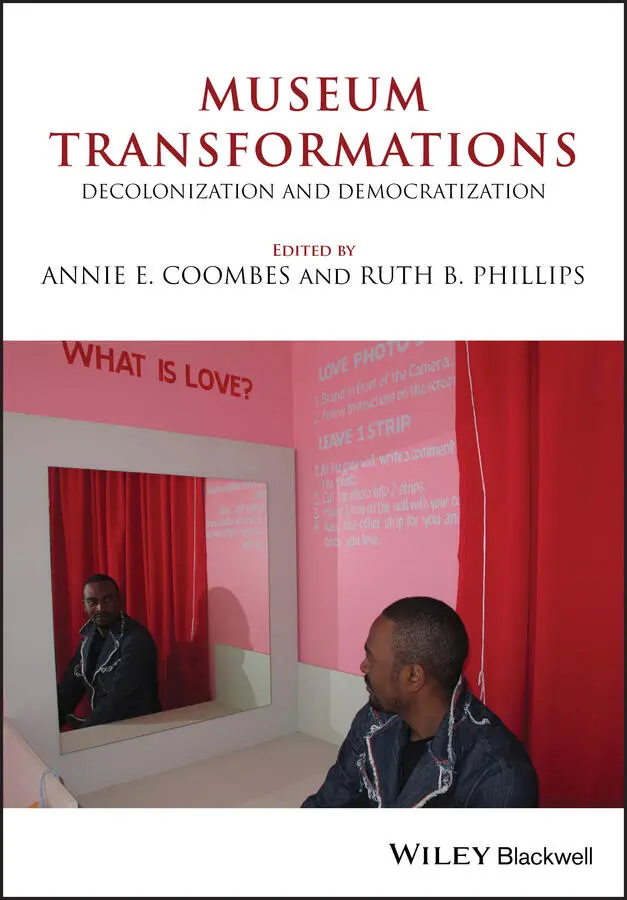
- Название:Museum Transformations
- Автор:
- Жанр:
- Год:неизвестен
- ISBN:нет данных
- Рейтинг книги:4 / 5. Голосов: 1
-
Избранное:Добавить в избранное
- Отзывы:
-
Ваша оценка:
Museum Transformations: краткое содержание, описание и аннотация
Предлагаем к чтению аннотацию, описание, краткое содержание или предисловие (зависит от того, что написал сам автор книги «Museum Transformations»). Если вы не нашли необходимую информацию о книге — напишите в комментариях, мы постараемся отыскать её.
Museum Transformations — читать онлайн ознакомительный отрывок
Ниже представлен текст книги, разбитый по страницам. Система сохранения места последней прочитанной страницы, позволяет с удобством читать онлайн бесплатно книгу «Museum Transformations», без необходимости каждый раз заново искать на чём Вы остановились. Поставьте закладку, и сможете в любой момент перейти на страницу, на которой закончили чтение.
Интервал:
Закладка:
Uhl, Heidemarie. 2008. “Going Underground: Der ‘Ort der Information’ des Berliner Holocaust-Denkmals” [The Information Center of the Berlin Holocaust Memorial]. Zeithistorische Forschungen/Studies in Contemporary History , 5. Accessed April 7, 2014. http://www.zeithistorische-forschungen.de/16126041-Uhl-3–2008.
Young, James E. 2000. At Memory’s Edge: After-Images of the Holocaust in Contemporary Art and Architecture . New Haven: Yale University Press.
Further Reading
Dekel, Irit. 2009. “Ways of Looking: Observation and Transformation at the Holocaust Memorial, Berlin.” Memory Studies 2(1): 71–86.
Dekel, Irit. 2013. Mediation at the Holocaust Memorial in Berlin: Spheres of Speakability . New York: Palgrave Macmillan.
Hirsch, Marianne, and Irene Kascandes, eds. 2004. Teaching the Representation of the Holocaust . New York: Modern Language Association of America.
Moeller, Robert G. 2006. “The Politics of the Past in the 1950’s: Rhetorics of Victimisation in East and West Germany.” In Germans as Victims , edited by Bill Niven, 26–42. Basingstoke, UK: Palgrave Macmillan.
Young, James E. 1993. The Texture of Memory: Holocaust Memorials and Meaning . New Haven: Yale University Press.
Sibylle Quack is a professor of political science, who earned her PhD at the University of Hanover. From 2000 to 2004, she was the first director of the Foundation Memorial to the Murdered Jews of Europe in Berlin. She has taught history and political science at the University of Hannover, New York University, and Dartmouth College. Currently she works with the Federal Government Commissioner for Culture and the Media in Berlin. Her main publications are Zuflucht Amerika: Zur Sozialgeschichte der Emigration deutsch-jüdischer Frauen in die US nach 1933 (Dietz, 1995); Between Sorrow and Strength: Women Refugees of the Nazi Period (Cambridge University Press, 1995); Auf dem Weg zur Realisierung: Das Denkmal für die ermordeten Juden Europas und der Ort der Information: Architektur und historisches Konzept (Deutsche Verlagsanstalt, 2002); Dimensionen der Verfolgung: Opfer und Opfergruppen im Nationalsozialismus (Deutsche Verlagsanstalt, 2003).
2
GHOSTS OF FUTURE NATIONS, OR THE USES OF THE HOLOCAUST MUSEUM PARADIGM IN INDIA
Kavita Singh
The past 20 years have contributed one entirely new term to the lexicon of museums: the holocaust museum. Originating in a cluster of institutions that were built to memorialize the Jewish Holocaust, the holocaust museum has, in a few short decades, become an object of desire for many groups who seek public acknowledgment of their own historical traumas. Today, in places as far apart as Armenia, Bangladesh, Bosnia, Cambodia, Chile, China, Hungary, South Africa, Russia, and Rwanda, there are museums dedicated to traumatic histories that follow the paradigm established by Holocaust museums. 1
The proliferation of holocaust museums across the globe in the late twentieth century has been so prominent that it has itself become the subject of study. The phenomenon has been described as part of a “global rush to build memorials” (Williams 2007) in an “international difficult histories boom” (Attwood in Chapter 3, this volume, citing Macdonald). Several scholars perceive the growth of holocaust museums as part of the millennial “explosion of memory discourses” (Huyssen 2003, 4) that has followed the postmodern fall of official narratives. Now, as formerly marginalized groups bring their reckonings of the past into the public fold, they find that they lack the resources of officially recorded histories. As a consequence, their versions are couched as memory – personal, embodied, and tragically avoidable – as opposed to the impersonality and inevitability of official history .
Since most of these museums focus on the attempts by criminal regimes to obliterate or suppress populations, they must resurrect memory in the face of erasure and concealment. The making of these museums has thus involved prodigious effort and imaginative agility, as their proponents have had to assemble archives in the face of official silence, or find objects in the rubble of destruction. In contrast to the difficulties faced by the pioneering projects of this sort, however, attempts to make holocaust museums or museums of trauma today are at least facilitated by the support of international networks of specialists, consultants, and professional associations, who have helped develop a useful blueprint for future holocaust museums. With narrative techniques that switch between honoring individual victims and conveying the mass scale of destruction, with an increasing consensus about the kinds of objects acceptable for display, with a somber or monochromatic design language, and with emotive architectural forms that use hard materials, sharp edges, and acute angles to evoke a sense of discomfort and disorientation, the holocaust museum has become crystallized as a museum genre . 2
As scholars discuss the aesthetics, ethics, and politics of the many forms taken by the phenomenon, an important strand in the debate centers on the legitimate ownership of memory in such museums. 3Thus, the memory inscribed within Holocaust museums dedicated to the Shoah may be contested between Jewish and non-Jewish victims of the Nazi regime. In turn, the visibility of this Holocaust may make groups such as Armenians and Kurds rue that they are victims of earlier, forgotten genocides.
The competitive jostling of different groups for acknowledgment and visibility of their historical traumas is best demonstrated by the controversies that have beset the Canadian Museum for Human Rights, currently under construction in Winnipeg, Manitoba. The museum was the brainchild of Israel “Izzy” Asper, a Jewish Canadian media magnate of Ukrainian origin who felt that Canada needed an institution like the United States Holocaust Memorial Museum in Washington, DC (Steiman 2007). As the project gained federal support and became a Canadian national institution, its proposed foregrounding of the Shoah as its central theme came under attack. Other groups too demanded representation within the museum, including the aboriginal peoples of Canada and Ukrainian migrants, whose forebears had suffered under Stalin. These groups reportedly asked for floor-area shares proportionate to the losses suffered by their communities (Stephen Inglis, pers. comm. 2010). In a morbid extension of Canadian multiculturalism, a public poll showed that Canadians believed the museum needed to be “fair,” “inclusive,” and “equitable” and “should not elevate the suffering of one community over another” (Adams 2011).
The construction of new museums about traumatic pasts is usually justified as a way of addressing a society’s need to bear witness, to mourn, to bring about reconciliation, and thus to repair old wounds. The suggestion is that these museums offer a “talking cure” for societies: just as an individual can be healed through a retelling of the story of her trauma, the social body too will be able to repair itself through a cathartic recollection of traumatic historical events. In truth, however, the greatest value of such memorialization lies not in its relationship with the past, but in its instrumentalization of the past to intervene in the present and shape the future. The evocation of yesterday’s injustice inevitably makes a case for reparation today; the memorialization of past trauma can be mobilized to press for tangible gains in the here and now. Many observers have noted how Holocaust memorialization serves as a charter myth for Israel; the sheer scale and horror of Jewish suffering testify to the necessity of a Jewish homeland – while also making the Palestinian issue shrink in comparison.
Читать дальшеИнтервал:
Закладка:
Похожие книги на «Museum Transformations»
Представляем Вашему вниманию похожие книги на «Museum Transformations» списком для выбора. Мы отобрали схожую по названию и смыслу литературу в надежде предоставить читателям больше вариантов отыскать новые, интересные, ещё непрочитанные произведения.





Обсуждение, отзывы о книге «Museum Transformations» и просто собственные мнения читателей. Оставьте ваши комментарии, напишите, что Вы думаете о произведении, его смысле или главных героях. Укажите что конкретно понравилось, а что нет, и почему Вы так считаете.