Museum Transformations
Здесь есть возможность читать онлайн «Museum Transformations» — ознакомительный отрывок электронной книги совершенно бесплатно, а после прочтения отрывка купить полную версию. В некоторых случаях можно слушать аудио, скачать через торрент в формате fb2 и присутствует краткое содержание. Жанр: unrecognised, на английском языке. Описание произведения, (предисловие) а так же отзывы посетителей доступны на портале библиотеки ЛибКат.
- Название:Museum Transformations
- Автор:
- Жанр:
- Год:неизвестен
- ISBN:нет данных
- Рейтинг книги:4 / 5. Голосов: 1
-
Избранное:Добавить в избранное
- Отзывы:
-
Ваша оценка:
Museum Transformations: краткое содержание, описание и аннотация
Предлагаем к чтению аннотацию, описание, краткое содержание или предисловие (зависит от того, что написал сам автор книги «Museum Transformations»). Если вы не нашли необходимую информацию о книге — напишите в комментариях, мы постараемся отыскать её.
Museum Transformations — читать онлайн ознакомительный отрывок
Ниже представлен текст книги, разбитый по страницам. Система сохранения места последней прочитанной страницы, позволяет с удобством читать онлайн бесплатно книгу «Museum Transformations», без необходимости каждый раз заново искать на чём Вы остановились. Поставьте закладку, и сможете в любой момент перейти на страницу, на которой закончили чтение.
Интервал:
Закладка:
Religious reading or historical remembrance? The Room of Names
The questions that arose in the planning and realization of the exhibition’s third room, the Room of Names, were similarly difficult (see Figure 1.3). The controversies surrounding this room, however, tended to remain in the background. The entire Kuratorium, as well as political decision-makers, greatly appreciated the willingness of the Memorial Yad Vashem in Jerusalem to make available for use in the information center their database containing over three million names of Shoah victims, based on the “Pages of Testimony” compiled since the early 1950s (Shalev and Avraham 2005, 128–137). This was recognized by all sides as an extraordinary gesture of reconciliation. Nevertheless, for critics of the memorial, as well as museum experts, it also entailed some risks. As in the case of the Room of Names, they saw a tendency to emotionally stage and symbolically reduce the historical context of the Holocaust, which is inimical to the conveyance of historical knowledge. The mere reading of the names of those who were murdered would be reminiscent of liturgical elements and would amplify the “sacralization of remembrance” all the more so as the subterranean location of the center under Eisenman’s memorial can be regarded as a sort of crypt beneath a vast cemetery. I strongly promoted the idea of reading the names and at the same time providing biographical information on each person who carried the name. Consultations with museum experts ultimately yielded the result that the names of murdered Jews from Yad Vashem’s extensive database would be projected onto all four walls of the exhibition room. In parallel with this, basic biographical information on these individuals would be provided in an audio program.
By providing these individual albeit very brief biographies, the center was able to avoid the religiously ritualized reading of names. At the same time, the audio program is so arresting, dignified, and appropriate to mourning and remembrance that this room can undoubtedly be regarded as the centerpiece. As Brigitte Sion (2008, 65) writes in her study, “Visitors slow down, freeze, stare at the names and listen to the life stories: a child from Dresden, a grandmother from Budapest, a student from Lyons, a singer from Venice. One more. It is hard to exit the room.” The fact that such biographical information is available for only a fraction of the more than three million names collected in the Yad Vashem database reveals the tremendous task for the future: scholars will be busy for years researching as many personal histories as possible in order to put a face to the names in the database. And the stories they unearth can subsequently be presented in the information center. To this day, only approximately ten thousand names from Yad Vashem’s collection have been reviewed in this way and presented in the center. Scholars from the Holocaust Memorial Foundation cooperate closely with Yad Vashem and other institutions in Germany and abroad that are conducting research into the individual fates and biographies of people who perished in the Holocaust.
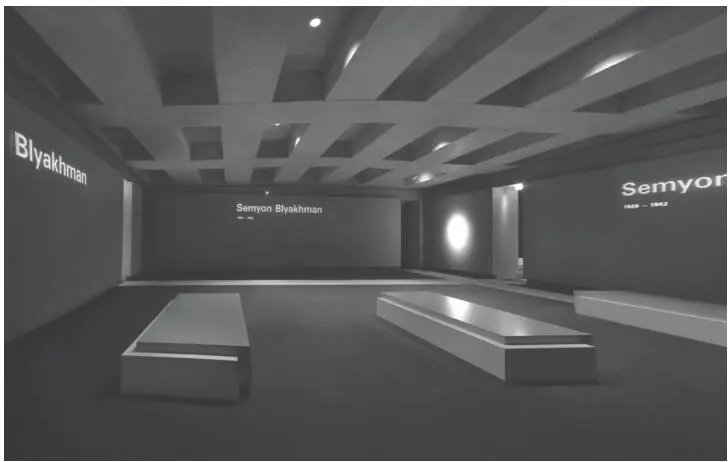
FIGURE 1.3Room of Names, Memorial to the Murdered Jews of Europe. The room is empty. A reading of names and short biographies of Jews from across Europe who were murdered, or are presumed dead, emanates from speakers. At the same time, the names and, if known, year of birth and year of death of the victims appear on all four walls.
© Foundation Memorial to the Murdered Jews of Europe, Lepkowski, 2007.
Visitors to the information center can access the actual database of Yad Vashem and its “Pages of Testimony” at computer terminals in a separate part of the exit foyer outside the Room of Names, and print out any information they have found. This way, visitors who have never been to Israel can also research the fates of their relatives in Berlin. (For a critical discussion of presenting the names of Holocaust victims at the memorial, see Dekel 2008, 166–188, and passim).
The outcome
The exhibition concept that eventually emerged from fraught discussions is an exemplary portrayal of the individual fates of victims of the Holocaust from across Europe. In accordance with contemporary exhibition culture, it is subjectcentered. Visitors are encouraged to empathetically acknowledge individual life stories, particularly in regard to the history of the Holocaust (Köhr 2008; Geissler 2011). The variety of the biographies allows us to perceive Jewish life across Europe before the Holocaust in all its diversity (see Figure 1.4).
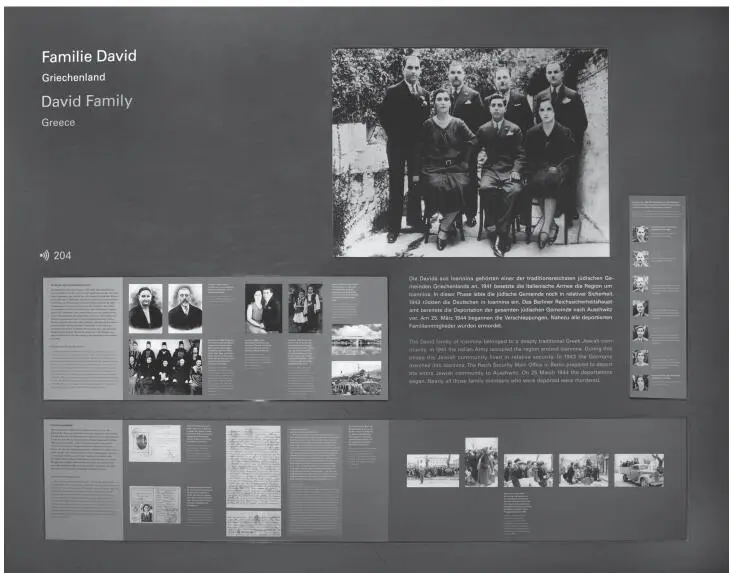
FIGURE 1.4Room of Families, Memorial to the Murdered Jews of Europe. Different social, national, and religious Jewish milieus are shown in this room, based on the fates of 15 Jewish families. The stories of these Jewish families reflect the diversity of Jewish culture and tradition in Europe before the Holocaust. Photos and personal documents bear witness to the dissolution, expulsion, and extermination of these families and their members.
© Foundation Memorial to the Murdered Jews of Europe, Lepkowski, 2008.
Interest in Jewish milieus especially in the countries of eastern Europe (e.g., Poland, Russia, and Lithuania) has not been very strong in the past, at least in Germany, in contrast to many other countries. The center’s exhibition hence fills a knowledge gap, particularly for many young Germans. At the same time, it not only conveys knowledge about the victims of the Holocaust, but also fulfills the center’s aspiration to provide information about those responsible for the crimes. This aspect of Germany’s Nazi past becomes visible in the historical presentation of the different stages in the escalation of violence and the naming of the perpetrators in the entry foyer. Another important element of the center is the portal of memorial sites located in the exit foyer. This enables visitors to find their way to other exhibitions and institutions, particularly those located at the original historical sites in Germany and abroad. In an adjacent room visitors can view videos from an archive of interviews with survivors which the foundation has established in cooperation with the Fortunoff Archives at Yale University (Baranowski 2009; Foundation Memorial to the Murdered Jews of Europe 2010, 14–54). The last of the four exhibition rooms, the Room of Sites, shows films and images of places where European Jews were persecuted and killed, and of ghettos, deportation routes, and death marches. Between showcases in the shape of stelae, there are niches in which one can hear individual eyewitness reports from these sites.
Reactions
Since its completion, the Memorial to the Murdered Jews of Europe has become a tourist magnet. Visitors from all over the world stroll through Eisenman’s sculpture and have their pictures taken lying or sitting on one of the stelae in front of the Brandenburg Gate. There is a surprising uninhibitedness even gaiety at this place dedicated to the mourning and remembrance of the victims of the Holocaust. While the earlier tendency of people jumping from stela to stela is less and less tolerated, playing hide and seek is still widespread, especially among younger visitors. It appears that in most cases a visit to the information center conveys the meaning of the memorial and provides visitors with an opportunity for further reflection and contemplation. The Austrian cultural scientist Heidemarie Uhl has pointed out that this surprising constellation, “the actual Memorial as a tourist attraction and ‘hands-on’ sculpture in public space and the subterranean Information Center as the actual place where remembrance takes place,” strongly contradicts the expectations and intentions that prevailed at the memorial’s inception (Uhl 2008, 2). Other authors have also witnessed an “unexpected reversal”: While the center has become the site of Holocaust remembrance, the field of stelae “expresses the ephemeral and fragile nature of memory as it is experienced in the presence” (Sion 2008, 171).
Читать дальшеИнтервал:
Закладка:
Похожие книги на «Museum Transformations»
Представляем Вашему вниманию похожие книги на «Museum Transformations» списком для выбора. Мы отобрали схожую по названию и смыслу литературу в надежде предоставить читателям больше вариантов отыскать новые, интересные, ещё непрочитанные произведения.





Обсуждение, отзывы о книге «Museum Transformations» и просто собственные мнения читателей. Оставьте ваши комментарии, напишите, что Вы думаете о произведении, его смысле или главных героях. Укажите что конкретно понравилось, а что нет, и почему Вы так считаете.