Halogen Bonding in Solution
Здесь есть возможность читать онлайн «Halogen Bonding in Solution» — ознакомительный отрывок электронной книги совершенно бесплатно, а после прочтения отрывка купить полную версию. В некоторых случаях можно слушать аудио, скачать через торрент в формате fb2 и присутствует краткое содержание. Жанр: unrecognised, на английском языке. Описание произведения, (предисловие) а так же отзывы посетителей доступны на портале библиотеки ЛибКат.
- Название:Halogen Bonding in Solution
- Автор:
- Жанр:
- Год:неизвестен
- ISBN:нет данных
- Рейтинг книги:5 / 5. Голосов: 1
-
Избранное:Добавить в избранное
- Отзывы:
-
Ваша оценка:
Halogen Bonding in Solution: краткое содержание, описание и аннотация
Предлагаем к чтению аннотацию, описание, краткое содержание или предисловие (зависит от того, что написал сам автор книги «Halogen Bonding in Solution»). Если вы не нашли необходимую информацию о книге — напишите в комментариях, мы постараемся отыскать её.
Halogen Bonding in Solution
Halogen Bonding in Solution
Halogen Bonding in Solution — читать онлайн ознакомительный отрывок
Ниже представлен текст книги, разбитый по страницам. Система сохранения места последней прочитанной страницы, позволяет с удобством читать онлайн бесплатно книгу «Halogen Bonding in Solution», без необходимости каждый раз заново искать на чём Вы остановились. Поставьте закладку, и сможете в любой момент перейти на страницу, на которой закончили чтение.
Интервал:
Закладка:
Possibly, the first CSD evaluation of what we now understand to be the halogen bond was in 1979 where the geometry of the C–I⋯O interaction was evaluated [66]. Murray‐Rust and Motherwell noted an anisotropic distribution of contact distances as a function of C–I⋯O angle, where shorter contacts (and less variability) were observed for near linear (C–I⋯O ∠ ≈180°) contacts. The trend, although less pronounced, was also observed with Br and Cl species, which we now attribute to their weaker halogen bond donor ability. This initial study pulling from 20 000 structures was revisited again seven years later where the database had grown to 40 000 structures [4]. Here, Ramasubbu, Parthasarathy, and Murray‐Rust evaluated halocarbons (C–X (X = Cl, Br, I)) and their contacts with metals, Lewis bases (nitrogen and oxygen species), and other halogens. The geometric characteristics of the “electrophile–nucleophile pairing(s)” showed that electrophilic metals favor a “side‐on” approach to halogens, nucleophiles exhibited a “head‐on” approach, and other halogens can participate as either the nucleophile (head‐on) or the electrophile (side‐on). These early CSD studies and others [67-69] reinforced the trends previously observed by Bent and Hassel, but observations from larger data sets provided more convincing conclusions.
Elaborating on halogen–halogen contacts, Parthasarathy and Desiraju established a classification scheme that is still used today [68]. The two contacts, type I and type II, are influenced by the anisotropic electron density and polarizability of halogens and have distinct geometrical conditions ( Figure 1.6). The type II interaction is a true halogen bond – the electropositive portion of the halogen interacts with the electron‐rich site of another. Type I contacts are considered geometry‐based contacts that arise from close packing [62]. While not halogen bonds, the type I contacts have been designed into solid‐state structure and provide a convenient method of classification. The prefixes cis ‐ and trans ‐ have been recent additions to describe type I contacts, providing specificity of the arrangement of molecules in type I interactions [70]. A later report by Desiraju highlights a greater frequency of type II interactions following the donor atom species I > Br > Cl > F, further emphasizing that the type II contacts are true halogen bonds [62,69].
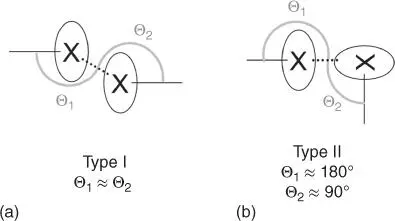
Figure 1.6ChemDraw figure depicting the structural scheme for both type I (a) and type II (b) halogen⋯halogen contacts.
1.3.2 Fundamental Studies and Halogen Bond–Hydrogen Bond Interplay
The CSD studies confirmed geometric trends from large amounts of data, further validating the characteristics of halogen bonds. However, several solid‐state fundamental studies have demonstrated that the halogen bond is a tunable and predicable supramolecular tool. One example comes from Bruce and coworkers, where they systematically evaluated halogen bond distances between 4‐( N , N ‐dimethylamino)pyridine (DMAP) and iodobenzenes with different degrees of fluorination [71]. Here it was shown that the I⋯N distance correlates with the degree of fluorination and with calculated p K avalues, signifying that the halogen bond is tunable for the construction of solids ( Figure 1.7). The halogen bond angle (CI⋯N) and distance largely correlate within these data; however there are some outliers that highlight the difficulties in constructing systematic solid‐state investigations where many intermolecular interactions are at play.
Another systematic evaluation of halogen bond tunability comes from a collaborative study between Aakeröy, Metrangolo, and Resnatti [72]. These studies sought to rank common halogen bond donors. Initially, ESP maps of six ditopic halogen bond donor systems were computed to determine the V S,maxat the σ‐hole and establish a hierarchy of halogen bond strength ( Figure 1.8). The values highlight how the σ‐hole is influenced by the type of halogen, the hybridization of the carbon the halogen is bound to, and the degree of fluorination. More importantly, the V S,maxrankings were correlated to the operating halogen bond donors in cocrystal structures. For example, when the halogen bond donor 1‐(iodoethynyl)‐4‐iodobenzene is cocrystallized with 4‐phenylpyridine, two halogen bond donor sites compete for a single Lewis basic site (only considering the pyridine nitrogen in this instance). The resulting structure shows that the better halogen bond donor (iodoethynyl) interacts with the pyridine nitrogen, while the weaker iodobenzene donor forms a type I halogen–halogen contact with an adjacent molecule ( Figure 1.8b).
The above study suggests that the halogen bond can be used for hierarchical supramolecular synthesis. As such, the Aakeröy group began to consider adopting the hydrogen bond “best donor–best acceptor” concept to the halogen bond construction of crystalline solids [73]. p K avalues have been employed to help predict the best donor–best acceptor pairs for hydrogen bond cocrystals [74]; however, p K avalues are not readily adaptable to many halogen bond systems, leading to the use of ESP values. In one example of this concept transfer, ESP values for several multi‐topic N ‐heterocyclic halogen bond acceptors were evaluated and cocrystallized with a diverse set of halogen bond donors [75]. The results highlighted that the site of larger negative ESP was the halogen bond acceptor in the crystal structure, paralleling the behavior of the hydrogen bond. By computing Δ E values (ESP difference) between the two Lewis basic acceptor sites, the authors were able to predict the site of halogen bond contacts. The study concluded that if Δ E was greater than 75 kJ/mol, then selectivity (best donor interacting with best acceptor) would occur. If Δ E was less than 35 kJ/mol, then no preference was observed, and often both acceptor sites would be occupied. Intermediate Δ E values were deemed to be unpredictable. ESP values were also adapted to systems that simultaneously use halogen and hydrogen bonds [76]. Here, a Q value was introduced (the Q value being the difference in ESP values of the halogen and hydrogen bond donor) to help predict which interactions would be present in the final structure. The donor molecules contain both halogen and hydrogen donors and were evaluated with a diverse set of acceptors in a series of cocrystals. It was reported that increasingly large Q values showed a tendency for only hydrogen bonding to be present as the main structure directing interaction. In contrast, lower Q values showed a greater chance of having both interactions operating. However, the authors note this is a “rule of thumb,” and more work in this area needs to be conducted.
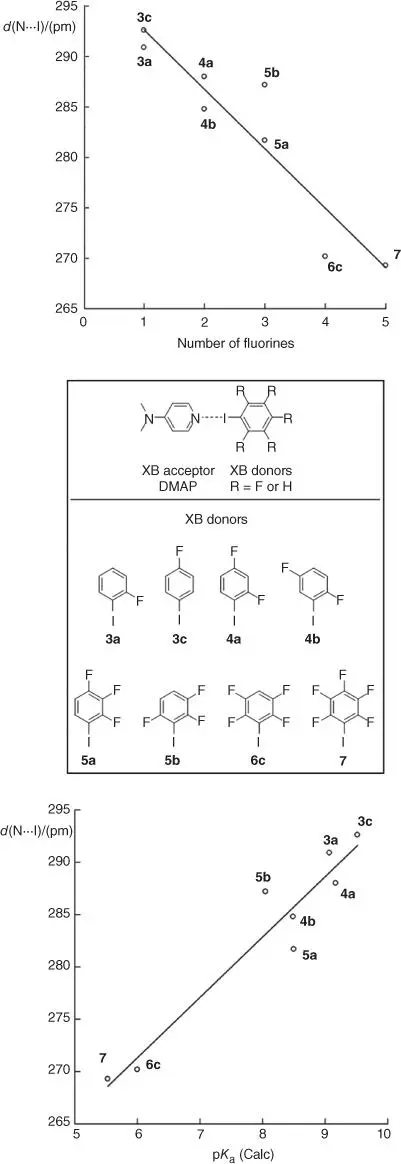
Figure 1.7Halogen bond contacts between DMAP halogen bond acceptor nitrogen and iodine halogen bond donors of perfluoroarenes were evaluated. The various halogen bond donors with corresponding labels are shown in the middle bottom. Plot of N⋯I distance versus degree of fluorination (left) and plot of N⋯I distance versus calculated p K a(right).
Source: From Präsang et al. [71]. © 2009 American Chemical Society.
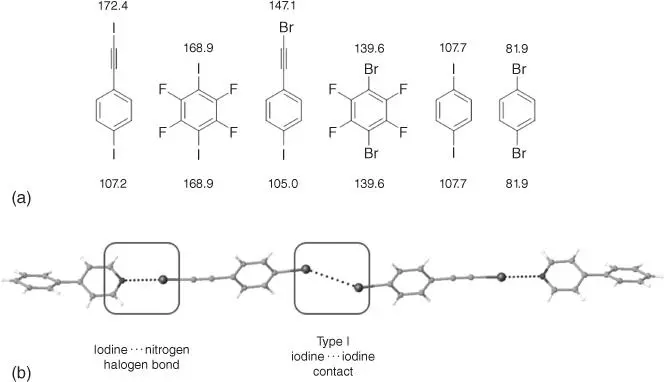
Figure 1.8Six halogen bond donors were systematically evaluated computationally, statistically, and experimentally by Aakeröy et al. The reported values are the V S,maxat the σ‐hole region of the respective halogen in kilojoule per mole (kJ/mol), (a). Iodine atom interactions in the cocrystal structure of 1‐(iodoethynyl)‐4‐iodobenzene and 4‐phenylpyridine (b). CCDC ref code: BISBIQ.
Читать дальшеИнтервал:
Закладка:
Похожие книги на «Halogen Bonding in Solution»
Представляем Вашему вниманию похожие книги на «Halogen Bonding in Solution» списком для выбора. Мы отобрали схожую по названию и смыслу литературу в надежде предоставить читателям больше вариантов отыскать новые, интересные, ещё непрочитанные произведения.









Обсуждение, отзывы о книге «Halogen Bonding in Solution» и просто собственные мнения читателей. Оставьте ваши комментарии, напишите, что Вы думаете о произведении, его смысле или главных героях. Укажите что конкретно понравилось, а что нет, и почему Вы так считаете.