Halogen Bonding in Solution
Здесь есть возможность читать онлайн «Halogen Bonding in Solution» — ознакомительный отрывок электронной книги совершенно бесплатно, а после прочтения отрывка купить полную версию. В некоторых случаях можно слушать аудио, скачать через торрент в формате fb2 и присутствует краткое содержание. Жанр: unrecognised, на английском языке. Описание произведения, (предисловие) а так же отзывы посетителей доступны на портале библиотеки ЛибКат.
- Название:Halogen Bonding in Solution
- Автор:
- Жанр:
- Год:неизвестен
- ISBN:нет данных
- Рейтинг книги:5 / 5. Голосов: 1
-
Избранное:Добавить в избранное
- Отзывы:
-
Ваша оценка:
Halogen Bonding in Solution: краткое содержание, описание и аннотация
Предлагаем к чтению аннотацию, описание, краткое содержание или предисловие (зависит от того, что написал сам автор книги «Halogen Bonding in Solution»). Если вы не нашли необходимую информацию о книге — напишите в комментариях, мы постараемся отыскать её.
Halogen Bonding in Solution
Halogen Bonding in Solution
Halogen Bonding in Solution — читать онлайн ознакомительный отрывок
Ниже представлен текст книги, разбитый по страницам. Система сохранения места последней прочитанной страницы, позволяет с удобством читать онлайн бесплатно книгу «Halogen Bonding in Solution», без необходимости каждый раз заново искать на чём Вы остановились. Поставьте закладку, и сможете в любой момент перейти на страницу, на которой закончили чтение.
Интервал:
Закладка:
By adjusting the electron‐withdrawing ability of adjacent moieties. Increasing the electron‐withdrawing ability of adjacent groups results in a greater σ‐hole leading to, in most cases, a more potent interaction. The opposite is true as well – an electron‐donating species will often diminish halogen bond strength.
By noncovalent cooperativity. Noncovalent cooperativity is an emerging strategy to enhance the interaction strength of noncovalent forces. The introduction of a hydrogen bond to the electronegative belt of the halogen further polarizes the halogen resulting in a more potent σ‐hole resulting in a hydrogen bond‐enhanced halogen bond [14–16].
1.1.6 Additional Nomenclature
Prior to the IUPAC definition of the halogen bond, a variety of terms were used to describe the attractive interactions with halogens, many of which have been pointed out by Bent [17]. One term used in early halogen bond studies referred to the interaction as a donor–acceptor complex , a consequence of the focus on charge‐transfer studies. Thus, in many early papers, the halogen is referenced as an acceptor, signifying that the halogen was accepting electron density. This terminology has been mostly phased out when discussing halogen bonds. Other nomenclature found in the literature before the official IUPAC definition includes fluorine [18,19], chlorine [20,21], bromine [22], and iodine bonds [23,24]. While this terminology does specify which donor is operating, the use of the more inclusive halogen bond term is the preferred method of representing the interaction. The field generally distinguishes between inorganic and organic halogen bond donors, as the interaction profile (e.g. electrostatic, charge transfer, dispersion) in these species is usually different. There are other specific notations that have been embraced within the community such as the term charge‐assisted halogen bond [25–31]. The use of a formal charge, most often alkylation of Lewis basic sites (e.g. quaternization of amines), can result in a powerful electron‐withdrawing group. If the history of the hydrogen bond is any indication, there will surely be new terminology that arises to describe other unique halogen bond interactions in the future. Already, the halogen bond field has examples of hydrogen bond‐enhanced halogen bonds [14–16] and three‐center‐four‐electron halogen bonds [32–34].
The above section has been constructed to provide the newcomer with a general understanding of the halogen bond. To enrich this knowledge, the following section chronicles key developments that provide context to the 2013 IUPAC definition.
1.2 Historical Perspective
To understand how the IUPAC definition of the halogen bond developed, one can look to the past. In fact, some have traced the observation of the halogen bond back to around the discovery of iodine. Consider what chemistry was probably like during the late Napoleonic era: mixing compounds, observing color changes, evolving gases, minimal safety concerns, etc. In fact, observing changes in color was how the first halogen bond complexes were detected (although not referred to as halogen bonds). The following is a brief commentary on a select number of historical studies considered to involve the halogen bond.
Early halogen bond observations occurred near the start of the nineteenth century in France, around the discovery and isolation of a new substance by Bernard Courtois in 1812. Samples of this material were given to a few chemists, including Sir Humphry Davy and Joseph Louis Gay‐Lussac. Shortly thereafter (December 1813), both Davy and Gay‐Lussac identified (independently) and quarreled who was first to establish the new substance, iodine [35]. Less than a year later (July 1814), J. J. Colin, working for Gay‐Lussac, reported the formation of a liquid with a metallic luster when mixing the newly identified material (I 2) with dry gaseous ammonia [36]. At the time the composition of the substance was unknown, but was eventually established by Frederick Guthrie in 1863 as Iodide of Iodammonium [37]. While the nature and atomic positioning of the two components remained unknown, Guthrie correctly predicted the formula of NH 3I 2. We now understand this material as a complex formed by a halogen bond between an iodine atom and the nitrogen atoms of the ammonia (I–I⋯NH 3). Similar 1 : 1 dimers between Br 2, Cl 2, and various amines were later reported by Remsen and Norris [38], while Rhoussopoulos provided initial evidence of iodoform participating in unique noncovalent interactions with quinoline [39].
The interest in I 2continued into the early 1900s, resulting in numerous observations that are now understood to be rooted in the halogen bond phenomena. For example, Lachman in the early twentieth century noted various colors from solutions of diatomic iodine [40]. These colors range from brown or red brown solutions when combined with acetone, alcohols, ethers, amines, and benzene to more violet solutions with aliphatic hydrocarbons, carbon tetrachloride and chloroform. The diverse color palette of iodine solutions is now attributed to I 2⋯solvent complexes driven by the halogen bond. More importantly, studies of dihalogen complexes with various Lewis bases would have influences on two chemistry Nobel Prizes. The following few paragraphs will identify some of these impactful solution, solid, gas, and computational investigations leading to the rediscovery of the halogen bond in the late twentieth to early twenty‐first century.
The works of Benesi and Hildenbrand in 1948 detailed that “ …new evidence has been found for the presence of addition compounds of iodine and the solvent molecule ” [41]. These studies evaluating aromatic hydrocarbons and their π‐systems as acceptors (e.g. I 2⋯benzene) were influential in the development of conceptual models to explain halogen and Lewis base adducts. In fact, a couple years later in 1950, Mulliken evaluated carbonyl derivatives and ethers with diatomic iodine that helped developed electron donor–acceptor concepts used to understand these complexes [42]. A key component of the above studies was the use of UV–vis spectroscopy to closely monitor the changes, quantify behavior, and understand the nature of these early halogen bonded complexes. Ultimately, the widespread contributions of Mulliken led to him winning the 1966 Nobel Prize in Chemistry for “fundamental work concerning chemical bonds and the electronic structure of molecules by the molecular‐orbital method” [43].
While many of these early studies observed spectroscopic changes, little was known about the atomic arrangements of these halogen bonding complexes. X‐ray crystallographic studies began to reveal structural features of the halogen bond. Numerous cocrystal structures reported by Hassel in the 1950s were critical to elucidating structural features of the halogen bond. Early structures included Br 2⋯dioxane [44], Br 2⋯benzene [45], Cl 2⋯benzene [46], and Br 2⋯acetone [47] adducts ( Figure 1.3). Hassel noted the distinctive features of the halogen bond common to all solid‐state studies: R–X⋯Y angles of near 180° and contacts shorter than the sum of their respective vdW radii. Hassel's 1970 Nobel lecture provides perspective on early solid‐state studies of halogen interactions and highlights themes still topical today such as hydrogen and halogen bond interplay [48]. In his lecture he also discusses a number of early halocarbon⋯Lewis basic cocrystals such as 1 : 1 hexamethylenetetramine/iodoform adduct and 1 : 1 tetraiodoethylene/pyrizine adduct ( Figure 1.3).
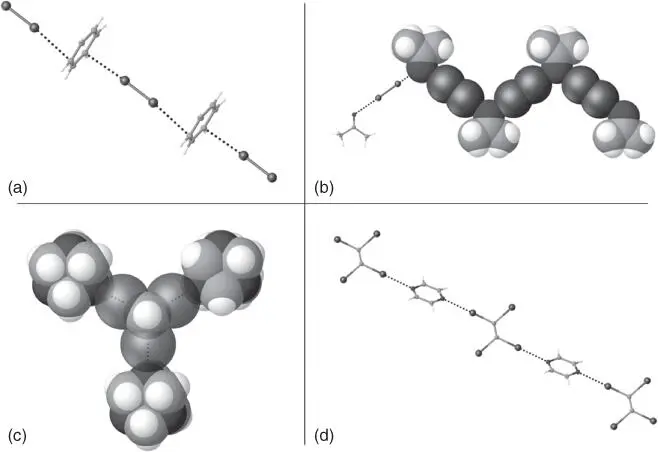
Figure 1.3Early halogen bonding cocrystals from Hassel. Bromine/benzene adduct (a, BENZBR01), bromine/acetone adduct (b, ACETBR), hexamethylenetetramine/iodoform adduct (c, HEXAIF10), and tetraiodoethylene/pyrizine adduct (d, IETPYA10). CSD ref codes are provided after the location description. Dotted lines represent halogen bond contacts, and space‐filling diagrams are drawn using default van der Waals radii in OLEX2.
Читать дальшеИнтервал:
Закладка:
Похожие книги на «Halogen Bonding in Solution»
Представляем Вашему вниманию похожие книги на «Halogen Bonding in Solution» списком для выбора. Мы отобрали схожую по названию и смыслу литературу в надежде предоставить читателям больше вариантов отыскать новые, интересные, ещё непрочитанные произведения.









Обсуждение, отзывы о книге «Halogen Bonding in Solution» и просто собственные мнения читателей. Оставьте ваши комментарии, напишите, что Вы думаете о произведении, его смысле или главных героях. Укажите что конкретно понравилось, а что нет, и почему Вы так считаете.