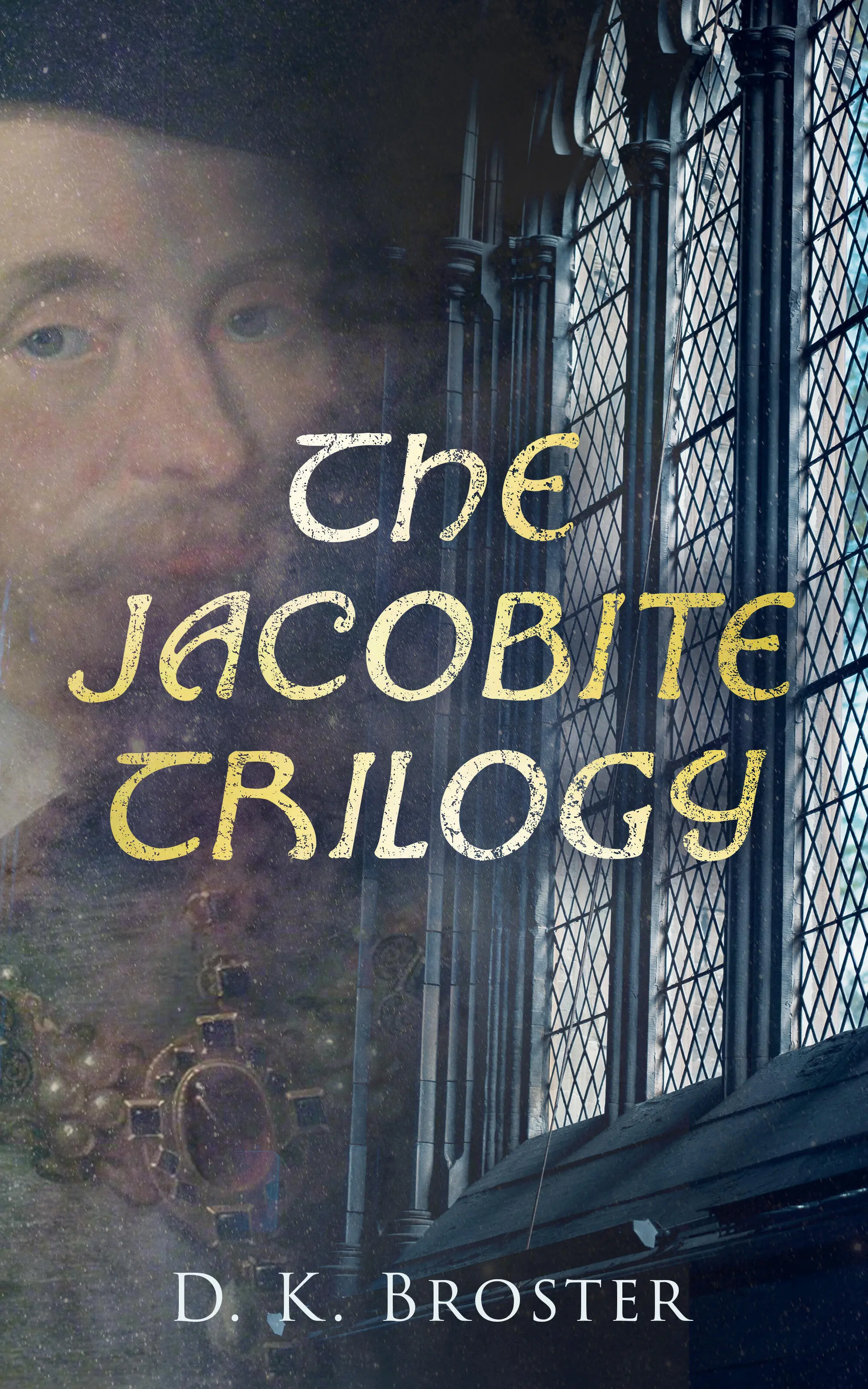
D. Broster - The Jacobite Trilogy
Здесь есть возможность читать онлайн «D. Broster - The Jacobite Trilogy» — ознакомительный отрывок электронной книги совершенно бесплатно, а после прочтения отрывка купить полную версию. В некоторых случаях можно слушать аудио, скачать через торрент в формате fb2 и присутствует краткое содержание. Жанр: unrecognised, на английском языке. Описание произведения, (предисловие) а так же отзывы посетителей доступны на портале библиотеки ЛибКат.
- Название:The Jacobite Trilogy
- Автор:
- Жанр:
- Год:неизвестен
- ISBN:нет данных
- Рейтинг книги:3 / 5. Голосов: 1
-
Избранное:Добавить в избранное
- Отзывы:
-
Ваша оценка:
The Jacobite Trilogy: краткое содержание, описание и аннотация
Предлагаем к чтению аннотацию, описание, краткое содержание или предисловие (зависит от того, что написал сам автор книги «The Jacobite Trilogy»). Если вы не нашли необходимую информацию о книге — напишите в комментариях, мы постараемся отыскать её.
"The Flight of the Heron" – Set in Scotland during the Jacobite rising of 1745, this is the story of an unlikely friendship between a young Jacobite and Highland chieftain Ewen Cameron who follows Bonnie Prince Charlie in his bid for the throne and a Government Army Officer, the Englishman Captain Keith Windham of the Royal Scots. In the battle of Culloden Cameron captures Windham after swordfight and takes him prisoner. Windham manages to escape, but by the prophecy of Cameron's visionary foster father, the two men are about to cross paths five times.
"The Gleam in the North" – In an unsettling time following Jacobite Rebellion, Ewen Cameron is living in Scottish Highlands by his beloved loch with his offspring, two young boys. When his younger son falls in the cold loch water, he gets rescued in the last minute and falls ill, so Ewen goes strolling through hills and moors looking for someone who can help his boy. However, King George's Redcoats are patrolling through the Highlands, assisted by local clan spies, lurking to catch mutineers from the Rebellion. Ewen gets captured and taken to London to be executed where he inevitably crosses paths with his old friend Keith Windham.
"The Dark Mile" – Ewen Cameron of Ardroy lives in peace with his beloved Alison and their two young boys, when they get a visit by Ian Stewart, Ewen's cousin who is being pressured to get married. He is not happy with choices presented to him, so he tries to avoid it, but when he meets beautiful Olivia Campbell they get romantically involved. However, their relationship is not welcomed by their families who have some unresolved issues dating from the time of the Rebellion.
The Jacobite Trilogy — читать онлайн ознакомительный отрывок
Ниже представлен текст книги, разбитый по страницам. Система сохранения места последней прочитанной страницы, позволяет с удобством читать онлайн бесплатно книгу «The Jacobite Trilogy», без необходимости каждый раз заново искать на чём Вы остановились. Поставьте закладку, и сможете в любой момент перейти на страницу, на которой закончили чтение.
Интервал:
Закладка:
Yet Ewen and Alison sat by their fire after all, sat there until the last peat crumbled, and it began to grow cold; but Alison, as once before, was warm in the Cameron tartan, for Ewen had wrapped it round her knees over her pretty gown. He sat at her feet, looking very long and large, the firelight, while it lasted, playing on the shining golden brown of his hair, accentuating too the faint hollow in his cheek, the slight suggestion of a line between the brows which the last two months had set there.
“Ewen, I want to tell you something.” Alison hesitated and a tinge of colour stole over her face. “Do you know, m’eudail, that you talk in your sleep?”
He looked up at her surprised. “Do I? No, dearest, I did not know. Did I talk much—to disturb you?”
She shook her head. Ewen seemed to turn over this information for a moment. “I believe,” he said thoughtfully, “that as a boy I used to do it sometimes, so Aunt Margaret said, but I thought that I had outgrown it. What did I talk of—you, sweetheart, I’ll warrant?”
“No,” said Alison, smiling down upon him. “Not a word of your wife. You seemed to think that you were speaking to someone of whom she may well be jealous; and what is more, when I spoke to you, thinking for a moment that you were awake, you answered quite sensibly.”
“Jealous!” exclaimed Ewen, turning his clear, candid gaze full upon her. “My little white love, there’s no one in this world of whom you have occasion to be jealous, nor ever has been. Do not pretend to be ignorant of where my heart is kept!” He took her clasped hands, opened them gently, and kissed the palms. “The space is small,” he said, looking critically at it, “but, such as the heart is, all of it lies there.”
Alison enveloped him in a warm, sweet smile, and slid the hands round his neck. “All? No; there’s a corner you have kept for someone else, and in it you have set up a little shrine, as the Papists do, for your saint—for Lochiel. But I am not jealous,” she added very softly. “I understand.”
Ewen gave her a look, put his own hands over those clasped round his neck, and dropped his head on to her knee in silence. After a while she put her cheek against the thick, warm waves of his hair. Joy and apprehension had so clasped hands about Alison Cameron this day that it was hard to know which was the stronger.
But in the night she knew. The icy fingers of foreboding seemed gripped about her heart. Not even Ewen’s quiet, unhurried breathing beside her, not even the touch of his hand, over which her fingers stole in search of comfort, could reassure her; his nearness but made the pain the sharper. Oh, to have him hers only to lose him so soon! But her father—alone, dying, over the seas! She reached out and lit a candle, that she might look once more at the husband she was leaving for her father’s sake, for God knew whether she should ever see him asleep beside her again. It was not the seas alone which were about to sunder them. . . .
Ewen was sleeping so soundly, too, so quietly; and he looked as young and untroubled as the boy she had known five years ago in Paris. There was no sign on his face, in its rather austere repose, of the trouble which had forced its way through his unconscious lips last night. Alison had not told him by the fire, that on their bridal night he had uttered protests, bewildered questionings, against that double retreat in which he had shared. ‘Must we go back, Lochiel—must we go back?’
She gazed at him a long time, until for tears she could see him no longer, and, blowing out the light, lay and sobbed under her breath. She thought she should die of her unhappiness; she almost wished that she might; yet she sobbed quietly lest she should wake Ewen to unhappiness also. But quite suddenly, though he had not stirred, she heard his voice in the darkness; and then she was in his arms, and he was comforting her in their own Highland tongue, with all its soft endearments and little words of love. And there at last she fell asleep.
But Ewen stayed awake until the grudging March daylight crept into the little room where he lay wide-eyed, with Alison’s dark curls on his heart, and within it a chilly sword that turned and turned. He would never hold her thus again; he was sure of it.
* * * * *
The morning was very cold, and when he took Alison to the French brig a little snow was falling; the gang-plank was slippery too with rime. He carried her bodily over it, and down to the cabin which she would share with Jean Wishart.
There under the low beams Alison’s courage broke at last. Clinging to him convulsively she said, in a voice that was not hers, that he must come with her; that she could not go without him—she could not! He must come too, and then he would be safe . . .
Ewen turned even paler than she. “My darling, my heart’s darling, you don’t mean that!”
Alison swayed; her eyes closed. Alarmed, he put her on a seat against the bulkhead, and, kneeling by her, began to chafe her hands. Soon they clenched in his, and she opened her eyes, dark pools of sorrow, and said firmly through colourless lips, “No, no, I did not mean it! I know that you cannot come. Will you . . . can you forget what I said, Ewen?”
“It is forgotten. It was not you who spoke,” he answered, trying to keep his own voice steady as he knelt there, holding her hands very tightly. There was a trampling sound on deck; how long had they for all the thousand, thousand things that remained to say? There was no time to say even one. He bent his head and pressed his lips passionately upon the hands he held. Anguish though it was to lose her, it was better that she should go. For since he had urged her to marry him that he might take her back to Ardroy he saw with different eyes. The future looked blacker than he had realised; away in Ross he had not known of the desperate want of money, even of food, the gradually thinning ranks. He knew of these now, and saw even Cumberland’s delay at Aberdeen in a sinister light, as if the Hanoverian commander knew that the fates were working on his side and that there was no need for haste. . . .
Above him Alison’s voice said suddenly, “Ewen . . . Ewen, why do you not say, ‘Stay then in Scotland with me—do not go to France yourself!’?”
He was startled; had she read his thoughts? “Why, my darling,” he answered as readily as he could, “because your father needs you so sorely.”
Her voice sank still lower. “There is another reason, too—do not deny it! You think that I am safer away!”
And Ewen did not answer.
“And you gave me this ring—the Prince’s ring—not only as a wedding gift, but because you feared that one day . . . soon . . . it might be taken from you!”
After a pause he said, “Partly, perhaps.”
“Then . . . I cannot leave you, even for my father,” said Alison, and sprang up. “I must stay in Scotland, beside you. I am your wife. Take me back to the quay, Ewen—tell Mrs. Wishart . . .”
But Ewen, on his feet too, caught her in his arms. “No, darling, no! Think of your father, whom you may never see again. And, love of my heart”—he tried to make his voice light—“you cannot come besieging Fort William with me! When we have beaten Cumberland, as we beat Cope and Hawley, I will come to France and fetch you home to Ardroy.”
“When we have beaten Cumberland.” Alison looked up into her husband’s eyes with a most insistent question in her own. But he did not answer the question, though he knew very well what it was, for he said gently, “How can one see into the future, darling? One can only . . . do one’s duty.”
Even as he uttered that rigorous word there came a knock at the cabin door, and a gruff French voice announced that they would be casting off in another minute or two, and that if Monsieur wished to land he must be quick.
Читать дальшеИнтервал:
Закладка:
Похожие книги на «The Jacobite Trilogy»
Представляем Вашему вниманию похожие книги на «The Jacobite Trilogy» списком для выбора. Мы отобрали схожую по названию и смыслу литературу в надежде предоставить читателям больше вариантов отыскать новые, интересные, ещё непрочитанные произведения.



Обсуждение, отзывы о книге «The Jacobite Trilogy» и просто собственные мнения читателей. Оставьте ваши комментарии, напишите, что Вы думаете о произведении, его смысле или главных героях. Укажите что конкретно понравилось, а что нет, и почему Вы так считаете.