D. Broster - The Jacobite Trilogy
Здесь есть возможность читать онлайн «D. Broster - The Jacobite Trilogy» — ознакомительный отрывок электронной книги совершенно бесплатно, а после прочтения отрывка купить полную версию. В некоторых случаях можно слушать аудио, скачать через торрент в формате fb2 и присутствует краткое содержание. Жанр: unrecognised, на английском языке. Описание произведения, (предисловие) а так же отзывы посетителей доступны на портале библиотеки ЛибКат.
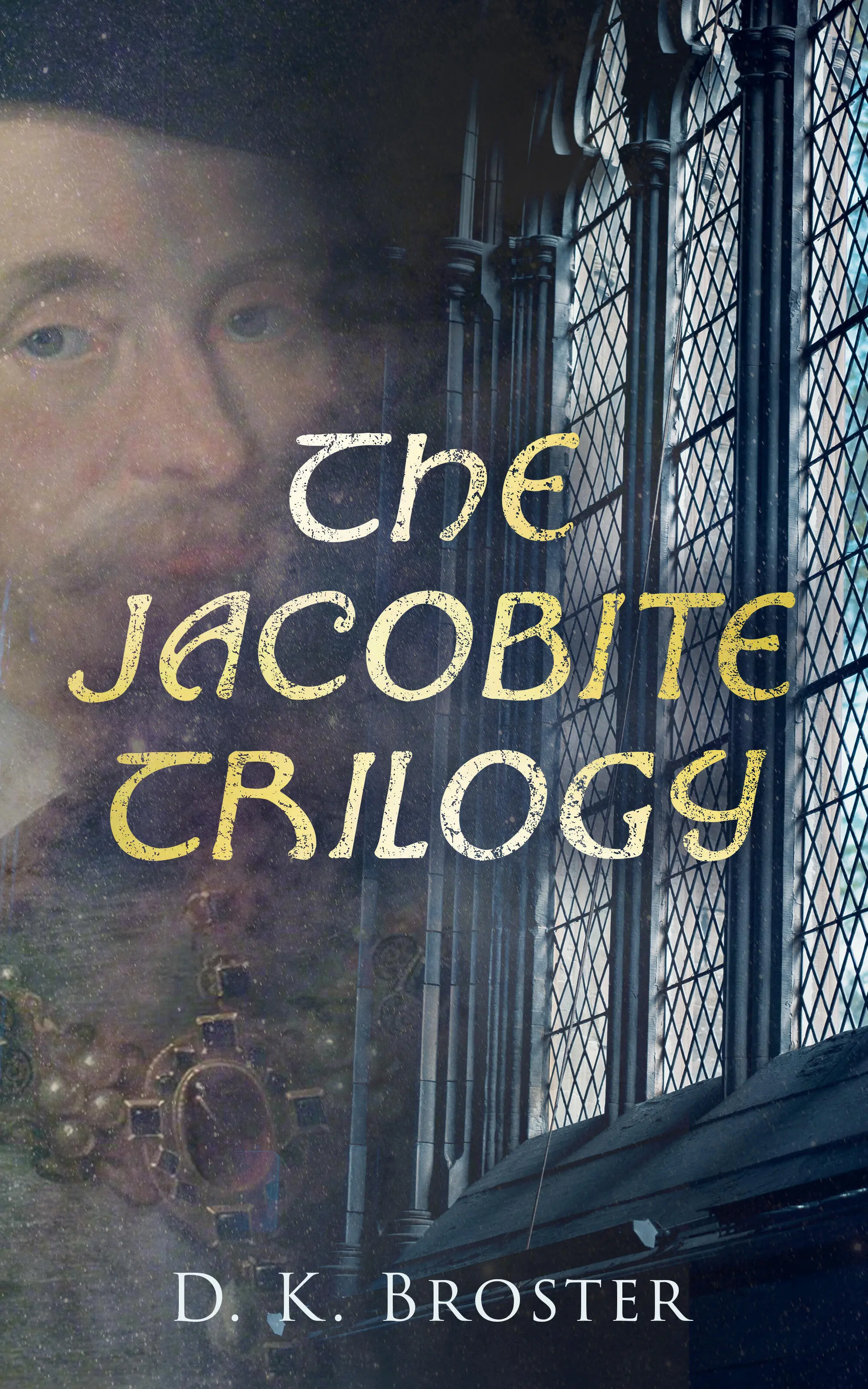
- Название:The Jacobite Trilogy
- Автор:
- Жанр:
- Год:неизвестен
- ISBN:нет данных
- Рейтинг книги:3 / 5. Голосов: 1
-
Избранное:Добавить в избранное
- Отзывы:
-
Ваша оценка:
The Jacobite Trilogy: краткое содержание, описание и аннотация
Предлагаем к чтению аннотацию, описание, краткое содержание или предисловие (зависит от того, что написал сам автор книги «The Jacobite Trilogy»). Если вы не нашли необходимую информацию о книге — напишите в комментариях, мы постараемся отыскать её.
"The Flight of the Heron" – Set in Scotland during the Jacobite rising of 1745, this is the story of an unlikely friendship between a young Jacobite and Highland chieftain Ewen Cameron who follows Bonnie Prince Charlie in his bid for the throne and a Government Army Officer, the Englishman Captain Keith Windham of the Royal Scots. In the battle of Culloden Cameron captures Windham after swordfight and takes him prisoner. Windham manages to escape, but by the prophecy of Cameron's visionary foster father, the two men are about to cross paths five times.
"The Gleam in the North" – In an unsettling time following Jacobite Rebellion, Ewen Cameron is living in Scottish Highlands by his beloved loch with his offspring, two young boys. When his younger son falls in the cold loch water, he gets rescued in the last minute and falls ill, so Ewen goes strolling through hills and moors looking for someone who can help his boy. However, King George's Redcoats are patrolling through the Highlands, assisted by local clan spies, lurking to catch mutineers from the Rebellion. Ewen gets captured and taken to London to be executed where he inevitably crosses paths with his old friend Keith Windham.
"The Dark Mile" – Ewen Cameron of Ardroy lives in peace with his beloved Alison and their two young boys, when they get a visit by Ian Stewart, Ewen's cousin who is being pressured to get married. He is not happy with choices presented to him, so he tries to avoid it, but when he meets beautiful Olivia Campbell they get romantically involved. However, their relationship is not welcomed by their families who have some unresolved issues dating from the time of the Rebellion.
The Jacobite Trilogy — читать онлайн ознакомительный отрывок
Ниже представлен текст книги, разбитый по страницам. Система сохранения места последней прочитанной страницы, позволяет с удобством читать онлайн бесплатно книгу «The Jacobite Trilogy», без необходимости каждый раз заново искать на чём Вы остановились. Поставьте закладку, и сможете в любой момент перейти на страницу, на которой закончили чтение.
Интервал:
Закладка:
The ferryman’s voice broke in on his passenger’s reflections. “ ’Tis all much changed in Inverness now, sir, and for the better.” Evidently, like most of the inhabitants, he was Jacobite at heart. “To think that only two weeks agone I ferried Lord Loudoun and the Lord President and the Chief of Macleod over in this very boat, and all their troops crossing helter-skelter too, to get away from the Prince. . . . You’ll be yourself, perhaps, from chasing after Lord Loudoun yonder?” he added tentatively.
“Yes,” answered Ewen, his eyes still fixed on Inverness, “I am from Lord Cromarty’s force.”
The reason why the Earl of Loudoun, commanding the district for the Government, had evacuated Inverness without a battle, was really due to the somewhat ludicrous failure of his attempt to seize the person of the Prince when, in mid-February, the latter was the guest of Lady Mackintosh at Moy Hall. Conceiving the idea of surprising him there, the Earl had set out secretly at night with a force of fifteen hundred men for that purpose. But timely warning having been sent from Inverness, the Prince slipped out of Moy Hall, and the whole of Lord Loudoun’s force was thrown into confusion, and a part of it into headlong flight, by the ruse of Donald Fraser, the Moy blacksmith, and four of Lady Mackintosh’s Highland servants, who, by firing off their pieces in the dark and calling to imaginary regiments to come up, re-enacted the comedy of High Bridge on an even more piquant scale. Not only was the Earl obliged to return ignominiously to Inverness, but the desertions from his Highland companies consequent upon this affair were so great that he thought it better to await Cumberland’s advance among the Whig clans of Ross and Cromarty, to which he and his force accordingly retired; and Prince Charles’s army had entered Inverness without a blow.
The water lapped the sides of the ferryboat impatiently. The sky looked full of snow, and nearly as dark as on the day of Falkirk, while the wind was even colder than Ewen remembered it as they had plodded over Shap Fell in the December retreat from England. In Cæsar’s time, as he used to read in his boyhood, armies went into winter quarters. But all their marching and fighting had been done in the severest season of the year, in autumn and winter; and who knew what awaited them in the not less cruel rigours of a Highland spring? For Cumberland, he knew, had been at Aberdeen since the end of February.
Ewen frowned, and his thoughts went back to the somewhat comic warfare from which he had just been recalled. For when Lord Cromarty had been sent with a Jacobite force over the Moray Firth after Lord Loudoun, the latter, retreating farther north into Sutherland, established himself at Dornoch on the other side of the deep-winding firth of that name, which Cromarty, having no boats, could not cross. But directly Cromarty attempted to go round by the head of the firth Lord Loudoun sent his men across by ferry to Tain, on the Ross-shire side, once more; and when Lord Cromarty returned to Ross, Lord Loudoun recalled his followers to Dornoch. And thus a vexatious and absurd game of catch as catch can had been going on, and might go on for ever unless the Prince could send another detachment to hold Tain. No, Ewen was not sorry that Lochiel had recalled him.
He pulled his bonnet with the draggled eagle’s feathers and the soiled cockade farther down on his brows, and wrapped his plaid round him, for they were now in the icy middle of the firth. The ferryman babbled on, telling him for the most part things he knew already; how, for instance, when the Prince had had the castle here blown up after its surrender, an unfortunate French engineer had been blown up with it. It was useless to ask the man what he really wanted to know, how Miss Alison Grant did over there in Inverness, Alison on whom he had not set eyes since Hector and he had said farewell to her last All Hallows in Edinburgh. It was a question whether they three would ever meet again, for Hector had been one of the officers left behind as part of the ill-fated garrison of Carlisle, and since the thirtieth of December he had been a prisoner in English hands. How Alison was bearing this ill news Ewen could only guess; it was all the heavier for her too, because her father was in France, having been despatched thither on a mission by the Prince directly after Falkirk.
Ewen knew that Alison and his aunt had come to Inverness in the hopes of seeing him, immediately on the news of the town’s surrender to the Highland army on February 18, but as it was before their arrival that Ewen himself had been sent off with Lord Cromarty’s composite force, the meeting had not taken place. Miss Cameron, as a letter had since told him, had thought it best on that to return to Ardroy, but, feeling sure that sooner or later Ewen’s duties would bring him to Inverness, she had left Alison there in the care of Lady Ogilvy, whose husband, with his regiment, was on the other side of the Spey. And now Lochiel had recalled Ewen—but only to accompany him on another enterprise. Of his approaching return Ewen had told Alison in a letter which he had despatched yesterday by Lachlan, but he had not told her how brief his stay would be, nor had he broached the project which was in his own mind—the determination which had been growing there since the retreat northward.
But, as he thought of what that was, the harassed look went out of his eyes, and he became deafer than ever to the ferryman’s chatter.
* * * * *
At the guardhouse by the bridge over the Ness Ewen stopped to enquire where Lady Ogilvy was to be found, for he was not sure of her lodging, and as he was talking to the officer there he heard a youthful voice behind him asking exactly the same question in Gaelic.
Ewen turned quickly, for he knew that voice. There in the entry stood a half-shy, half-excited boy of fifteen, who had never been in a town before—young Angus, Neil MacMartin’s eldest son. His face lit up, and he darted forward. “Letters, Mac ’ic Ailein!” And out of an old sporran too big for him he produced two, none the better for their sojourn in that receptacle.
With a smile and a kind word his master took them. One was from Miss Cameron to himself, the other, addressed to Miss Alison Grant at Ardroy, in an unknown and foreign-seeming hand, had been redirected by his aunt to Inverness. He put them both in his pocket, gave the lad money to procure himself food and lodging and a new pair of brogues to go home in, told him where to find his father and not to return to Ardroy without seeing him again, and himself set off in haste for Lady Ogilvy’s lodging.
But Angus Og, footsore and hungry though he was, seeing his young chieftain quite unaccompanied, pattered at a little distance behind him with all the air of a bodyguard, his head full of wild plans for joining his father and uncle in this place of many houses instead of returning to Slochd nan Eun. If they were in Mac ’ic Ailein’s tail, why not he?
Young Lady Ogilvy lodged in one of the larger houses at the lower end of Kirk Street, and as Ewen passed the many-paned projecting window on the ground-floor he caught sight of a blue ribbon confining dark curls. After that he was not much conscious of being admitted, or of anything until he found its wearer in his arms.
“Oh, my darling! . . . You were expecting me—Lachlan brought you my letter?”
Alison nodded, holding very fast to him, her eyes closed like one surrendered to ecstasy. Much as they had to say to one another, for a time neither said it; it was enough merely to be together again after the months of strain and waiting and endurance and disillusioned hopes. But when they had had their fill of looking at each other they began to talk.
“I knew that you would come back to Inverness,” said Alison happily. They were both sitting on the window seat now. And she added, with all her old gaiety, “If Lochiel would permit so forward an act, I would kiss him for having recalled you from Lord Cromarty’s force.”
Читать дальшеИнтервал:
Закладка:
Похожие книги на «The Jacobite Trilogy»
Представляем Вашему вниманию похожие книги на «The Jacobite Trilogy» списком для выбора. Мы отобрали схожую по названию и смыслу литературу в надежде предоставить читателям больше вариантов отыскать новые, интересные, ещё непрочитанные произведения.
Обсуждение, отзывы о книге «The Jacobite Trilogy» и просто собственные мнения читателей. Оставьте ваши комментарии, напишите, что Вы думаете о произведении, его смысле или главных героях. Укажите что конкретно понравилось, а что нет, и почему Вы так считаете.