D. Broster - The Jacobite Trilogy
Здесь есть возможность читать онлайн «D. Broster - The Jacobite Trilogy» — ознакомительный отрывок электронной книги совершенно бесплатно, а после прочтения отрывка купить полную версию. В некоторых случаях можно слушать аудио, скачать через торрент в формате fb2 и присутствует краткое содержание. Жанр: unrecognised, на английском языке. Описание произведения, (предисловие) а так же отзывы посетителей доступны на портале библиотеки ЛибКат.
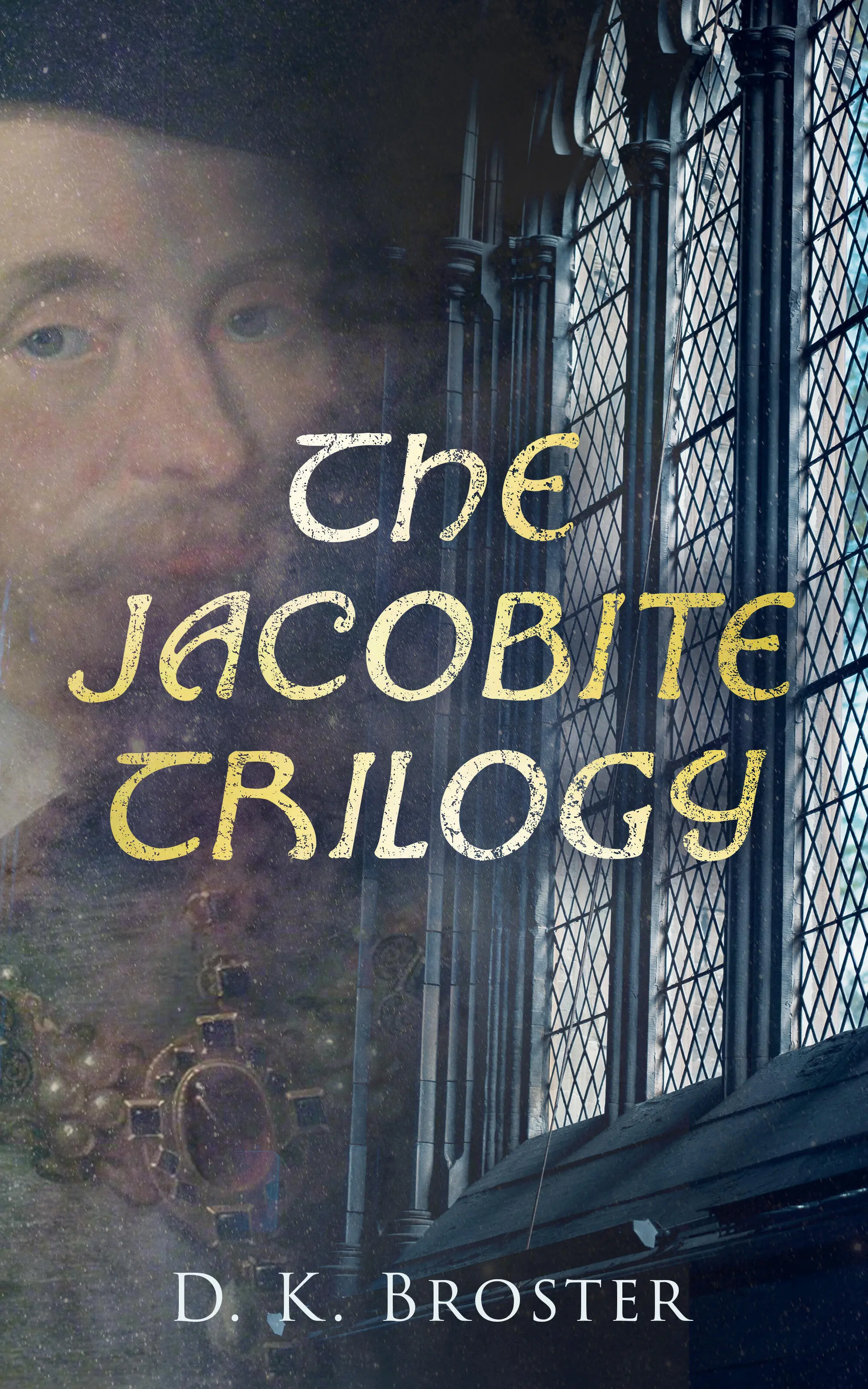
- Название:The Jacobite Trilogy
- Автор:
- Жанр:
- Год:неизвестен
- ISBN:нет данных
- Рейтинг книги:3 / 5. Голосов: 1
-
Избранное:Добавить в избранное
- Отзывы:
-
Ваша оценка:
The Jacobite Trilogy: краткое содержание, описание и аннотация
Предлагаем к чтению аннотацию, описание, краткое содержание или предисловие (зависит от того, что написал сам автор книги «The Jacobite Trilogy»). Если вы не нашли необходимую информацию о книге — напишите в комментариях, мы постараемся отыскать её.
"The Flight of the Heron" – Set in Scotland during the Jacobite rising of 1745, this is the story of an unlikely friendship between a young Jacobite and Highland chieftain Ewen Cameron who follows Bonnie Prince Charlie in his bid for the throne and a Government Army Officer, the Englishman Captain Keith Windham of the Royal Scots. In the battle of Culloden Cameron captures Windham after swordfight and takes him prisoner. Windham manages to escape, but by the prophecy of Cameron's visionary foster father, the two men are about to cross paths five times.
"The Gleam in the North" – In an unsettling time following Jacobite Rebellion, Ewen Cameron is living in Scottish Highlands by his beloved loch with his offspring, two young boys. When his younger son falls in the cold loch water, he gets rescued in the last minute and falls ill, so Ewen goes strolling through hills and moors looking for someone who can help his boy. However, King George's Redcoats are patrolling through the Highlands, assisted by local clan spies, lurking to catch mutineers from the Rebellion. Ewen gets captured and taken to London to be executed where he inevitably crosses paths with his old friend Keith Windham.
"The Dark Mile" – Ewen Cameron of Ardroy lives in peace with his beloved Alison and their two young boys, when they get a visit by Ian Stewart, Ewen's cousin who is being pressured to get married. He is not happy with choices presented to him, so he tries to avoid it, but when he meets beautiful Olivia Campbell they get romantically involved. However, their relationship is not welcomed by their families who have some unresolved issues dating from the time of the Rebellion.
The Jacobite Trilogy — читать онлайн ознакомительный отрывок
Ниже представлен текст книги, разбитый по страницам. Система сохранения места последней прочитанной страницы, позволяет с удобством читать онлайн бесплатно книгу «The Jacobite Trilogy», без необходимости каждый раз заново искать на чём Вы остановились. Поставьте закладку, и сможете в любой момент перейти на страницу, на которой закончили чтение.
Интервал:
Закладка:
“But he has not recalled me in order to stay in Inverness, darling—at least not for more than a couple of days. He and Keppoch are shortly going with reinforcements to the siege of Fort William, and I go too.”
All the peace and content was dashed out of Alison’s face. “Oh, Ewen . . . and I thought you would be staying here!” She bit her lip and the tears came into her eyes.
Her hand was in Ewen’s, and he sat a moment silent, looking down with some intentness at his ring upon it. “But we shall have two days together, m’eudail. And . . . do you not think that those two days are long enough . . . that the time has come . . . to change this ring of my mother’s for another?”
The colour ran over Alison’s face and her hand made a movement as if to withdraw itself. “Oh, my dear,” she said rather breathlessly, “not when my father is absent—not till he comes back! And not when . . . when one does not know what will befall next!”
“But, my heart,” said Ewen quietly, “that is just why I want to make you my wife. Do you not see that? Why, you should have been mine these six months. I have waited even longer than I had thought to wait, and God knows that was long enough.” And as Alison said nothing, but looked down, twisting her ring, he went on, suppressing a little sigh, “There are many reasons why we should be wed without further loss of time, and these two days that we have now seem designed for that. Our marriage could easily be arranged in the time; Mr. Hay, the Episcopal minister of Inverness is, I believe, in the town; Lochiel would take your father’s place. And I could carry you back to Ardroy, as its mistress, when we start for Fort William . . . Alison, dear love, say Yes!”
He was very gentle as he pleaded, for she seemed oddly reluctant, considering that they had been formally contracted since last July, and should indeed have been married in the autumn. She even mentioned Hector and his perilous situation, rather tentatively, as a reason for delay; but Ewen told her that her brother’s prospects were ten times better than those of most who wore the white cockade, for he held a French commission, and could not be treated otherwise than as a prisoner-of-war. And finally Alison said that she would ask Lady Ogilvy’s opinion.
Ewen tried not to be hurt. Since he had not the mistaken conviction of some young men that he knew all about women, even Alison’s feelings were sometimes a mystery to him. He longed to say, “I have not a French commission, Alison,” and leave her to draw a conclusion which might get the better of her hesitancy, but it would have been cruel. And as he looked at her in perplexity he remembered a commission of another kind, and put his hand into his pocket.
“When I saw you, Alison, everything else went out of my head. But here is a letter I should have given you ere this; forgive me. It was sent to you at Ardroy, and Aunt Marget despatched one of the MacMartin lads hither with it; and meeting me by the bridge just now he gave it to me for you. It is from France, I think.”
“I do not know the hand,” said Alison, studying the superscription, and finally breaking the seal. Ewen looked out of the window; but he did not see any of the passers-by.
Suddenly there was an exclamation from the girl beside him on the window seat. He turned; her face was drained of colour.
“My father . . . Ewen, Ewen, I must go at once—he is very ill . . . dying, they think. Oh, read!”
Horrified, Ewen read a hasty French letter, already more than two weeks old, which said that M. Grant, on the point of leaving France again, had been taken seriously ill at Havre-de-Grâce; the writer, apparently a recent French acquaintance of his, appealed to Mlle Grant to sail for France at once, if she wanted to see her father alive—not that the state of M. Grant at the moment was desperate, but because the doctor held out small hope of ultimate recovery.
Alison had sprung to her feet, and clasping and unclasping her hands was walking up and down the room.
“Ewen, Ewen, what if I am not in time! My dearest, dearest father, ill and quite alone over there—no Hector anywhere near him now! I must go at once. I heard Lady Ogilvy say that there was a French vessel in port here due to sail for France in a day or two; I could go in that. Perhaps the captain could be persuaded to sail earlier . . .”
In contrast to her restlessness, Ewen was standing quite still by the window.
“Ewen,” she began again, “help me! Will you make enquiries of the captain of the ship? I think she is for St. Malocs, but that would serve; I could post on into Normandy. Will you find out the captain now—this afternoon? . . . Ewen, what ails you?”
For her lover was gazing at her with an expression which was quite new to her.
“I am deeply sorry to hear this ill news of Mr. Grant,” he said in a low voice, and seemed to find a difficulty in speaking, “—more sorry than I have words for. But, Alison, what of me?”
“You would not wish to keep me back, surely?”
“What do you think?” asked the young man rather grimly. “But I will not—no, it would not be right. I will let you go, but only as my wife. You’ll marry me to-morrow, Alison!”
There was no pleading about him now. He moved a step or two nearer, having to keep a tight hold on himself neither to frighten her nor to let slip a word against this other claim which, much as he respected it, was coming in once more to sweep her away from him, when he had waited so long. Whatever might be read on his face, his actions were perfectly gentle.
And Alison came to him, the tears running down her cheeks, and put her two hands in his. “Yes, Ewen, I am ready. Heart’s darling, I wish it, too; you must not think I am unwilling. . . . And you said that you would carry me off by force if I were,” she added, laughing a little hysterically, as he folded her once again in his arms.
* * * * *
So next day they were married in the little Episcopal meeting-house of Inverness. Only a very few people were present, but the Prince was among them: not the lighthearted adventurer of the escapade in Edinburgh in which the bridegroom had played so belauded a part, but a young man who looked what the last three months had made him, soured and distrustful. Yet he gave them a glimpse of his old charming smile after the ceremony, when he kissed the bride and wished them both happiness.
“I would I were venerable enough to give you my blessing, my friends,” he said, “since ’tis all I have to give; but I think I am somewhat the junior of your husband, Lady Ardroy; and in any case how could I bestow my benediction upon a bridegroom who has the bad taste to be so much taller than his future King!”
“But you know that I am at your feet, my Prince,” said Ewen, smiling, and he kissed once more the hand which he had kissed that night at Holyrood.
Last of all Lochiel, grave and gentle, who had given Alison away, kissed her too, and said, “Ewen is a very fortunate man, my dear; but I think you are to be congratulated also.”
For their brief wedded life a little house which Mr. Grant had hired the previous summer had been hastily prepared; it was bare almost to penury, a tent for a night or two, meet shelter for those who must part so soon. And Ewen had no gift ready for his bride—save one. When they came home he put on her middle finger the ring which the Prince had given him in Edinburgh.
Next day was theirs to play at housekeeping, and they were a great deal more gay over it than Jeanie Wishart, Alison’s woman, who went about her work perpetually murmuring, “Puir young things!” In the afternoon, since the March sun had come out to look at them, they wandered among the Islands and gazed down at Ness, hurrying past, broad and clear and shallow, to the firth. That evening they had thought to spend alone by their own fireside; yet nothing would serve Lady Ogilvy save to give a supper for the new-married pair, and Lady Ardroy, in a rose-coloured gown, was toasted by not a few who would never drink a pledge again; and all the Jacobite songs were sung . . . but not, somehow, that only too appropriate, ‘Oh, this is my departing time, for here nae longer maun I stay,’ with which gatherings were wont to conclude.
Читать дальшеИнтервал:
Закладка:
Похожие книги на «The Jacobite Trilogy»
Представляем Вашему вниманию похожие книги на «The Jacobite Trilogy» списком для выбора. Мы отобрали схожую по названию и смыслу литературу в надежде предоставить читателям больше вариантов отыскать новые, интересные, ещё непрочитанные произведения.



Обсуждение, отзывы о книге «The Jacobite Trilogy» и просто собственные мнения читателей. Оставьте ваши комментарии, напишите, что Вы думаете о произведении, его смысле или главных героях. Укажите что конкретно понравилось, а что нет, и почему Вы так считаете.