Andrew Carnie - Syntax
Здесь есть возможность читать онлайн «Andrew Carnie - Syntax» — ознакомительный отрывок электронной книги совершенно бесплатно, а после прочтения отрывка купить полную версию. В некоторых случаях можно слушать аудио, скачать через торрент в формате fb2 и присутствует краткое содержание. Жанр: unrecognised, на английском языке. Описание произведения, (предисловие) а так же отзывы посетителей доступны на портале библиотеки ЛибКат.
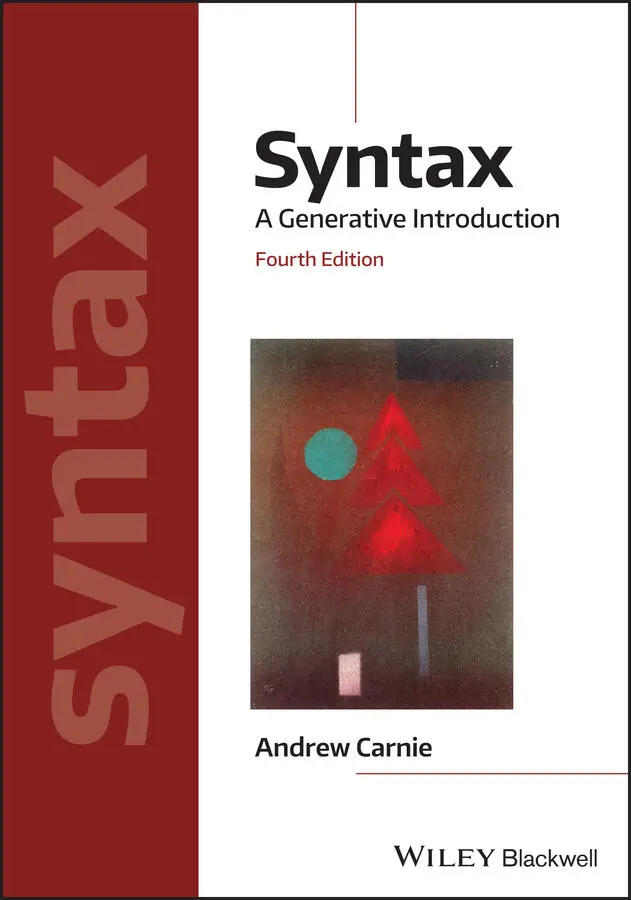
- Название:Syntax
- Автор:
- Жанр:
- Год:неизвестен
- ISBN:нет данных
- Рейтинг книги:4 / 5. Голосов: 1
-
Избранное:Добавить в избранное
- Отзывы:
-
Ваша оценка:
Syntax: краткое содержание, описание и аннотация
Предлагаем к чтению аннотацию, описание, краткое содержание или предисловие (зависит от того, что написал сам автор книги «Syntax»). Если вы не нашли необходимую информацию о книге — напишите в комментариях, мы постараемся отыскать её.
remains the leading introduction to the rules, principles, and processes that determine the structure of sentences in language. Comprehensive yet accessible, the text provides a well-balanced, student-friendly introduction to syntactic theory. Topics include phrase structure, the lexicon, binding theory, case theory, movement, covert movement, locality conditions, ditransitives, verbal inflection and auxiliaries, ellipsis, control theory, non-configurational languages, and more. Students are provided with numerous exercises and pedagogical features designed to strengthen comprehension, review learning objectives, test knowledge, and highlight major issues in the field.
The
features revised material throughout, including a new section on Chomsky's Merge and additional problem sets in every chapter, while new examples throughout the text broaden the appeal and relatability of the text to a more diverse set of students. The optional
has also been thoroughly revised and expanded to offer students the opportunity to practice the skills and concepts introduced in the primary text. This classic textbook:
Presents authoritative and comprehensive coverage of basic, intermediate, and advanced topics Includes ample exercises and clear explanations using straightforward language Offers extensive online student and instructor resources, including problem sets, PowerPoint slides, an updated instructor's manual, author-created videos, online-only chapters, and other supplementary material Features a wealth of learning tools, including learning objectives, discussion questions, and problems of varying levels of difficulty In the new fourth edition,
remains an essential textbook for beginning syntacticians, perfect for undergraduate and graduate course in linguistics, grammar, language, and second language teaching.
Available as a set with
, 2nd Edition
Syntax — читать онлайн ознакомительный отрывок
Ниже представлен текст книги, разбитый по страницам. Система сохранения места последней прочитанной страницы, позволяет с удобством читать онлайн бесплатно книгу «Syntax», без необходимости каждый раз заново искать на чём Вы остановились. Поставьте закладку, и сможете в любой момент перейти на страницу, на которой закончили чтение.
Интервал:
Закладка:
In his excellent book The Atoms of Language , Mark Baker inventories a set of possible parameters of language variation within the UG hypothesis. This is an excellent and highly accessible treatment of parameters. I strongly recommend this book for further reading on how language variation is consistent with Universal Grammar.
You now have enough information to try GPS7, GPS8, and CPS 11 .
7. CHOOSING AMONG THEORIES ABOUT SYNTAX
There is one last preliminary we have to touch on before actually doing some real syntax. In this book we are going to posit many hypotheses. Some of these we’ll keep, others we’ll revise, and still others we’ll reject. How do we know what is a good hypothesis and what is a bad one? Chomsky (1965) proposed that we can evaluate how good theories of syntax are using what are called the levels of adequacy. Chomsky claimed that there are three stages that a grammar (the collection of descriptive rules that constitute your theory) can attain in terms of scientific adequacy.
If your theory only accounts for the data in a corpus (say a series of printed texts) and nothing more, it is said to be an observationally adequate grammar. Needless to say, this isn’t much use if we are trying to account for the cognition of an i-language. As we discussed above, it doesn’t tell us the whole picture. We also need to know what kinds of sentences are unacceptable, or ill-formed. A theory that accounts for both corpora and native speaker judgments about well-formedness is called a descriptively adequate grammar. On the surface this may seem to be all we need. Chomsky, however, has claimed that we can go one step better. He points out that a theory that also accounts for how children acquire their language is the best. He calls this an explanatorily adequate grammar. The simple theory of parameters might get this label. Generative grammar strives towards explanatorily adequate grammars.
You now have enough information to try GPS9 and CPS12 .
8. THE SCIENTIFIC METHOD AND THE STRUCTURE OF THIS TEXTBOOK
Throughout this chapter I’ve emphasized the importance of the scientific method to the study of syntax. It’s worth noting that we’re not only going to apply this principle to small problems or specific rules, but we’ll also apply it in a more global way. This principle is in part a guide to the way in which the rest of this book is structured.
In chapters 2–5 (the remainder of Part 1 of the book) we’re going to develop an initial hypothesis about the way in which syntactic rules are formed. These are the phrase structure rules (PSRs). Chapters 2 and 3 examine the words these rules use, the form of the rules, and the structures they generate. Chapters 4 and 5 look at ways we can detail the structure of the trees formed by the PSRs.
In chapters 6–9 (Part 2 of the book), we examine some data that present problems for the simple grammar presented in Part 1. When faced withmore complicated data, we revise our hypotheses , and this is precisely what we do. We develop a special refined kind of PSR known as an X-bar rule. X-bar rules are still phrase structure rules, but they offer a more sophisticated way of looking at trees. This more sophisticated version also needs an additional constraint known as the “theta criterion”, which is the focus of chapter 8.
In chapters 10–13 (Part 3) we consider even more data, and refine our hypothesis once again, this time adding a new rule type: the transformation (we retain X-bar, but enrich it with transformations). Part 4 of the book (chapters 14–18) refines these proposals even further.
With each step we build upon our initial hypothesis, just as the scientific method tells us to. I’ve been teaching with this proposal–then-revision method of theory construction for a couple of years now, and every now and then I hear the complaint from a student that we should just start with the final answer (i.e. the revised hypotheses found in the later chapters in the book). Why bother learning all this “other” “wrong” stuff? Why should we bother learning phrase structure rules? Why don’t we just jump straight into X-bar theory? Well, in principle, I could have constructed a book like that, but then you, the student, wouldn’t understand why things are the way they are in the latter chapters. The theory would appear to be unmotivated, and you wouldn’t understand what the technology actually does. By proposing a simple hypothesis early on in the initial chapters, and then refining and revising it, building new ideas onto old ones, you not only get an understanding of the motivations for and inner workings of our theoretical premises, but you get practice in working like a real linguist. Professional linguists, like all scientists, work from a set of simple hypotheses and revise them in light of predictions made by the hypotheses. The earlier versions of the theory aren’t “wrong” so much as they need refinement and revision. These early versions represent the foundations out of which the rest of the theory has been built. This is simply how science works.
9. CONCLUSION
In this chapter, we’ve done very little syntax but talked a lot about the assumptions underlying the approach we’re going to take to the study of sentence structure. The basic approach to syntax that we’ll be using here is generative grammar; we’ve seen that this approach is scientific in that it uses the scientific method. It is descriptive and rule-based. Further, it assumes that a certain amount of grammar is built in and the rest is acquired.
IDEAS, RULES, AND CONSTRAINTS INTRODUCED IN THIS CHAPTER
1 Linguistics : The scientific study of language.
2 Syntax (the field): The scientific study of sentence structure
3 Syntax (as part of grammar): The level of linguistic organization that mediates between sounds and meaning, where words are organized into phrases and sentences.
4 The Scientific Method : Observe some data, make generalizations about that data, draw a hypothesis, test the hypothesis against more data.
5 Falsifiable Prediction : To prove that a hypothesis is correct you have to look for the data that would prove it wrong . The prediction that might prove a hypothesis wrong is said to be falsifiable.
6 Grammar : Not what you learned in school. This is the set of mental rules or procedures that generate a sentence.
7 Prescriptive Grammar : The grammar rules as taught by so-called “language experts”. These rules, often inaccurate descriptively, prescribe how people should talk/write, rather than describe what they actually do.
8 Descriptive Grammar : A scientific grammar that describes, rather than prescribes, how people talk/write.
9 Anaphor : A word that ends in -self or -selves (a better definition will be given in chapter 5).
10 Antecedent : The noun an anaphor refers to.
11 Asterisk (*) : The mark used to mark syntactically ill-formed (unacceptable or ungrammatical) sentences. The hash mark, pound, or number sign (#) is used to mark semantically strange, but syntactically well-formed, sentences.
12 Grammatical Gender : Masculine vs. Feminine vs. Neuter. Does not have to be identical to the actual sex or gender identity of the referent. For example, a dog might be female, but we can refer to it with the neuter pronoun it . Similarly, boats don’t have a sex, but are grammatically feminine.
13 Number : The quantity of individuals or things described by a noun. English distinguishes singular (e.g., a cat ) from plural (e.g., cats ). Other languages have more or less complicated number systems.
Читать дальшеИнтервал:
Закладка:
Похожие книги на «Syntax»
Представляем Вашему вниманию похожие книги на «Syntax» списком для выбора. Мы отобрали схожую по названию и смыслу литературу в надежде предоставить читателям больше вариантов отыскать новые, интересные, ещё непрочитанные произведения.










Обсуждение, отзывы о книге «Syntax» и просто собственные мнения читателей. Оставьте ваши комментарии, напишите, что Вы думаете о произведении, его смысле или главных героях. Укажите что конкретно понравилось, а что нет, и почему Вы так считаете.