Andrew Carnie - Syntax
Здесь есть возможность читать онлайн «Andrew Carnie - Syntax» — ознакомительный отрывок электронной книги совершенно бесплатно, а после прочтения отрывка купить полную версию. В некоторых случаях можно слушать аудио, скачать через торрент в формате fb2 и присутствует краткое содержание. Жанр: unrecognised, на английском языке. Описание произведения, (предисловие) а так же отзывы посетителей доступны на портале библиотеки ЛибКат.
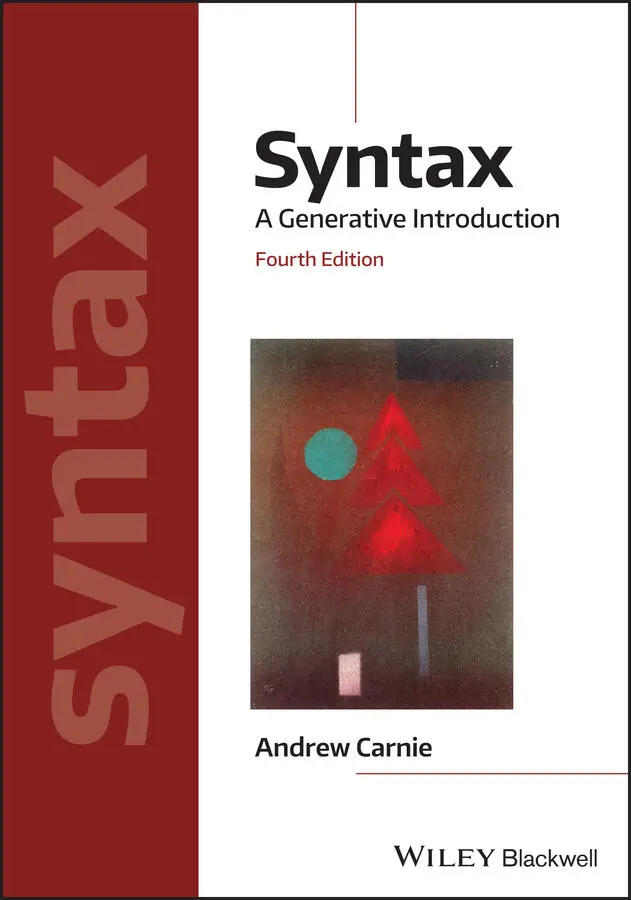
- Название:Syntax
- Автор:
- Жанр:
- Год:неизвестен
- ISBN:нет данных
- Рейтинг книги:4 / 5. Голосов: 1
-
Избранное:Добавить в избранное
- Отзывы:
-
Ваша оценка:
Syntax: краткое содержание, описание и аннотация
Предлагаем к чтению аннотацию, описание, краткое содержание или предисловие (зависит от того, что написал сам автор книги «Syntax»). Если вы не нашли необходимую информацию о книге — напишите в комментариях, мы постараемся отыскать её.
remains the leading introduction to the rules, principles, and processes that determine the structure of sentences in language. Comprehensive yet accessible, the text provides a well-balanced, student-friendly introduction to syntactic theory. Topics include phrase structure, the lexicon, binding theory, case theory, movement, covert movement, locality conditions, ditransitives, verbal inflection and auxiliaries, ellipsis, control theory, non-configurational languages, and more. Students are provided with numerous exercises and pedagogical features designed to strengthen comprehension, review learning objectives, test knowledge, and highlight major issues in the field.
The
features revised material throughout, including a new section on Chomsky's Merge and additional problem sets in every chapter, while new examples throughout the text broaden the appeal and relatability of the text to a more diverse set of students. The optional
has also been thoroughly revised and expanded to offer students the opportunity to practice the skills and concepts introduced in the primary text. This classic textbook:
Presents authoritative and comprehensive coverage of basic, intermediate, and advanced topics Includes ample exercises and clear explanations using straightforward language Offers extensive online student and instructor resources, including problem sets, PowerPoint slides, an updated instructor's manual, author-created videos, online-only chapters, and other supplementary material Features a wealth of learning tools, including learning objectives, discussion questions, and problems of varying levels of difficulty In the new fourth edition,
remains an essential textbook for beginning syntacticians, perfect for undergraduate and graduate course in linguistics, grammar, language, and second language teaching.
Available as a set with
, 2nd Edition
Syntax — читать онлайн ознакомительный отрывок
Ниже представлен текст книги, разбитый по страницам. Система сохранения места последней прочитанной страницы, позволяет с удобством читать онлайн бесплатно книгу «Syntax», без необходимости каждый раз заново искать на чём Вы остановились. Поставьте закладку, и сможете в любой момент перейти на страницу, на которой закончили чтение.
Интервал:
Закладка:
25) “the cat spots the kissing fishes”

Her job, then, is to correctly match up the sentence with the situation. 10More crucially she has to make sure that she does not match it up with all the other possible alternatives, such as the things going on around her (like her older brother kicking the furniture or her father making breakfast for her, etc.). This matching of situations with expressions is a kind of mathematical relation (or function) that maps sentences onto particular situations. Another way of putting it is that she has to figure out the rule(s) that decode(s) the meaning of the sentences. It turns out that this task is at least very difficult, if not impossible.
Let’s make this even more abstract to get at the mathematics of the situation. Assign each sentence some number. This number will represent the input to the rule. Similarly, we will assign each situation a number. The function (or rule) modeling language acquisition maps from the set of sentence numbers to the set of situation numbers. Now let’s assume that the child has the following set of inputs and correctly matched situations (perhaps explicitly pointed out to her by her parents). The x value represents the sentence she hears. The y is the number correctly associated with the situation.
| 26) Sentence (input) | Situation (output) |
| x | y |
| 1 | 1 |
| 2 | 2 |
| 3 | 3 |
| 4 | 4 |
| 5 | 5 |
Given this input, what do you suppose that the output where x = 6 will be?
| 6 | ? |
Most people will jump to the conclusion that the output will be 6 as well. That is, they assume that the function (the rule) mapping between inputs and outputs is x = y . But what if I were to tell you that in the hypothetical situation I envision here, the correct answer is situation number 126? The rule that generated the table in (26) is actually:
27) [(x – 5)*(x – 4)*(x – 3)*(x – 2)*(x – 1)] + x = y
With this rule, all inputs equal to or less than 5 will give an output equal to the input, but for all inputs greater than 5, they will give some large number.
When you hypothesized the rule was x = y , you didn’t have all the crucial information; you only had part of the data. This seems to mean that if you hear only the first five pieces of data in our table then you won’t get the rule, but if you learn the sixth you will figure it out. Is this necessarily the case? Unfortunately not: Even if you add a sixth line, you have no way of being sure that you have the right function until you have heard all the possible inputs. The important information might be in the sixth line, but it might also be in the 7,902,821,123,765th sentence that you hear. You have no way of knowing for sure if you have heard all the relevant data until you have heard them all. In an infinite system, you can’t hear all the data, even if you were to hear 1 new sentence every 10 seconds for your entire life. If we assume the average person lives to be about 75 years old, if they heard one new sentence every 10 seconds, ignoring leap years and assuming they never sleep, they’d have only heard about 39,420,000 sentences over their lifetime. This is a much smaller number than infinity. Despite this poverty of input, by the age of 5 most children are fairly confident with their use of complicated syntax. Productive systems are (possibly) unlearnable, because you never have enough input to be sure you have all the relevant facts. This is called the logical problem of language acquisition.
Generative grammar gets around this logical puzzle by claiming that the child acquiring English, Irish, or Yoruba has some help: a flexible blueprint to use in constructing her knowledge of language called Universal Grammar. Universal Grammar restricts the number of possible functions that map between situations and utterances, thus making language learnable.
You now have enough information to try CPS8 & 9 .
6.4 Other Arguments for UG
The evidence for UG doesn’t rely on the logical problem alone, however. There are many other arguments that support the hypothesis that at least a certain amount of language is built in.
An argument that is directly related to the logical problem of language acquisition discussed above has to do with the fact that we know things about the grammar of our language that we couldn’t possibly have learned. Start with the data in (28). A child might plausibly have heard sentences of these types (the underline represents the place where the question word who might start out – that is, as either the object or the subject of the verb will question ):
28)
| a) Who do you think that Siobhan | will question _____ first? |
| b) Who do you think Siobhan | will question _____ first? |
| c) Who do you think _____ | will question Seamus first? |
The child has to draw a hypothesis about the distribution of the word that in English sentences. One conclusion consistent with these observed data is that the word that in English is optional. You can either have it or not. Unfortunately this conclusion is not accurate. Consider the fourth sentence in the paradigm in (28). This sentence is the same as (28c) but with a that :
d) *Who do you think that _____ will question Seamus first?
It appears as if that is only optional when the question word ( who in this case) starts in object position (as in 28a and b). It is obligatorily absent when the question word starts in subject position (as in 28c and d) (don’t worry about the details of this generalization). What is important to note is that no one has ever taught you that (28d) is ungrammatical. Nor could you have come to that conclusion on the basis of the data you’ve heard. The logical hypothesis on the basis of the data in (28a–c) predicts sentence (28d) to be grammatical. There is nothing in the input a child hears that would lead them to the conclusion that (28d) is ungrammatical, yet every English-speaking child knows it is. One solution to this conundrum is that we are born with the knowledge that sentences like (28d) are ungrammatical. 11This kind of argument is often called the poverty of the stimulusargument for UG.
Most parents raising a toddler will swear up and down that they are teaching their child to speak and that they actively engage in instructing their child in the proper form of the language. The claim that overt instruction by parents plays any role in language development is easily falsified. The evidence from the experimental language acquisition literature is very clear: parents, despite their best intentions, do not, for the most part, correct ungrammatical utterances by their children. More generally, they correct the content rather than the form of their child’s utterances (see for example the extensive discussion in Holzman 1997).
29) (from Marcus et al. 1992)
1 Adult : Where is that big piece of paper I gave you yesterday?
2 Child : Remember? I writed on it.
3 Adult : Oh that’s right, don’t you have any paper down here, buddy?
When a parent does try to correct a child’s sentence structure, it is more often than not ignored by the child:
30) (from Pinker 1995: 281 – attributed to Martin Braine)
Читать дальшеИнтервал:
Закладка:
Похожие книги на «Syntax»
Представляем Вашему вниманию похожие книги на «Syntax» списком для выбора. Мы отобрали схожую по названию и смыслу литературу в надежде предоставить читателям больше вариантов отыскать новые, интересные, ещё непрочитанные произведения.









Обсуждение, отзывы о книге «Syntax» и просто собственные мнения читателей. Оставьте ваши комментарии, напишите, что Вы думаете о произведении, его смысле или главных героях. Укажите что конкретно понравилось, а что нет, и почему Вы так считаете.