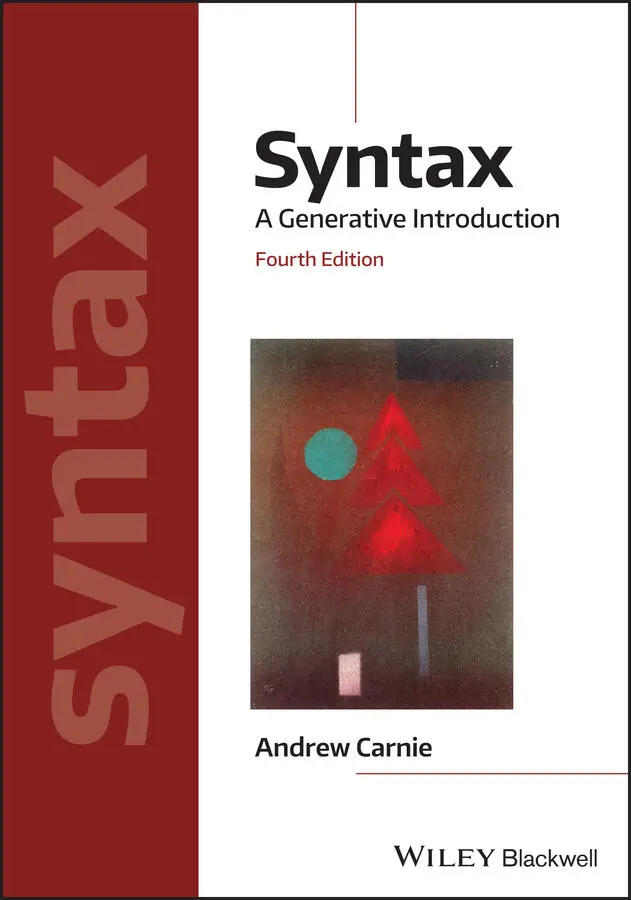
Andrew Carnie - Syntax
Здесь есть возможность читать онлайн «Andrew Carnie - Syntax» — ознакомительный отрывок электронной книги совершенно бесплатно, а после прочтения отрывка купить полную версию. В некоторых случаях можно слушать аудио, скачать через торрент в формате fb2 и присутствует краткое содержание. Жанр: unrecognised, на английском языке. Описание произведения, (предисловие) а так же отзывы посетителей доступны на портале библиотеки ЛибКат.
- Название:Syntax
- Автор:
- Жанр:
- Год:неизвестен
- ISBN:нет данных
- Рейтинг книги:4 / 5. Голосов: 1
-
Избранное:Добавить в избранное
- Отзывы:
-
Ваша оценка:
Syntax: краткое содержание, описание и аннотация
Предлагаем к чтению аннотацию, описание, краткое содержание или предисловие (зависит от того, что написал сам автор книги «Syntax»). Если вы не нашли необходимую информацию о книге — напишите в комментариях, мы постараемся отыскать её.
remains the leading introduction to the rules, principles, and processes that determine the structure of sentences in language. Comprehensive yet accessible, the text provides a well-balanced, student-friendly introduction to syntactic theory. Topics include phrase structure, the lexicon, binding theory, case theory, movement, covert movement, locality conditions, ditransitives, verbal inflection and auxiliaries, ellipsis, control theory, non-configurational languages, and more. Students are provided with numerous exercises and pedagogical features designed to strengthen comprehension, review learning objectives, test knowledge, and highlight major issues in the field.
The
features revised material throughout, including a new section on Chomsky's Merge and additional problem sets in every chapter, while new examples throughout the text broaden the appeal and relatability of the text to a more diverse set of students. The optional
has also been thoroughly revised and expanded to offer students the opportunity to practice the skills and concepts introduced in the primary text. This classic textbook:
Presents authoritative and comprehensive coverage of basic, intermediate, and advanced topics Includes ample exercises and clear explanations using straightforward language Offers extensive online student and instructor resources, including problem sets, PowerPoint slides, an updated instructor's manual, author-created videos, online-only chapters, and other supplementary material Features a wealth of learning tools, including learning objectives, discussion questions, and problems of varying levels of difficulty In the new fourth edition,
remains an essential textbook for beginning syntacticians, perfect for undergraduate and graduate course in linguistics, grammar, language, and second language teaching.
Available as a set with
, 2nd Edition
Syntax — читать онлайн ознакомительный отрывок
Ниже представлен текст книги, разбитый по страницам. Система сохранения места последней прочитанной страницы, позволяет с удобством читать онлайн бесплатно книгу «Syntax», без необходимости каждый раз заново искать на чём Вы остановились. Поставьте закладку, и сможете в любой момент перейти на страницу, на которой закончили чтение.
Интервал:
Закладка:
14 Person : The perspective of the participants in the conversation. The speaker or speakers ( I, me, we, us ) are called the first person . The addressee(s) ( you ) is called the second person . Anyone else (those not involved in the conversation) ( he, him, she, her, it, they, them ) is referred to as the third person .
15 Case : The form a noun takes depending upon its position in the sentence. We discuss this more in chapter 11.
16 Nominative : The form of a noun in subject position ( I, you, he, she, it, we, they ).
17 Accusative : The form of a noun in object position ( me, you, him, her, it, us, them ).
18 Corpus (pl. Corpora) : A collection of real-world language data.
19 Native Speaker Judgments (Intuitions) : Information about the subconscious knowledge of a language. This information is tapped by means of the acceptability judgment task.
20 Semantic Judgment : A judgment about the meaning of a sentence, often relying on our knowledge of the context in which the sentence was uttered.
21 Syntactic Judgment : A judgment about the form or structure of a sentence.
22 Garden Path Sentence : A sentence with a strong ambiguity in structure that makes it hard to understand.
23 Center Embedding : A sentence in which a relative clause consisting of a subject and a verb is placed between the main clause subject and verb. E.g., The house [Bill built] leans to the left .
24 Parsing : The mental tools a listener uses to process and understand a sentence.
25 Competence : What you know about your language.
26 Performance : The real-world behaviors that are a consequence of what you know about your language.
27 i-language : This is the cognitive structure underlying your ability to speak a language. The i- stands for “internal”. This is the primary object of study in this book.
28 e-language : The outward expression of a particular language like English, French or Mandarin. The e- stands for “external”. These are the particular instances of the human ability to speak an i-language. The data sources we use to examine i- language are e-languages.
29 Human Language Capacity (HLC) . The general ability to have an i-language and to express an e-language.
30 Generative Grammar : A theory of linguistics in which grammar is viewed as a cognitive faculty. Language is generated by a set of rules or procedures. The version of generative grammar we are looking at here is primarily the Principles and Parameters approach (P&P), and we will be touching occasionally on Minimalism , a more recent approach.
31 Learning : The gathering of conscious knowledge (like linguistics or chemistry).
32 Acquisition : The gathering of subconscious information (like language).
33 Innate : Hard-wired or built-in, an instinct.
34 Recursion : The ability to embed structures iteratively inside one another. Allows us to produce sentences we’ve never heard before.
35 Universal Grammar (UG) : The innate (or instinctual) part of each language’s grammar.
36 The Logical Problem of Language Acquisition : The proof that an infinite system like human language cannot be learned on the basis of observed data – an argument for UG.
37 Poverty of the stimulus : The idea that we know things about our language that we could not have possibly learned – an argument for UG.
38 Universal : A property found in all the languages of the world.
39 Bioprogram Hypothesis : The idea that creole languages share similar features because of an innate basic setting for language.
40 Observationally Adequate Grammar : A grammar that accounts for observed real-world data (such as corpora).
41 Descriptively Adequate Grammar : A grammar that accounts for observed real- world data and native speaker judgments.
42 Explanatorily Adequate Grammar : A grammar that accounts for observed real- world data and native speaker judgments and offers an explanation for the facts of language acquisition.
FURTHER READING:Baker (2001b), Barsky (1997), Bickerton (1984), Chomsky (1965), Duffield (2018), Ghomeshi (2010), Jackendoff (1993), Sampson (1997), Uriagereka (1998)
GENERAL PROBLEM SETS
GPS1. PRESCRIPTIVE RULES
[Creative and Critical Thinking; Basic]
In the text above, we claimed that descriptive rules are the primary focus of syntactic theory. This doesn’t mean that prescriptive rules don’t have their uses. What are these uses? Why do societies have prescriptive rules?
GPS2. OBLIGATORY SPLIT INFINITIVES
[Creative and Critical Thinking, Analysis; Intermediate]
The linguist Arnold Zwicky has observed 14that the prescription not to split infinitives can result in utterly ungrammatical sentences. The adverb soon can be reasonably placed before the infinitive (a) or after it (b) and, for most native speakers of English, also in the split infinitive (c):
a) I expect soon to see the results.
b) I expect to see the results soon.
c) I expect to soon see the results.
Zwicky notes that certain modifiers like more than or already when used with a verb like to double , obligatorily appear in a split infinitive construction (g). Putting them anywhere else results in the ungrammatical 15sentences (d–f):
d) *I expect more than [to double] my profits.
e) *I expect [to double] more than my profits.
f) *I expect [to double] my profits more than .
g) I expect [to more than double] my profits.
Explain in your own words what this tells us about the validity of prescriptive rules such as “Don’t split infinitives”. Given these facts, how much stock should linguists put in prescriptive rules if they are following the scientific method?
GPS3: NON-BINARY PRONOUNS AND ANAPHORS 16
[Data Analysis, Critical Thinking; Advanced]
BACKGROUND: In the chapter above, we discussed how anaphors must agree in person, number and gender with the noun they refer to. But we didn’t do a very deep investigation of what we mean by “gender”. Let’s consider the following commonly accepted distinction that social scientists use: Sex refers to the biological characteristics of an individual 17and gender refers to a social construct that can correlate with sex, but it doesn’t have to. In many cultures, gender is typically defined by how individuals identify themselves. In other countries, often those who have more socially conservative perspectives, the society classes people into genders based on their outward appearance. Either way, gender can be distinct from the sex assigned at birth. People whose gender does not align with their biological sex assigned at birth are often known as transgender and those people whose gender corresponds to their biological sex are called cisgender . Somewhat confusingly, in English, we use the same terms to describe sex assigned at birth and gender: “male” and “female”. Needless to say, conflation of these terms has led to a lot of conflict and misunderstanding. 18Of particular interest for our question about pronouns, there are also people for whom the traditional two-way male/female gender distinction is not appropriate. They identify as having gender characteristics outside the traditional male and female distinction. These individuals are often called non-binary 19Below we’ll be talking about the use of pronouns and anaphors for non-binary people. Let us refer to this notion of gender, which is tightly tied to identity as personal gender.
Читать дальшеИнтервал:
Закладка:
Похожие книги на «Syntax»
Представляем Вашему вниманию похожие книги на «Syntax» списком для выбора. Мы отобрали схожую по названию и смыслу литературу в надежде предоставить читателям больше вариантов отыскать новые, интересные, ещё непрочитанные произведения.









Обсуждение, отзывы о книге «Syntax» и просто собственные мнения читателей. Оставьте ваши комментарии, напишите, что Вы думаете о произведении, его смысле или главных героях. Укажите что конкретно понравилось, а что нет, и почему Вы так считаете.