Andrew Carnie - Syntax
Здесь есть возможность читать онлайн «Andrew Carnie - Syntax» — ознакомительный отрывок электронной книги совершенно бесплатно, а после прочтения отрывка купить полную версию. В некоторых случаях можно слушать аудио, скачать через торрент в формате fb2 и присутствует краткое содержание. Жанр: unrecognised, на английском языке. Описание произведения, (предисловие) а так же отзывы посетителей доступны на портале библиотеки ЛибКат.
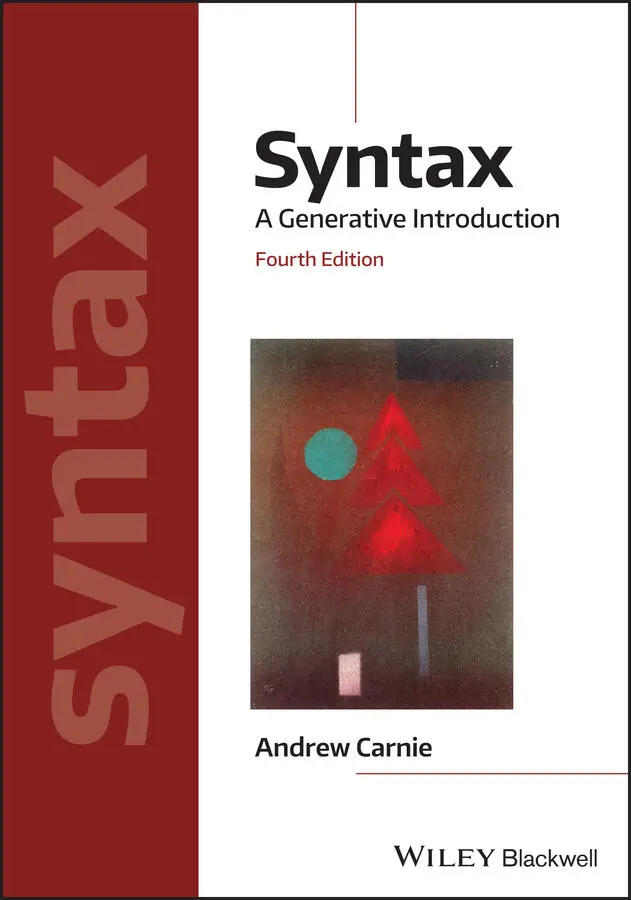
- Название:Syntax
- Автор:
- Жанр:
- Год:неизвестен
- ISBN:нет данных
- Рейтинг книги:4 / 5. Голосов: 1
-
Избранное:Добавить в избранное
- Отзывы:
-
Ваша оценка:
Syntax: краткое содержание, описание и аннотация
Предлагаем к чтению аннотацию, описание, краткое содержание или предисловие (зависит от того, что написал сам автор книги «Syntax»). Если вы не нашли необходимую информацию о книге — напишите в комментариях, мы постараемся отыскать её.
remains the leading introduction to the rules, principles, and processes that determine the structure of sentences in language. Comprehensive yet accessible, the text provides a well-balanced, student-friendly introduction to syntactic theory. Topics include phrase structure, the lexicon, binding theory, case theory, movement, covert movement, locality conditions, ditransitives, verbal inflection and auxiliaries, ellipsis, control theory, non-configurational languages, and more. Students are provided with numerous exercises and pedagogical features designed to strengthen comprehension, review learning objectives, test knowledge, and highlight major issues in the field.
The
features revised material throughout, including a new section on Chomsky's Merge and additional problem sets in every chapter, while new examples throughout the text broaden the appeal and relatability of the text to a more diverse set of students. The optional
has also been thoroughly revised and expanded to offer students the opportunity to practice the skills and concepts introduced in the primary text. This classic textbook:
Presents authoritative and comprehensive coverage of basic, intermediate, and advanced topics Includes ample exercises and clear explanations using straightforward language Offers extensive online student and instructor resources, including problem sets, PowerPoint slides, an updated instructor's manual, author-created videos, online-only chapters, and other supplementary material Features a wealth of learning tools, including learning objectives, discussion questions, and problems of varying levels of difficulty In the new fourth edition,
remains an essential textbook for beginning syntacticians, perfect for undergraduate and graduate course in linguistics, grammar, language, and second language teaching.
Available as a set with
, 2nd Edition
Syntax — читать онлайн ознакомительный отрывок
Ниже представлен текст книги, разбитый по страницам. Система сохранения места последней прочитанной страницы, позволяет с удобством читать онлайн бесплатно книгу «Syntax», без необходимости каждый раз заново искать на чём Вы остановились. Поставьте закладку, и сможете в любой момент перейти на страницу, на которой закончили чтение.
Интервал:
Закладка:
To complicate matters further let’s add in another definition: grammatical gender. Many languages have two or more “genders” or “noun classes” that they use to classify all the nouns in their language. We use different terms to describe grammatical gender from personal gender. Rather than using “male” and “female”, we use “masculine”, “feminine” and “neuter”. Often these genders have no obvious correlation to sexual characteristics. For example, in French, maison ‘house’ is feminine and is used with the feminine article la , by contrast camion ‘truck’ is masculine and used with the masculine article le . In Modern Irish the word cailín ‘girl’ is masculine and the word for ‘stallion’, stail , is feminine! Clearly there is no actual sex or personal gender underlying this categorization. English doesn’t express gender on most nouns, but the pronoun system shows what we might think of as grammatical gender in the distinction between he, she and it pronouns.
Number(singular vs. plural) also seems to have a grammatical usage distinct from the reference of the word. There are a set of nouns that are grammatically plural but clearly refer to singular entities. These words are known as pluralia tantum . For example, pants and scissors have no singular form and they show up with the plural form of verbs ( the pants are in the drawer vs. *The pant(s) is in the drawer .) Despite taking plural agreement, they can refer to singular elements. So, number, like gender, can both be personal and grammatical.
PART 1 : Non-binary they and subject number agreement .
Many non-binary people (as well as some other transgender people and some cisgender people) are now choosing to refer to themselves with pronouns other than the binary male/female contrasts. It is common for many non-binary people to identify the pronouns they , them , and theirs as the correct ones to use in reference to them.
Consider a person whose name is Chris. They are non-binary and they find that the pronouns that correctly identify their gender are they, them and theirs . Consider the following sentences, which all refer to singular Chris.
1 Chris is leaving.
2 *Chris are leaving.
3 *They is leaving.
4 They are leaving.
Are is the form of the verb to be used with 3 rdperson plurals and is is the form used with 3 rdperson singulars. Based on the sentences in (a-d), figure out which of the following determines the form of the verb: biological sex and number, personal gender and number, or grammatical gender and number. How can you tell?
PART 2 : Gender in anaphors
Now let’s consider the form of anaphors. Again, assume in this section that Chris is non- binary (i.e. identifies as neither male nor female in personal gender) and they use the they/them/their pronouns. Consider the following sentences: 20
e) Chris is introducing *himself.
f) Chris is introducing *herself.
g) Chris is introducing themselves/themself.
h) They are introducing *himself.
i) They are introducing *herself.
j) They are introducing themselves/themself.
Ignore for the moment the issue of whether it should be themselves or themself , for the moment assume either is ok. What determines the form of the first part of the anaphor (the them/him/her part)? Is it grammatical gender (cf. part 1 above) or is it personal gender? How can you tell? Is this the same as what determines subject agreement?
PART 3 : Number in anaphors
There are at least two speech varieties concerning the self/selves part of the anaphor when the singular they/them/their set is used. Some speakers will tend to use themselves , others will tend to use themself . In the following sentences, they , themselves and themself are both meant to have a singular referent: non-binary Chris.
k) Dialect 1 : Chris is introducing themselves to the president.
l) Dialect 2 : Chris is introducing themself to the president.
m) Dialect 1 : They are introducing themselves to the president.
n) Dialect 2 : They are introducing themself to the president.
What determines the number expressed on the anaphor ( themselves vs. themself ) in each of the dialects? Is it personal number (where non-binary they is singular) or is it grammatical number (where non-binary they is plural)? How can you tell?
PART 4 : Revising our hypothesis .
In the text above we proposed the following hypothesis about the form of anaphors:
An anaphor must agree in person, gender and number with its antecedent .
Propose a revision to our hypothesis about what determines the form of anaphors that takes into account your observations in parts 2 and 3.
GPS4. JUDGMENTS
[Application of Skills; Intermediate]
All of the following sentences have been claimed to be ungrammatical or unacceptable by someone at some time. For each sentence,
1 indicate whether this unacceptability is due to a prescriptive or a descriptive judgment, and
2 for all descriptive judgments indicate whether the unacceptability has to do with syntax or semantics (or both).
One- or two-word answers are appropriate. If you are not a native speaker of English, enlist the help of someone who is. If you are not familiar with the prescriptive rules of English grammar, you may want to consult a writing guide or English.
1 Who did you see in Las Vegas?
2 You are taller than me.
3 My red is refrigerator.
4 Who do you think that saw Bill?
5 Hopefully, we’ll make it through the winter without snow.
6 My friends wanted to quickly leave the party.
7 Bunnies carrots eat.
8 John’s sister is not his sibling.
GPS5: PERFORMANCE VS. COMPETENCE
[Application of Skills (Basic)]
For each of the scenarios described below indicate whether the phenomena being described are best thought of as exhibiting the traits of performance or competence or a mix of the two.
1 Joe-Ellen is talking to her father about lending him some money, she starts to speak and says “Dad you need to get a new job, one where your boss …” and then she gets a text from her best friend telling her about the latest chapter in the on-going drama between two of their mutual friends. She reads the text which ends with “those guys”, and she then continues in her conversation with her dad saying “respect you”, using the agreement inflection that would be triggered by “those guys” rather than “your boss”.
2 Josh has been reading a novel from the regency period and comes across a sentence that sounds very convoluted and odd to him. So he thinks about the sentence to determine if this sentence is acceptable to him or not.
3 I’m lecturing to my introductory syntax class about phrase structure and distracted by cat sitting on the windowsill of the classroom. So, I stop mid-sentence and I go off on a tangent about my cats and how they’re fantastic. I never really come back to what I was saying before and my students are confused and uncertain about the topic I was lecturing about.
4 It’s been a terrible flu season, and Raini has lost her voice to laryngitis. Mike is over bringing her some soup. Raini is trying to tell him that she wants him to go to the pharmacy to get some medicine. But he can’t really hear her, and all he hears is “Go”. He’s terribly insulted because he was just trying to help, so he leaves and refuses to talk to her for a month.
Читать дальшеИнтервал:
Закладка:
Похожие книги на «Syntax»
Представляем Вашему вниманию похожие книги на «Syntax» списком для выбора. Мы отобрали схожую по названию и смыслу литературу в надежде предоставить читателям больше вариантов отыскать новые, интересные, ещё непрочитанные произведения.









Обсуждение, отзывы о книге «Syntax» и просто собственные мнения читателей. Оставьте ваши комментарии, напишите, что Вы думаете о произведении, его смысле или главных героях. Укажите что конкретно понравилось, а что нет, и почему Вы так считаете.