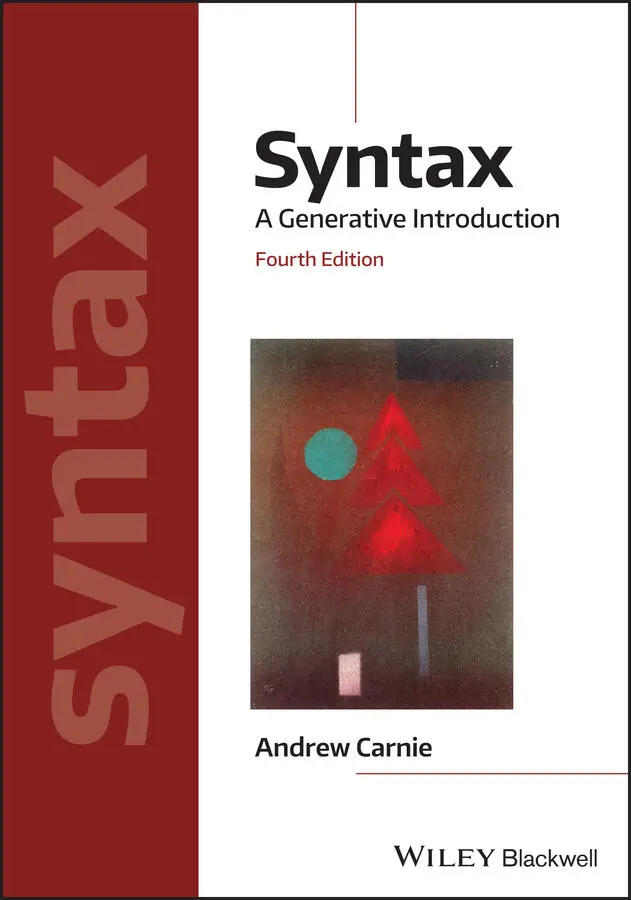
Andrew Carnie - Syntax
Здесь есть возможность читать онлайн «Andrew Carnie - Syntax» — ознакомительный отрывок электронной книги совершенно бесплатно, а после прочтения отрывка купить полную версию. В некоторых случаях можно слушать аудио, скачать через торрент в формате fb2 и присутствует краткое содержание. Жанр: unrecognised, на английском языке. Описание произведения, (предисловие) а так же отзывы посетителей доступны на портале библиотеки ЛибКат.
- Название:Syntax
- Автор:
- Жанр:
- Год:неизвестен
- ISBN:нет данных
- Рейтинг книги:4 / 5. Голосов: 1
-
Избранное:Добавить в избранное
- Отзывы:
-
Ваша оценка:
Syntax: краткое содержание, описание и аннотация
Предлагаем к чтению аннотацию, описание, краткое содержание или предисловие (зависит от того, что написал сам автор книги «Syntax»). Если вы не нашли необходимую информацию о книге — напишите в комментариях, мы постараемся отыскать её.
remains the leading introduction to the rules, principles, and processes that determine the structure of sentences in language. Comprehensive yet accessible, the text provides a well-balanced, student-friendly introduction to syntactic theory. Topics include phrase structure, the lexicon, binding theory, case theory, movement, covert movement, locality conditions, ditransitives, verbal inflection and auxiliaries, ellipsis, control theory, non-configurational languages, and more. Students are provided with numerous exercises and pedagogical features designed to strengthen comprehension, review learning objectives, test knowledge, and highlight major issues in the field.
The
features revised material throughout, including a new section on Chomsky's Merge and additional problem sets in every chapter, while new examples throughout the text broaden the appeal and relatability of the text to a more diverse set of students. The optional
has also been thoroughly revised and expanded to offer students the opportunity to practice the skills and concepts introduced in the primary text. This classic textbook:
Presents authoritative and comprehensive coverage of basic, intermediate, and advanced topics Includes ample exercises and clear explanations using straightforward language Offers extensive online student and instructor resources, including problem sets, PowerPoint slides, an updated instructor's manual, author-created videos, online-only chapters, and other supplementary material Features a wealth of learning tools, including learning objectives, discussion questions, and problems of varying levels of difficulty In the new fourth edition,
remains an essential textbook for beginning syntacticians, perfect for undergraduate and graduate course in linguistics, grammar, language, and second language teaching.
Available as a set with
, 2nd Edition
Syntax — читать онлайн ознакомительный отрывок
Ниже представлен текст книги, разбитый по страницам. Система сохранения места последней прочитанной страницы, позволяет с удобством читать онлайн бесплатно книгу «Syntax», без необходимости каждый раз заново искать на чём Вы остановились. Поставьте закладку, и сможете в любой момент перейти на страницу, на которой закончили чтение.
Интервал:
Закладка:
6. WHERE DO THE RULES COME FROM?
In this chapter, we’ve been talking about our subconscious knowledge of syntactic rules, but we haven’t dealt yet with how we get this knowledge. This is sort of a side issue, but it may affect the shape of our theory. If we know how children acquire their rules, then we are in a better position to develop a proper formalization of them. The way in which children develop knowledge is an important question in cognitive science. The theory of generative grammar makes some very specific (and very surprising) claims about this.
6.1 Learning vs. Acquisition
One of the most common misconceptions about language is the idea that children and adults “learn” languages. Recall that the basic kind of knowledge we are talking about here is subconscious knowledge. When producing a sentence, you don’t consciously think about where to put the subject, where to put the verb, etc. Your subconscious language faculty does that for you. Cognitive scientists make a distinction in how we get conscious and subconscious knowledge. Conscious knowledge (like the rules of algebra, syntactic theory, principles of organic chemistry or how to take apart a carburetor) is learned. A lot of subconscious knowledge, like how to speak or the ability to visually identify discrete objects, is acquired. In part, this explains why classes in the formal grammar of a foreign language often fail abysmally to train people to speak those languages. By contrast, being immersed in an environment where you can subconsciously acquire a language is much more effective. In this text we’ll be primarily interested in how people acquire the rules of their language. Not all rules of grammar are acquired, however. Some facts about i-language seem to be built into our brains, or innate.
You now have enough information to answer GPS6 .
6.2 Innateness: Parts of i-Language as Instincts
If you think about the other types of knowledge that are subconscious, you’ll see that many of them (for example, the ability to walk) are built directly into our brains – they are instincts. No one had to teach you to walk (despite what your parents might think!). Kids start walking on their own. Walking is an instinct. Probably the most controversial claim that Noam Chomsky has made is that parts of i-language are also an instinct. That is many parts of i-language are built in, or innate. Chomsky claims that much of i- language is an ability hard-wired into our brains.
Obviously, particular languages (e-languages) are not innate. It is never the case that a child of Slovak parents growing up in North America who has never been spoken to in Slovak grows up speaking Slovak. They’ll speak English (or whatever other language is spoken around them). So, on the surface it seems crazy to claim that language is an instinct. But when we are talking about i-languages, there are very good reasons to believe, however, that a human facility (the Human Language Capacity) for language is innate. We call the innate parts of the HLC, Universal Grammar(or UG).
6.3 The Logical Problem of Language Acquisition
What follows is a fairly technical proof of the idea that parts of our linguistic system are at least plausibly construed as an innate, in-built system. If you aren’t interested in this proof (and the problems with it), then you can reasonably skip ahead to section 6.4.
The argument in this section is that a productive system like the rules of Language probably could not be learned or acquired. Infinite systems are in principle, given certain assumptions, both unlearnable and unacquirable. Since we’ll show that syntax is an infinite system, we shouldn’t have been able to acquire it. So it follows that it is built in. The argument presented here is based on an unpublished paper by Alec Marantz, but is based on an argument dating back to at least Chomsky (1965).
1 First here’s a sketch of the proof, which takes the classical form of an argument by modus ponens:
2 Premise (i) : Syntax is a productive, recursive and infinite system.
3 Premise (ii): Rule-governed infinite systems are unacquirable.
4 Conclusion : Therefore syntax is an unacquirable system. Since we have such a system, it follows that at least parts of syntax are innate.
There are parts of this argument that are very controversial. In the challenge problem sets at the end of this chapter you are invited to think very critically about the form of this proof. Challenge Problem Set CPS8 considers the possibility that premise (i) is false (but hopefully you will conclude that, despite the argument given in the problem set, the idea that Language is productive and infinite is correct). Premise (ii) is more dubious, and is the topic of Challenge Problem Set CPS9. Here, in the main body of the text, I will give you the classic versions of the support for these premises, without criticizing them. You are invited to be skeptical and critical of them when you do the Challenge Problem sets.
Let’s start with premise (i): i-language is a productive system. That is, you can produce and understand sentences you have never heard before. For example, I can practically guarantee that you have never heard or read the following sentence:
18) The dancing chorus-line of elephants broke my television set.
The magic of syntax is that it can generate forms that have never been produced before. Another example of this productive quality lies in what is called recursion. It is possible to utter a sentence like (19):
19) Rosie reads magazine articles.
It is also possible to put this sentence inside another sentence, like (20):
20) I think [Rosie reads magazine articles].
Similarly, you can put this larger sentence inside of another one:
21) Drew believes [I think [Rosie reads magazine articles]]
And, of course, you can put this bigger sentence inside of another one:
22) Dana doubts that [Drew believes [I think [Rosie reads magazine articles]]].
and so on, and so on ad infinitum. It is always possible to embed a sentence inside of a larger one. This means that i-language is a productive (probably infinite) system. There are no limits on what we can talk about. Other examples of the productivity of syntax can be seen in the fact that you can infinitely repeat adverbs (23) and you can infinitely add coordinated nouns to a noun phrase (24):
23)
1 a very big peanut
2 a very very big peanut
3 a very very very big peanut
4 a very very very very big peanut etc.
24)
1 Dave left
2 Dave and Alina left
3 Dave, Dan, and Alina left
4 Dave, Dan, Erin, and Alina left
5 Dave, Dan, Erin, Jaime, and Alina left etc.
It follows that for every grammatical sentence of English, you can find a longer one (based on one of the rules of recursion, adverb repetition, or coordination). This means that the production of syntax is at least countably infinite. This premise is relatively uncontroversial (however, see the discussion in Challenge Problem Set CPS8).
Let’s now turn to premise (ii), the idea that infinite systems are unlearnable. In order to make this more concrete, let us consider an algebraic treatment of a linguistic example. Imagine that the task of a child is to determine the rules by which her language is constructed. Further, let’s simplify the task, and say a child simply has to match up situations in the real world with utterances she hears. 9So upon hearing the utterance the cat spots the kissing fishe s, she identifies it with an appropriate situation in the context around her (as represented by the picture).
Читать дальшеИнтервал:
Закладка:
Похожие книги на «Syntax»
Представляем Вашему вниманию похожие книги на «Syntax» списком для выбора. Мы отобрали схожую по названию и смыслу литературу в надежде предоставить читателям больше вариантов отыскать новые, интересные, ещё непрочитанные произведения.










Обсуждение, отзывы о книге «Syntax» и просто собственные мнения читателей. Оставьте ваши комментарии, напишите, что Вы думаете о произведении, его смысле или главных героях. Укажите что конкретно понравилось, а что нет, и почему Вы так считаете.