Jeffrey McCullough - Transfusion Medicine
Здесь есть возможность читать онлайн «Jeffrey McCullough - Transfusion Medicine» — ознакомительный отрывок электронной книги совершенно бесплатно, а после прочтения отрывка купить полную версию. В некоторых случаях можно слушать аудио, скачать через торрент в формате fb2 и присутствует краткое содержание. Жанр: unrecognised, на английском языке. Описание произведения, (предисловие) а так же отзывы посетителей доступны на портале библиотеки ЛибКат.
- Название:Transfusion Medicine
- Автор:
- Жанр:
- Год:неизвестен
- ISBN:нет данных
- Рейтинг книги:3 / 5. Голосов: 1
-
Избранное:Добавить в избранное
- Отзывы:
-
Ваша оценка:
Transfusion Medicine: краткое содержание, описание и аннотация
Предлагаем к чтению аннотацию, описание, краткое содержание или предисловие (зависит от того, что написал сам автор книги «Transfusion Medicine»). Если вы не нашли необходимую информацию о книге — напишите в комментариях, мы постараемся отыскать её.
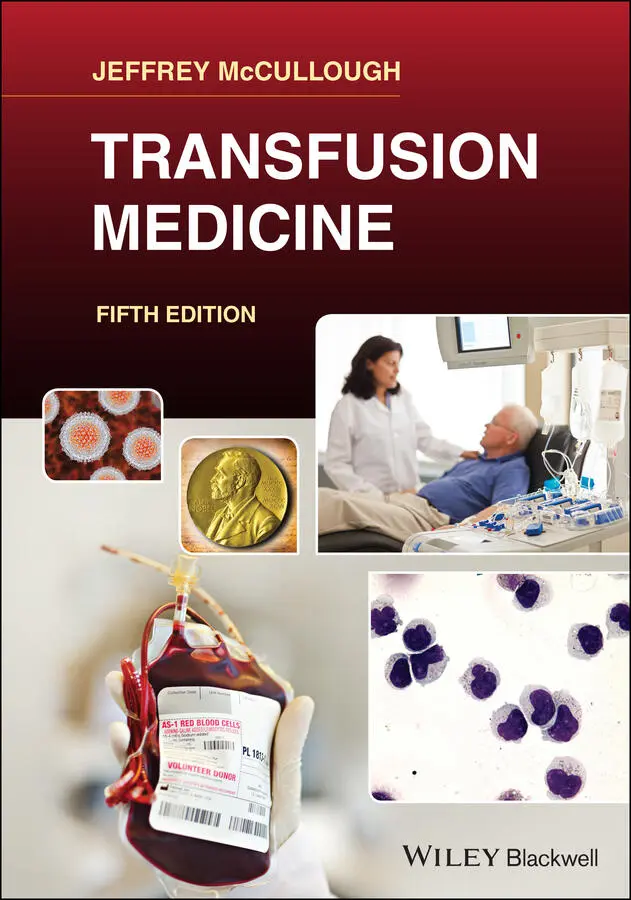
The Fifth Edition of
delivers a succinct, thorough, clinically focused, practical and authoritative treatment of a full range of topics in transfusion therapy. This ranges from issues with the blood supply, recruitment of both whole blood and apheresis donors, blood collection and storage, blood testing, blood safety, and transmissible diseases. This edition has been fully updated and revised to include exciting cellular therapies for cancer, transplantation of both hematopoietic cells and solid organs, infectious diseases and regenerative medicine.
The Fifth Edition includes new authors with highly relevant content that provides a solid grounding for readers in the field. The book:
Is an approachable comprehensive guide to the field of blood banking and transfusion medicine Provides complete and timely perspective on crucial topics, including the HLA system in transfusion medicine and transplantation and quality programs in blood banking and transfusion medicine Is extensively referenced, making it simple for readers to conduct further research on the topics of interest to them Includes new chapters on pediatric transfusion medicine and pathogen reduction Has an expended chapter on patient blood management Provides extensive discussions of the clinical use of blood transfusion in a wide variety of clinical situations including recent development In the management of acute traumatic blood loss Provides updated information about blood groups and molecular testing making inroads into clinical practice along with discussions of laboratory detection of blood groups and provision of red cells Perfect for all those working in the field of blood banking, transfusion medicine and hematology or oncology and fellows in pathology, hematology, surgery and anesthesiology.
is a good introduction for technologists specializing in blood banking and non-medical personnel working in areas related to hematology and transfusion medicine. Transfusion Medicine will also earn a place in the libraries of practicing pathologists with responsibility for blood banks.
Transfusion Medicine — читать онлайн ознакомительный отрывок
Ниже представлен текст книги, разбитый по страницам. Система сохранения места последней прочитанной страницы, позволяет с удобством читать онлайн бесплатно книгу «Transfusion Medicine», без необходимости каждый раз заново искать на чём Вы остановились. Поставьте закладку, и сможете в любой момент перейти на страницу, на которой закончили чтение.
Интервал:
Закладка:
Source plasma is the starting material for the further manufacture of some diagnostics and plasma “derivatives.” Derivatives are described in more detail in Chapter 2, and the selection and medical evaluation of plasma donors are described in Chapter 4. Plasmapheresis was done using sets of multiple plastic bags and involved separation of the blood from the donor such that there was a chance for return of red cells to the incorrect donor. Source plasma is now collected by semiautomated instruments that require less operator involvement, while producing larger amounts of plasma at a reasonable cost. Usually one venipuncture is used, and the system can be set up in about 5 minutes. This includes loading the disposable plastic set into the instrument, connecting the anticoagulant and solution bags, recording appropriate data, and placing the collection bags. The venipuncture area is prepared as for whole blood collection (see Chapter 4), and the venipuncture is done using the needle integral with the disposable plastic set used for the procedure. The operator then activates the instrument, and blood flow is initiated by the pumps in the instrument. Anticoagulant is metered into the blood flowing into the instrument in the proper ratio, and the centrifuge bowl is filled until the optical sensor detects the red cell interface and stops the inflow of blood. During this filling phase of the cycle, the plasma has been diverted into the collection bag. After the plasma–cell interface has reached the detector, the blood flow is reversed and the red cells are pumped from the bowl back to the donor. The cycle is then repeated until the desired amount of plasma is obtained. Usually about 500 mL of plasma can be obtained in about 30 minutes [128]. These instruments might be used to produce FFP but are not used extensively to produce source plasma.
The Fresenius Kabi Autopheresis C (Auto‐C) and Aurora plasmapheresis instruments operate on a different principle from the Haemonetics devices. The Autopheresis C combines filtration and centrifugation to separate blood in a smaller chamber (and possibly more efficiently). The instrument setup and donor preparation are the same as described for the Haemonetics systems and for whole blood collection. In these systems, blood is withdrawn from the donor into a closed, disposable plastic set with a total extracorporeal volume of about 165 mL. Blood separation occurs in a small, 7‐mL (Auto C or Aurora) or 15‐mL (Aurora Xi) cylinder that is part of the system. A magnet causes rotation of the cylinder inside a larger compartment. The cylinder is composed of a membrane, and as the cylinder rotates, plasma moves peripherally through the membrane, thus providing the filtration part of the separation system. The system does not operate in a continuous‐flow manner; blood is returned intermittently to the donor through the single venipuncture and the process is repeated. The Auto‐C system collects about 500 mL of plasma in about 30 minutes [129, 130]. The Aurora Xi is slightly more efficient; however, both systems are used extensively for the production of source plasma for further manufacture of plasma derivatives.
References
1 1. Abel JJ, Rowntree LC, Turner BB. Plasma removal with return of corpuscles. J Pharmacol Exp Ther 1914; 5:625–641.
2 2. Kliman A, Gaydos LA, Schroeder LR, Freireich EJ. Repeated plasmapheresis of blood donors as a source of platelets. Blood 1961; 18:303–309.
3 3. McCullough J. Introduction to apheresis donations including history and general principles. In: McLeod B, Price T, Weinstein R, eds. Apheresis: Principles and Practice, 2nd edn. Bethesda, MD: AABB Press, 2003, pp. 29–48.
4 4. Tullis JL, Tinch RJ, Baudanza P, et al. Plateletpheresis in a disposable system. Transfusion 1971; 11:368–377.
5 5. Graw RG, Herzig GP, Eisel RJ, Perry S. Leukocyte and platelet collection from normal donors with the continuous flow blood cell separator. Transfusion 1971; 11:94–101.
6 6. Tullis JL, Tinch RJ, Gibson JG, Baudanza P. A simplified centrifuge for the separation and processing of blood cells. Transfusion 1967; 7:232–242.
7 7. Tullis JL, Eberle WG, Baudanza P, Tinch R. Platelet‐pheresis description of a new technique. Transfusion 1968; 8:154–164.
8 8. Miller WV, Gillem HG, Yankee RA, Schmidt PJ. Pooled platelet concentrates prepared in a new blood bank centrifuge. Transfusion 1969; 9:251–254.
9 9. Szymanski IO, Patti K, Kliman A. Efficacy of the Latham blood processor to perform plateletpheresis. Transfusion 1973; 13:405–411.
10 10. Nusbacher J, Scher ML, MacPherson JL. Plateletpheresis using the Haemonetics Model 30 cell separator. Vox Sang 1977; 33:9–15.
11 11. Glowitz RJ, Slichter SJ. Frequent multiunit plateletpheresis from single donors: effects on donors’ blood and the platelet yield. Transfusion 1980; 20:199–205.
12 12. Lasky LC, Lin A, Kahn RA, McCullough J. Donor platelet response and product quality assurance in plateletpheresis. Transfusion 1981; 21:247–260.
13 13. Freireich EJ, Judson G, Levin RH. Separation and collection of leukocytes. Cancer Res 1965; 25:1517–1520.
14 14. Buckner D, Eisel R, Perry S. Blood cell separation in the dog by continuous flow centrifugation. Blood 1968; 31:653–672.
15 15. Millward BL, Hoeltge GA. The historical development of automated hemapheresis. J Clin Apher 1982; 1:25–32.
16 16. Graw RG, Herzig GP, Bisel RJ, Perry S. Leukocyte and platelet collection from normal donors with the continuous flow blood cell separator. Transfusion 1971; 11:94–101.
17 17. Jones AL. Continuous‐flow blood cell separation. Transfusion 1968; 8:94–103.
18 18. Hester JP, Kellogg RM, Mulzet AP, et al. Principles of blood separation and component extraction in a disposable continuous‐flow single‐stage channel. Blood 1979; 54:254–268.
19 19. Huestis DW, White RF, Price MJ, Inman M. Use of hydroxyethyl starch to improve granulocyte collection in the Latham blood processor. Transfusion 1975; 15:559–564.
20 20. Sussman LN, Coli W, Pichetshote C. Harvesting of granulocytes using a hydroxyethyl starch solution. Transfusion 1975; 15:461–465.
21 21. Aisner J, Schiffer CA, Wiernik PH. Granulocyte transfusions: evaluation of factors influencing results and a comparison of filtration and intermittent centrifugation leukapheresis. Br J Haematol 1978; 38:121.
22 22. Ito Y, Suaudeau J, Bowman RL. New flow‐through centrifuge without rotating seals applied to plasmapheresis. Science 1975; 189:999–1000.
23 23. Katz AJ, Genco PV, Blumberg N, et al. Platelet collection and transfusion using the Fenwal CS‐3000 cell separator. Transfusion 1981; 21:560–563.
24 24. Mintz PD, Coletta U. Prospective comparison of plateletpheresis with three cell separators using identical donors. Lab Med 1987; 18:537–539.
25 25. Kalmin ND, Grindon AJ. Comparison of two continuous‐flow cell separators. Transfusion 1983; 23:197–200.
26 26. Benjamin RJ, Rojas P, Christmas S, et al. Plateletpheresis efficiency: a comparison of the Spectra LRS and AMICUS separators. Transfusion 1999; 39:895–899.
27 27. Bueno JL, Barea L, Garcia F, Castro E. A comparison of PLT collections from two apheresis devices. Transfusion 2004; 44:119–124.
28 28. Snyder EL, Mechanic S, Cable R, et al. A comparison of the in vivo recovery and survival of platelets collected using the Amicus, CS‐3000 and Spectra blood cell separators. American Society for Apheresis annual meeting, March 1996, abstract #74.
29 29. Snyder EL, Baril L, Min K, et al. In vitro collection and posttransfusion engraftment characteristics of MNCs obtained using a new separator for autologous PBPC transplantation. Transfusion 2000; 40:961–967.
30 30. Moog R, Franck V, Pierce JA, Muller N. Evaluation of a concurrent multicomponent collection system for the collection and storage of WBC‐reduced RBC apheresis concentrates. Transfusion 2001; 41:1159–1164.
Читать дальшеИнтервал:
Закладка:
Похожие книги на «Transfusion Medicine»
Представляем Вашему вниманию похожие книги на «Transfusion Medicine» списком для выбора. Мы отобрали схожую по названию и смыслу литературу в надежде предоставить читателям больше вариантов отыскать новые, интересные, ещё непрочитанные произведения.








Обсуждение, отзывы о книге «Transfusion Medicine» и просто собственные мнения читателей. Оставьте ваши комментарии, напишите, что Вы думаете о произведении, его смысле или главных героях. Укажите что конкретно понравилось, а что нет, и почему Вы так считаете.