Jeffrey McCullough - Transfusion Medicine
Здесь есть возможность читать онлайн «Jeffrey McCullough - Transfusion Medicine» — ознакомительный отрывок электронной книги совершенно бесплатно, а после прочтения отрывка купить полную версию. В некоторых случаях можно слушать аудио, скачать через торрент в формате fb2 и присутствует краткое содержание. Жанр: unrecognised, на английском языке. Описание произведения, (предисловие) а так же отзывы посетителей доступны на портале библиотеки ЛибКат.
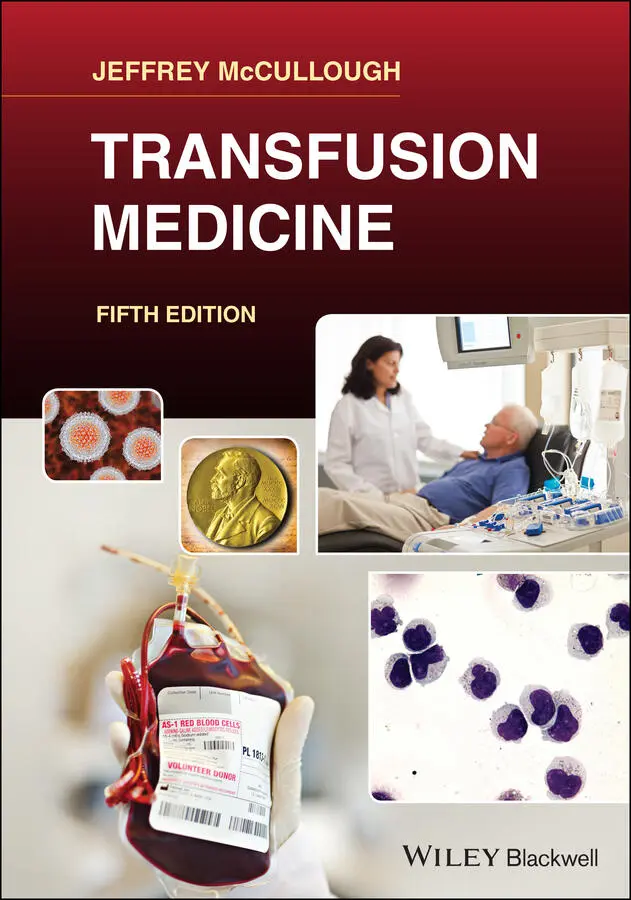
- Название:Transfusion Medicine
- Автор:
- Жанр:
- Год:неизвестен
- ISBN:нет данных
- Рейтинг книги:3 / 5. Голосов: 1
-
Избранное:Добавить в избранное
- Отзывы:
-
Ваша оценка:
Transfusion Medicine: краткое содержание, описание и аннотация
Предлагаем к чтению аннотацию, описание, краткое содержание или предисловие (зависит от того, что написал сам автор книги «Transfusion Medicine»). Если вы не нашли необходимую информацию о книге — напишите в комментариях, мы постараемся отыскать её.
The Fifth Edition of
delivers a succinct, thorough, clinically focused, practical and authoritative treatment of a full range of topics in transfusion therapy. This ranges from issues with the blood supply, recruitment of both whole blood and apheresis donors, blood collection and storage, blood testing, blood safety, and transmissible diseases. This edition has been fully updated and revised to include exciting cellular therapies for cancer, transplantation of both hematopoietic cells and solid organs, infectious diseases and regenerative medicine.
The Fifth Edition includes new authors with highly relevant content that provides a solid grounding for readers in the field. The book:
Is an approachable comprehensive guide to the field of blood banking and transfusion medicine Provides complete and timely perspective on crucial topics, including the HLA system in transfusion medicine and transplantation and quality programs in blood banking and transfusion medicine Is extensively referenced, making it simple for readers to conduct further research on the topics of interest to them Includes new chapters on pediatric transfusion medicine and pathogen reduction Has an expended chapter on patient blood management Provides extensive discussions of the clinical use of blood transfusion in a wide variety of clinical situations including recent development In the management of acute traumatic blood loss Provides updated information about blood groups and molecular testing making inroads into clinical practice along with discussions of laboratory detection of blood groups and provision of red cells Perfect for all those working in the field of blood banking, transfusion medicine and hematology or oncology and fellows in pathology, hematology, surgery and anesthesiology.
is a good introduction for technologists specializing in blood banking and non-medical personnel working in areas related to hematology and transfusion medicine. Transfusion Medicine will also earn a place in the libraries of practicing pathologists with responsibility for blood banks.
Transfusion Medicine — читать онлайн ознакомительный отрывок
Ниже представлен текст книги, разбитый по страницам. Система сохранения места последней прочитанной страницы, позволяет с удобством читать онлайн бесплатно книгу «Transfusion Medicine», без необходимости каждый раз заново искать на чём Вы остановились. Поставьте закладку, и сможете в любой момент перейти на страницу, на которой закончили чтение.
Интервал:
Закладка:
120 120. Webert KE, Cserti CM, Hannon J, et al. Proceedings of a consensus conference: pathogen inactivation—making decisions about new technologies. Transfus Med Rev 2008; 22(1):1–34.
121 121. Prowse C. Properties of pathogen‐inactivated plasma components. Transfus Med Rev 2009; 23(2):124–133.
122 122. Prowse CV. Component pathogen inactivation: a critical review. Vox Sang 2013; 104(3):183–199.
123 123. Doree B, Estcourt LJ, Trivella M. Pathogen‐reduced platelets for prevention of bleeding (review). Reprint of a Cochrane review, prepared and maintained by The Cochrane Collaboration, The Cochrane Library, 3rd edn. Chichester, UK: John Wiley & Sons, Ltd., 2013.
124 124. Koenigbauer UF, Eastlund T, Day JW. Clinical illness due to parvovirus B19 infection after infusion of solvent/detergent‐treated pooled plasma. Transfusion 2000; 40(10):1203–1206.
125 125. Flamholz R, Jeon H‐R, Baron JM, Baron BW. Study of three patients with thrombotic thrombocytopenic purpura exchanged with solvent/detergent‐treated plasma: is its decreased protein S activity clinically related to their development of deep venous thromboses? J Clin Apher 2000; 15(3):169–172.
126 126. Solheim B, Hellstern P. Composition, efficacy, and safety of S/D‐treated plasma. Transfusion 2003; 43:1176–1178.
127 127. Scully M, Longair I, Flynn M, et al. Cryosupernatant and solvent detergent fresh‐frozen plasma (Octaplas) usage at a single centre in acute thrombotic thrombocytopenic purpura. Vox Sang 2007; 93(2):154–158.
128 128. Santagostino E, Mancuso M, Morfini E, et al. Solvent/detergent plasma for the prevention of bleeding in recessively inherited coagulation disorders: dosing, pharmacokinetics and clinical efficacy. Haematologica 2006; 91(5):634–639.
129 129. Williamson LM, Cardigan R, Prowse CV. Methylene blue‐treated fresh‐frozen plasma: what is its contribution to blood safety? Transfusion 2003; 43(9):1322–1329.
130 130. Garwood M, Cardigan RA, Drummond O, et al. The effect of methylene blue photoinactivation and methylene blue removal on the quality of fresh‐frozen plasma. Transfusion 2003; 43(9):1238–1247.
131 131. Hornsey VS, Drummond O, Morrison A, et al. Pathogen reduction of fresh plasma using riboflavin and ultraviolet light: effects on plasma coagulation proteins. Transfusion 2009; 49(10):2167–2172.
132 132. Hambleton J, Wages D, Radu‐Radulescu L, et al. Pharmacokinetic study of FFP photochemically treated with amotosalen (S‐59) and UV light compared to FFP in healthy volunteers anticoagulated with warfarin. Transfusion 2002; 42(10):1302–1307.
133 133. Mohr H, Gravemann U, Müller TH. Inactivation of pathogens in single units of therapeutic fresh plasma by irradiation with ultraviolet light. Transfusion 2009; 49(10):2144–2151.
134 134. Mintz PD. Photochemically treated fresh frozen plasma for transfusion of patients with acquired coagulopathy of liver disease. Blood 2006; 107(9):3753–3760.
135 135. Mintz PD, Neff A, MacKenzie M, et al. A randomized, controlled Phase III trial of therapeutic plasma exchange with fresh‐frozen plasma (FFP) prepared with amotosalen and ultraviolet A light compared to untreated FFP in thrombotic thrombocytopenic purpura. Transfusion 2006; 46(10):1693–1704.
136 136. Mohr H, Steil L, Gravemann U, et al. Blood components: a novel approach to pathogen reduction in platelet concentrates using short‐wave ultraviolet light. Transfusion 2009; 49(12):2612–2624.
137 137. Lin L, Cook D, Wiesehahn G, et al. Photochemical inactivation of viruses and bacteria in platelet concentrates by use of a novel psoralen and long‐wavelength ultraviolet light. Transfusion 1997; 37(4):423–435.
138 138. Goodrich RP, Edrich RA, Li J, Seghatchian J. The Mirasol PRT system for pathogen reduction of platelets and plasma: an overview of current status and future trends. Transfus Apher Sci 2006; 35(1):5–17.
139 139. Snyder E, Raife T, Lin L, et al. Recovery and life span of 111indium‐radiolabeled platelets treated with pathogen inactivation with amotosalen HCl (S‐59) and ultraviolet A light. Transfusion 2004; 44(12):1732–1740.
140 140. Slichter SJ, Raife TJ, Davis K, et al. Platelets photochemically treated with amotosalen HCl and ultraviolet A light correct prolonged bleeding times in patients with thrombocytopenia. Transfusion 2006; 46(5):731–740.
141 141. van Rhenen D. Transfusion of pooled buffy coat platelet components prepared with photochemical pathogen inactivation treatment: the euroSPRITE trial. Blood 2003; 101(6):2426–2433.
142 142. McCullough J. Therapeutic efficacy and safety of platelets treated with a photochemical process for pathogen inactivation: the SPRINT Trial. Blood 2004; 104(5):1534–1541.
143 143. McCullough J. Pathogen inactivation: the penultimate paradigm shift. In: AuBuchon JP, Prowse CV, eds. Pathogen Inactivation: The Penultimate Paradigm Shift. Bethesda, MD: AABB Press, 2010, pp. 99–123.
144 144. Cazenave J‐P, Waller C, Kientz D, et al. An active hemovigilance program characterizing the safety profile of 7483 transfusions with plasma components prepared with amotosalen and UVA photochemical treatment. Transfusion 2010; 50(6):1210–1219.
145 145. Cazenave J‐P, Folléa G, Bardiaux L, et al. A randomized controlled clinical trial evaluating the performance and safety of platelets treated with MIRASOL pathogen reduction technology. Transfusion 2010; 50(11):2362–2375.
146 146. Knutson F, Osselaer J, Pierelli L, et al. A prospective, active haemovigilance study with combined cohort analysis of 19 175 transfusions of platelet components prepared with amotosalen‐UVA photochemical treatment. Vox Sang 2015; 109(4):343–352.
147 147. Cancelas J, Rugg N, Pratt P, et al. In vivo performance and correlation with in vitro parameters of stored RBCs obtained from whole blood treated with mirasol. Transfusion 2010; 50:10A (abstract).
148 148. Cancelas J, Rugg N, Dumont L. Comprehensive evaluation of a new process for S‐303 pathogen‐inactivation of red blood cells. Transfusion 2010; 50:9A (abstract).
149 149. Wages D, Hambleton J, Viele M. RBCs treated with Helinx pathogen inactivation show comparable recovery and survival to standard RBCs in a randomized crossover trial. Blood 2001; 8:449a (abstract).
150 150. Rios J, Hambleton J, Viele M. Helinx treated RBC transfusions are well tolerated and show comparable recovery and survival to control RBCs. Transfusion 2001; 41:S135 (abstract).
151 151. Winter KM, Johnson L, Kwok M, et al. Red blood cell in vitro quality and function is maintained after S‐303 pathogen inactivation treatment. Transfusion 2014; 54(7):1798–1807.
152 152. Benjamin RJ, McCullough J, Mintz PD, et al. Therapeutic efficacy and safety of red blood cells treated with a chemical process (S‐303) for pathogen inactivation: a Phase III clinical trial in cardiac surgery patients. Transfusion 2005; 45(11):1739–1749.
153 153. Aydinok Y, Piga A, Origa R, et al. Amustaline‐glutathione pathogen‐reduced red blood cell concentrates for transfusion‐dependent thalassaemia. Br J Haematol 2019; 186(4):625–636.
154 154. Aydinok Y, Piga A, Origa R, et al. Amustaline‐glutathione pathogen‐reduced red blood cell concentrates for transfusion‐dependent thalassaemia. Br J Haematol 2019; 186(4):625–636.
155 155. Cancelas JA, Rugg N, Fletcher D, et al. In vivo viability of stored red blood cells derived from riboflavin plus ultraviolet light‐treated whole blood. Transfusion 2011; 51(7):1460–1468.
156 156. Allain J‐P, Owusu‐Ofori A, Assennato SM, et al. Prevention of transfusion‐transmitted malaria by treatment of whole blood with the mirasol PRT system. Blood 2015; 126:770 (abstract).
157 157. Kruskall MS, AuBuchon JP, Anthony KY, et al. Transfusion to blood group A and O patients of group B RBCs that have been enzymatically converted to group O. Transfusion 2000; 40(11):1290–1298.
Читать дальшеИнтервал:
Закладка:
Похожие книги на «Transfusion Medicine»
Представляем Вашему вниманию похожие книги на «Transfusion Medicine» списком для выбора. Мы отобрали схожую по названию и смыслу литературу в надежде предоставить читателям больше вариантов отыскать новые, интересные, ещё непрочитанные произведения.




Обсуждение, отзывы о книге «Transfusion Medicine» и просто собственные мнения читателей. Оставьте ваши комментарии, напишите, что Вы думаете о произведении, его смысле или главных героях. Укажите что конкретно понравилось, а что нет, и почему Вы так считаете.