Jeffrey McCullough - Transfusion Medicine
Здесь есть возможность читать онлайн «Jeffrey McCullough - Transfusion Medicine» — ознакомительный отрывок электронной книги совершенно бесплатно, а после прочтения отрывка купить полную версию. В некоторых случаях можно слушать аудио, скачать через торрент в формате fb2 и присутствует краткое содержание. Жанр: unrecognised, на английском языке. Описание произведения, (предисловие) а так же отзывы посетителей доступны на портале библиотеки ЛибКат.
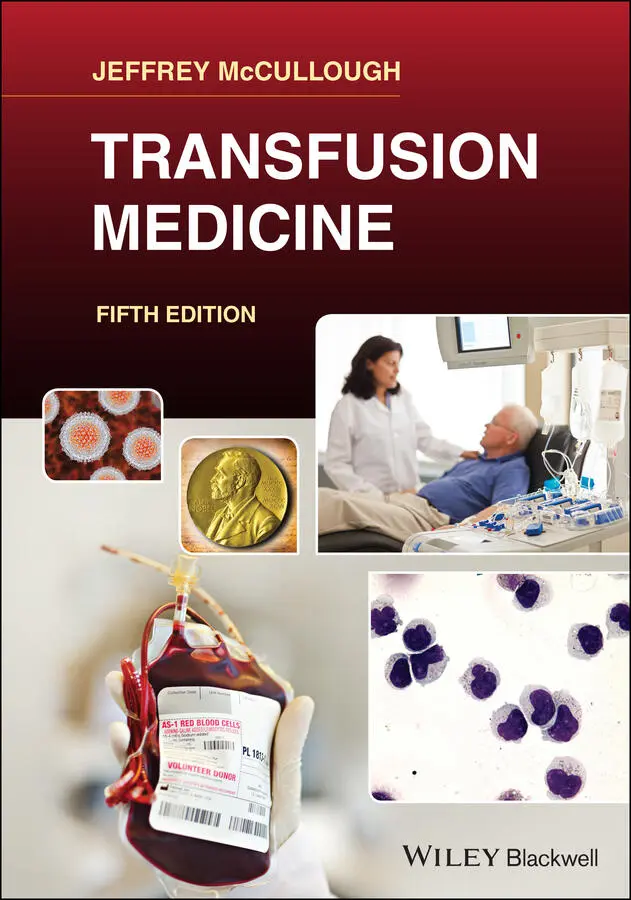
- Название:Transfusion Medicine
- Автор:
- Жанр:
- Год:неизвестен
- ISBN:нет данных
- Рейтинг книги:3 / 5. Голосов: 1
-
Избранное:Добавить в избранное
- Отзывы:
-
Ваша оценка:
Transfusion Medicine: краткое содержание, описание и аннотация
Предлагаем к чтению аннотацию, описание, краткое содержание или предисловие (зависит от того, что написал сам автор книги «Transfusion Medicine»). Если вы не нашли необходимую информацию о книге — напишите в комментариях, мы постараемся отыскать её.
The Fifth Edition of
delivers a succinct, thorough, clinically focused, practical and authoritative treatment of a full range of topics in transfusion therapy. This ranges from issues with the blood supply, recruitment of both whole blood and apheresis donors, blood collection and storage, blood testing, blood safety, and transmissible diseases. This edition has been fully updated and revised to include exciting cellular therapies for cancer, transplantation of both hematopoietic cells and solid organs, infectious diseases and regenerative medicine.
The Fifth Edition includes new authors with highly relevant content that provides a solid grounding for readers in the field. The book:
Is an approachable comprehensive guide to the field of blood banking and transfusion medicine Provides complete and timely perspective on crucial topics, including the HLA system in transfusion medicine and transplantation and quality programs in blood banking and transfusion medicine Is extensively referenced, making it simple for readers to conduct further research on the topics of interest to them Includes new chapters on pediatric transfusion medicine and pathogen reduction Has an expended chapter on patient blood management Provides extensive discussions of the clinical use of blood transfusion in a wide variety of clinical situations including recent development In the management of acute traumatic blood loss Provides updated information about blood groups and molecular testing making inroads into clinical practice along with discussions of laboratory detection of blood groups and provision of red cells Perfect for all those working in the field of blood banking, transfusion medicine and hematology or oncology and fellows in pathology, hematology, surgery and anesthesiology.
is a good introduction for technologists specializing in blood banking and non-medical personnel working in areas related to hematology and transfusion medicine. Transfusion Medicine will also earn a place in the libraries of practicing pathologists with responsibility for blood banks.
Transfusion Medicine — читать онлайн ознакомительный отрывок
Ниже представлен текст книги, разбитый по страницам. Система сохранения места последней прочитанной страницы, позволяет с удобством читать онлайн бесплатно книгу «Transfusion Medicine», без необходимости каждый раз заново искать на чём Вы остановились. Поставьте закладку, и сможете в любой момент перейти на страницу, на которой закончили чтение.
Интервал:
Закладка:
158 158. Olsson ML, Clausen H. Modifying the red cell surface: towards an ABO‐universal blood supply. Br J Haematol 2008; 140(1):3–12.
159 159. Bradley AJ, Test ST, Murad KL, et al. Interactions of IgM ABO antibodies and complement with methoxy‐PEG‐modified human RBCs. Transfusion 2001; 41(10):1225–1233.
160 160. Silverman T, Weiskopf R. Hemoglobin‐based oxygen carriers: current status and future directions. Transfusion 2009; 49:2495–2515.
161 161. Stowell CP, Levin J, Spiess BD, Winslow RM. Progress in the development of RBC substitutes. Transfusion 2001; 41(2):287–299.
162 162. Bachert SE, Dogra P, Boral LI. Alternatives to transfusion. Am J Clin Pathol 2020; 153(3):287–293.
163 163. Brotman I, Kocher M, McHugh S. Bovine hemoglobin‐based oxygen carrier treatment in a severely anemic Jehovah’s witness patient after cystoprostatectomy and nephrectomy. A A Pract 2019; 12(7):243–245.
164 164. Sloan EP. Diaspirin cross‐linked hemoglobin (DCLHb) in the treatment of severe traumatic hemorrhagic shock. A randomized controlled efficacy trial. JAMA 1999; 282(19):1857.
165 165. Winslow R. αα‐crosslinked hemoglobin: was failure predicted by preclinical testing? Vox Sang 2000; 70:1–20.
166 166. Mullon J, Giacoppe G, Clagett C, et al. Transfusions of polymerized bovine hemoglobin in a patient with severe autoimmune hemolytic anemia. N Engl J Med 2000; 342(22):1638–1643.
167 167. Lanzkron S, Moliterno AR, Norris EJ, et al. Polymerized human Hb use in acute chest syndrome: a case report. Transfusion 2002; 42(11):1422–1427.
168 168. Moore EE, Moore FA, Fabian TC, et al. Human polymerized hemoglobin for the treatment of hemorrhagic shock when blood is unavailable: the USA multicenter trial. J Am Coll Surg 2009; 208(1):1–13.
169 169. Winslow RM. Red cell substitutes. Semin Hematol 2007; 44(1):51–59.
170 170. Davis JM, El‐Haj N, Shah NN, et al. Use of the blood substitute HBOC‐201 in critically ill patients during sickle crisis: a three‐case series. Transfusion 2018; 58(1):132–137.
171 171. Expanded Access Study of HBOC‐201 (Hemopure) for the Treatment of Life‐Threatening Anemia. NCT01881503. Available from: https://clinicaltrials.gov/ct2/show/NCT01881503(cited November 6, 2019).
172 172. Gould SA, Rosen AL, Sehgal LR, et al. Fluosol‐DA as a Red‐Cell Substitute in Acute Anemia. N Engl J Med 1986; 314(26):1653–1656.
6 Production of Components by Apheresis
Thomas Gniadek MD, PhD
Although collected whole blood can be separated into its component parts (e.g., plasma, platelets, and packed red blood cells [RBCs]), the amount of each component collected from a single donor is limited in this approach by the amount of whole blood that can be collected at one time. As the demand for blood components increased during the 1900s, especially in the field of oncology, much effort was devoted to developing methods to collect individual blood components from a donor, while minimizing their overall whole blood loss. These procedures were called apheresis, meaning “to take away.”
As early as 1914, Abel et al. [1] removed whole blood, retained the plasma, and returned the red cells to the donor, a procedure termed plasmapheresis. During the 1950s and 1960s, manual apheresis procedures were developed using combinations of the plastic bags and tubing sets developed for whole blood collection. A standard unit of blood was removed, the desired component (either plasma or platelets) separated, and the remainder of the blood returned to the donor; the process was repeated several times, producing a larger amount of the desired component than would have been obtained from one unit of whole blood [2]. The method was time consuming, cumbersome, and expensive; therefore, more automated methods were sought.
Semiautomated apheresis methods were developed generally by two separate research groups [3]. In Boston, the centrifuge apparatus developed for plasma fractionation by Edwin Cohn was modified to process whole blood from normal donors [4], and at the National Institutes of Health a blood cell separator was developed to aid in the treatment of leukemia [5]. Both of these approaches ultimately led to the sophisticated apheresis machines, sometimes called blood cell separators, in widespread use today.
During apheresis, a donor’s whole blood is anticoagulated as it is passes through the instrument where it is separated into components, typically red cells, plasma, and a leukocyte–platelet fraction. The desired fraction or component is removed, and the remainder of the blood is recombined and returned to the donor. Several liters of donor blood can be processed through the instrument, resulting in a larger amount of the desired component than could be collected from one unit (500 mL) of whole blood.
Several instruments are currently available for the collection of platelets, granulocytes,lymphocytes, red cells, peripheral blood stem cells (PBSCs), or plasma by apheresis ( Table 6.1). Most of these instruments use centrifugation to separate blood components, some operate in a continuous flow and others with intermittent flow, some require two venipunctures (an outflow and return) and others only one venipuncture. The instruments are operated by microprocessors that control the various parameters, including blood flow rate, amount of the anticoagulant added to the whole blood entering the system, centrifuge conditions, among others. For many years, blood cell separators were designed to collect one component (usually platelets) at a time. Recently, the approach has changed so that instruments can collect several different components either one at a time or in various combinations ( Table 6.1). This creates marvelous opportunities for more creative and efficient use of blood donations.
Intermittent‐flow centrifugation
The special centrifuge system developed by Edwin Cohn (a professor of biochemistry at Harvard who originated the plasma fractionation procedure) was modified for use as a blood processor in collaboration with the Arthur D. Little Corporation (ADL) and one of its engineers, Allan Latham, and later James Tullis, MD, a Harvard hematologist [6]. The original motivation to modify the Cohn ADL bowl was for washing and deglycerolizing previously frozen red cells. However, because of the difficulty in obtaining an adequate supply of platelets, it soon became apparent that the Latham bowl could be used to separate whole blood and collect platelets [7, 8]. Soon a free‐standing device, the Model 10, containing the centrifuge bowl, was produced by Abbott Laboratories, but they did not choose to go into the business of manufacturing medical devices.
The Cohn ADL bowl was cumbersome because the bowl itself was made of stainless steel and had many parts, all of which had to be cleaned and sterilized between uses, making it impractical for routine or large‐scale use. The centrifuge bowl system was later made from Lucite and adapted to a special centrifuge [9] that became the Haemonetics system, known as the Model 30. This system was sterile, more self‐contained, and included anticoagulant solutions, storage bags, and ancillary materials. Experience with this disposable plateletpheresis system was gained rapidly in many centers, and it became clear that a large number of platelets could be collected safely from volunteer donors [10–12].
Continuous‐flow centrifugation
In the early 1960s, an IBM engineer named Mr. George Judson had a child who was treated at the National Cancer Institute (NCI) by leukodepletion. This personal connection led to a collaboration between NCI investigators and IBM to develop a more efficient leukocyte removal instrument [13, 14]. Supposedly, the first blood cell separator was constructed primarily of material obtained at a Bethesda, Maryland, hardware store [15]. Because the instrument was developed at the NCI, the plans were in the public domain. The American Instrument Company obtained these plans and developed their version of the device, which they called the Aminco Celltrifuge.
Читать дальшеИнтервал:
Закладка:
Похожие книги на «Transfusion Medicine»
Представляем Вашему вниманию похожие книги на «Transfusion Medicine» списком для выбора. Мы отобрали схожую по названию и смыслу литературу в надежде предоставить читателям больше вариантов отыскать новые, интересные, ещё непрочитанные произведения.









Обсуждение, отзывы о книге «Transfusion Medicine» и просто собственные мнения читателей. Оставьте ваши комментарии, напишите, что Вы думаете о произведении, его смысле или главных героях. Укажите что конкретно понравилось, а что нет, и почему Вы так считаете.